Long-lasting nerve block could change pain management
April 14, 2009 by Rob Graham Long-lasting nerve block could change pain management

Enlarge

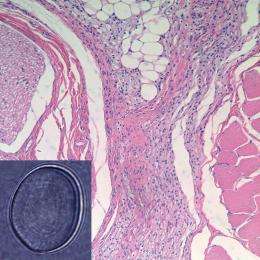
Pink perineurial tissue reacts to multilammellar liposomes containing local anesthetics (the purple dots, shown magnified in the inset). Courtesy Kohane Lab/Children's Hospital Boston

(PhysOrg.com) -- Harvard researchers at Children’s Hospital Boston have developed a slow-release anesthetic drug-delivery system that could potentially revolutionize treatment of pain during and after surgery, and may also have a large impact on chronic pain management.

In work funded by the National Institutes of Health (NIH), they used specially designed fat-based particles called liposomes to package saxitoxin, a potent anesthetic, and produced long-lasting local anesthesia in rats without apparent toxicity to or muscle cells.

The research will be published online during the week of April 13-17 by the .

“The idea was to have a single injection that could produce a nerve block lasting days, weeks, maybe even months,” explains Daniel Kohane of the Division of Critical Care Medicine in the Department of Anesthesiology at Children’s, the report’s senior author, and associate professor of anesthesia at Harvard Medical School. “It would be useful for conditions like where, rather than use narcotics, which are systemic and pose a risk of addiction, you could just put that piece of the body to sleep, so to speak.”

Previous attempts to develop slow-release anesthetics have not been successful because of the tendency for conventional anesthetics to cause toxicity to surrounding tissue. Indeed, drug-packaging materials have themselves been shown to cause tissue damage. Now, Kohane and colleagues report that if saxitoxin is packaged within liposomes, it is able to block nerve transmission of pain without causing significant nerve or muscle damage.

In lab experiments, the researchers evaluated various formulations - various types of liposomes containing saxitoxin with or without dexamethasone, a potent steroid known to augment the action of encapsulated anesthetics. The best liposomes produced nerve blocks lasting two days if they contained saxitoxin alone and seven days if combined with dexamethasone.

Cell culture experiments and tissue analysis confirmed that the formulations were not toxic to muscle or nerve cells. Furthermore, when the team examined expression of four genes known to be associated with nerve injury, they found no up-regulation.

“If these long-acting, low-toxicity formulations of local anesthetics are shown to be effective in humans, they could have a major impact on the treatment of acute and ,” says Alison Cole of the NIH’s National Institute of General Medical Sciences, which partially funded the work. “This slow-release technology may also have broader applications in drug delivery for the treatment of a variety of diseases.”

Kohane is currently optimizing the formulation to make it last even longer, while avoiding local and systemic toxicity. “It is conceivable we could have a formulation that is suitable for clinical trials before too long,” he says.

Hila Epstein-Barash, a research fellow in anesthesia at Children’s Hospital, was first author on the paper.

Provided by Harvard University (news : web)


print this article email this article download pdf blog this article bookmark this article     Stumble it Digg this share on Facebook retweet share on Reddit add to delicious
Rate this story - 4.8 /5 (4 votes)


April 14, 2009 all stories

Comments: 0

4.8 /5 (4 votes)
  • Stumble this up

  • Digg this

  • share this

  • hide
  • Related Stories

  • Researchers discover paradox about general anesthesia: It can increase post-surgical pain
    created Jun 24, 2008 | popularity not rated yet | comments 0
  • Treatment blocks pain without disrupting other functions
    created Oct 03, 2007 | popularity not rated yet | comments 0
  • Probing Question: How does anesthesia work?
    created Oct 25, 2007 | popularity not rated yet | comments 0
  • Protein found that may provide relief from neuropathic pain
    created Dec 05, 2007 | popularity not rated yet | comments 0
  • Study shows modified technique further reduces lung surgery pain
    created Jun 06, 2008 | popularity not rated yet | comments 0


  • hide
  • Relevant PhysicsForums posts

  • Improving the brain through chemistry
    created 21 hours ago
  • Sleep / REM Sleep and homeostasis
    created Nov 07, 2009
  • The Biceps Reflex
    created Nov 05, 2009
  • Consequenses of striking a Vein and an artery?
    created Nov 05, 2009
  • More from Physics Forums - Medical Sciences

Other News

Developmental delay could stem from nicotinic receptor deletion

Medicine & Health / Genetics

created 7 hours ago | popularity 4.5 / 5 (2) | comments 0

The loss of a gene through deletion of genetic material on chromosome 15 is associated with significant abnormalities in learning and behavior, said a consortium of researchers led by Baylor College of Medicine in a report ...


Expanding drug treatment: Is US ready to step up? (AP)

Expanding drug treatment: Is US ready to step up?

Medicine & Health / Other

created 2 hours ago | popularity not rated yet | comments 0

(AP) -- Based on the rhetoric, America's war on drugs seems poised to shift into a more enlightened phase where treatment of addicts gains favor over imprisonment of low-level offenders. Questions abound, ...


House passes health care bill on close vote (AP)

Landmark health bill passes House on close vote

Medicine & Health / Health

created 15 hours ago | popularity 3.7 / 5 (9) | comments 2

(AP) -- The Democratic-controlled House narrowly passed far-reaching health care legislation, handing President Barack Obama a hard-won victory on his chief domestic priority though the road ahead in the ...


Children who often drink full-fat milk weigh less

Medicine & Health / Health

created Nov 03, 2009 | popularity 5 / 5 (4) | comments 5

Eight-year-old children who drink full-fat milk every day have a lower BMI than those who seldom drink milk. This is not the case for children who often drink medium-fat or low-fat milk. This is one conclusion of a thesis ...


Turn On, Tune In, Develop?

Turn On, Tune In, Develop? Researchers Examine How Brain Benefits From Musical Training

Medicine & Health / Neuroscience

created Nov 06, 2009 | popularity 5 / 5 (11) | comments 4

For most people music is an enjoyable, although momentary, form of entertainment. But for those who seriously practiced a musical instrument when they were young, perhaps when they played in a school orchestra ...