Physicists see the cosmos in a coffee cup
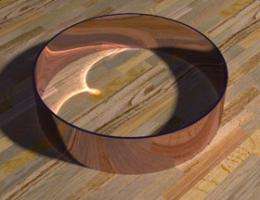
(PhysOrg.com) -- A Duke University professor and his graduate student have discovered a universal principle that unites the curious interplay of light and shadow on the surface of your morning coffee with the way gravity magnifies and distorts light from distant galaxies.
They think scientists will be able to use violations of this principle to map unseen clumps of dark matter in the universe.
Light rays naturally reflect off a curve like the inside surface of a coffee cup in a curving, ivy leaf pattern that comes to a point in the center and is brightest along its edge.
Mathematicians and physicists call that shape a "cusp curve," and they call the bright edge a "caustic," based on an alternative dictionary definition meaning "burning bright," explains Arlie Petters, a Duke professor of mathematics, physics and business administration. "It happens because a lot of light rays can pile up along curves."
Drawn by the mathematically-inclined artist Leonardo da Vinci in the early 16th century, caustics can be seen elsewhere in everyday life, including sunlight reflecting across a swimming pool's surface and choppy wave-light patterns reflecting off a boat hull.
Caustics also show up in gravitational lensing, a phenomenon caused by galaxies so massive that their gravity bends and distorts light from more distant galaxies. "It turns out that their gravity is so powerful that some light rays are also going to pile up along curves," said Petters, a gravitational lensing expert.
"Mother Nature has to be creating these things," Petters said. "It's amazing how what we can see in a coffee cup extends into a mathematical theorem with effects in the cosmos."
From the vantage point of Earth, the entire cosmos looks like a vast interplay of gravity and light that can extend far back into spacetime. "As with any illumination pattern, some areas will be brighter than others," Petters said. "And the brightest parts will be along these caustic curves."
Interpreting data from telescope surveys correctly requires understanding the distortions inherent in lensing, which sometimes warps a more distant point of light into multiple and magnified copies of themselves.
Petters and other researchers have previously found that, if such a light source seems to be juxtaposed within the confines of a caustic arch, two duplicate images will appear to be positioned abnormally close to each other and also seem equally bright. And because these clones are of seemingly equal brightness, subtracting one luminosity from the other results in a difference of zero.
In an article appearing in the March 23 Journal of Mathematical Physics, Petters and graduate student Amir Aazami extended the mathematics of such relatively simple examples to include what Petters called "higher order caustics." In such situations the interplay of light and gravity may extend further into spacetime and undergo various forms of "caustic metamorphosis" in the process.
Aazami was informally testing out a special case of their evolving caustics theorem called an "ellyptic umbilic" by using a technical computing software program called Mathematica when he noticed a pattern.
"It kept getting zero over and over again," Aazami said, no matter what scenario he tried the software on. "So I thought, 'it's making a mistake.' And I went back and looked again, and I kept getting zero. And I said, 'this is beginning to make sense!' That was the 'Ah Ha!' moment."
Petters realized his graduate student had found a universal mathematical principle so pervasive that it can impose balance on the most complicated gravitational lensing illusions. For instance, if lensing produces four light source copies of uneven brightnesses, the relative dimness of some is precisely balanced by the relative luminosity of others so they cancel each other out.
"It's miraculous that they cancel out," Petters said. "This relates to very sophisticated mathematics that you would never think could have anything to do with nature."
The Duke researchers said that for the simplest caustics, the theorem has already been corroborated by a few actual gravitational lensing observations. And they expect the higher order caustics to be observed once the Large Synoptic Survey Telescope (LSST), now being assembled in Chile, begins what Petters called "the most massive survey of the sky known" in a few years.
"We feel very confident that these universal invariants will show themselves in the data to come from the LSST," he said.
Another scenario he predicts are exceptions to the rule: "For one of the higher order caustics, if there are two pairs of lensed images that are close to each other but not equally bright, then the theorem is violated," he said.
"The reason would be some substructure in the galaxy," he said, likely dark matter near one of the images that causes it to be demagnified.
Dark matter is a mysterious substance that astronomers cannot directly observe but can "sense" by its gravitational tug on light. By using the LSST in conjunction with their theorem, astronomers "would be able to identify dark matter substructures in complex galactic systems," Petters predicted
Source: Duke University (news : web)


