New Pollution Monitoring: Our Air is Dirtier Than We Thought
April 14, 2009 by Miranda Marquit
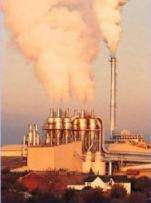
Air pollution is worse than we thought. Image credit: U.S. government.
(PhysOrg.comOne of my pet peeves is the focus we have on global warming. While global climate change is important, it continues to provide a red herring of sorts, taking attention away the public health concern that is air pollution. Recent developments in pollution tracking may change things. With help from satellites, scientists are beginning to understand just how dirty our air is becoming.
The idea of combining satellite data with ground data has been introduced to measure particulate pollution on the ground. In many areas, the equipment used to measure pollution at ground level is unavailable. However, it is possible to use satellites to track air pollution in those areas. According to Discover magazine, Sundar Christopher, a scientist at the University of Alabama, found that it was possible to measure particulate pollution remotely:
"'Remote sensing is the only viable way to monitor global particulate matter,' he says. Using NASA's Terra and Aqua satellites, he and his team examined 20 cities with populations greater than 10 million. In 15 of them, pollution levels were five to ten times higher than the World Health Organization's guidelines."
In order to get an idea of what the ground measurements of pollution are in some of the areas without this capability, the satellites were first trained on areas that had good ground sensing. After getting an idea of what particulate pollution looks like at certain levels, it was possible to compare the images to areas without ground monitoring, getting a good idea of what the pollution levels are in areas without on the ground pollution feedback. In addition to seeing how much pollution there is (and there is more than we thought), the University of Alabama team is going to be tracking the way air pollution moves across the globe.
This is probably a good thing. Having images to show us just how dirty our air is can help us make inroads in terms of pollution as a public health risk. Global warming is still debatable from a number of different standpoints; even though most climatologists agree that it is real, many people find ways to debate aspects (such as whether people are causing it) are debatable. However, air pollution is not really debatable. We're seeing it -- at ground level and now in the sky -- and we know it causes health problems. Perhaps a visual will encourage us to make a switch to energy sources that are better for the earth. And better for humans as well.
© 2009 PhysOrg.com


Oh, and By the way, if there`s heavy smog over large metropolitan/industrial areas, that`s most likely NOT a naturally-occuring phenomena.
The point is.. every human that is born is part of the problem and we accept mediocre solutions... we accept politicians and world leaders that focus on keeping business running.
What if we keep business running for the sake of money... do we then have enough money to leave the planet because its no longer habitable?
It starts with you and I...
Instead the gvmnt are considering purposely polluting our air via chemtrails as a solution to GW, wtf?
What if you and all your neighbors were suddenly challenged for every resource you need, heat, shelter, food, etc?
Welcome to a revolution, imagine the ecological fallout of that.
What if all the resources required for a good life could be provided without every one of us needing to spend 2000 hr's / yr at a jobsite? Say 1000 hrs / yr were enough? Wouldn't the PTB still simply invent work for us just to keep us "busy and stupid"?
It's nice to pontificate on Utopia. Unfortunately, there's no path leading there at this point in time. We're too wrapped up in ideologies and disbursal methods that are unsustainable.
At the end of WWII and in to the early 50's it was thought, from projections (the equivalent of today's computer models), that the average consumer would only need to work 10 to 20 hours a week to maintain a middle-class existence. Instead it's more common to see double-income-no-kids in order to maintain a middle-class lifestyle...
There's a lesson in there somewhere.
We ARE allready challenged. Animals are being born with two sexes, deserts are spreading, people in the industrialized countries have big problems getting pregnant because of all the parabenes and Phtalates in products they buy.. it goes on and on.
I do not believe that if we continue to travel that road we will eventually reach heaven/nirvana e.t.c.
Scarcity is a myth, its how we use the raw materials thats important. In the pacific ocean, there is a huge island of floating plastic - a complete and utter waste, which could be recycled.
and which computer models do they use to make sure their inputs are correct? If not, garbage in = garbage out!
blah, blah, blah
As for people in industrial countries having difficulty reproducing, I really don't see this as an issue. I see fertility treatments as an issue.
This massive island of plastics, I keep hearing about it, yet no one wants to do anything about it. If all the plastics end up in one area, you'd probably make a good amount of money, and now-a-days, catch some big government funding to clean it up and recycle it. Raw plastics are worth a decent amount of change.
Other than that, you're right, scarcity is a myth. Problem is, the people who need it don't have it, and the people that have it, well, we're not giving it away for free.
Look at your average warring countries, typically very poor, like most African nations, or lacking any sort of resource control. Meaning, they don't have the resources, or the means of disbursal.