Male fruit flies change to gain reproductive edge
April 14, 2009 By Krishna Ramanujan Male fruit flies change to gain reproductive edge

Enlarge

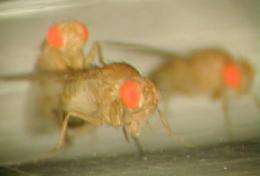
When male fruit flies sense competition during mating, they pack more proteins into their seminal fluid, boosting their reproductive success. (Stuart Wigby)

(PhysOrg.com) -- When it comes to wooing females, males of all species -- even fruit flies -- try to gain a competitive edge.

Provided by Male that sense competition during mating make their seminal fluid more potent by packing it with more proteins.

A study by researchers from Cornell, University of East Anglia and University College London focuses on two seminal fluid proteins in Drosphila melanogaster that are transferred to females during mating: sex peptide and ovulin. Both proteins influence the number of eggs a female fly produces. Sex peptide also makes females less receptive to other males after mating. Males that transfer more of these two proteins sire more offspring than other males.

"The presence of competition affects how much of these proteins are transferred," said Laura Sirot, a Cornell research associate in molecular biologist Mariana Wolfner's lab and one of the lead authors of the paper, published online and in a future print edition of the journal .

The research offers a model for studying these seminal proteins and their role in reproduction. Fly seminal proteins are chemically related to similar proteins found in other insects and mammals, including humans. The research may one day also help entomologists develop new ways to control such disease-carrying insects as mosquitoes.

The study describes how researchers placed an extra male near a mating pair to test whether the mating male adjusted the amount of seminal fluid proteins transferred. In the face of competition, the male did indeed deliver more sex peptide and ovulin to the female.

To test whether male fruit flies with larger accessory glands -- a major site where seminal fluid proteins are made -- have an evolutionary advantage, the researchers selected and bred males with larger and smaller glands. The males with larger glands transferred more sex peptide than the ones with smaller glands, but the amount of ovulin transferred did not change.

Together, these results show that the amounts of seminal proteins do not necessarily change in correlation with each other and that selection for larger increases reproductive success. It also uncovers a new strategy by which may be able to improve their reproductive success when faced with competition, said Sirot.

Provided by Cornell University


print this article email this article download pdf blog this article bookmark this article     Stumble it Digg this share on Facebook retweet share on Reddit add to delicious
Rate this story - not rated yet


April 14, 2009 all stories

Comments: 0

not rated yet
  • Stumble this up

  • Digg this

  • share this

  • hide
  • Related Stories

  • The precise role of seminal proteins in sustaining post-mating responses in fruit flies
    created Dec 18, 2007 | popularity not rated yet | comments 0
  • Newly discovered proteins in seminal fluid may affect odds of producing offspring
    created Jul 29, 2008 | popularity not rated yet | comments 0
  • Discovery could lead to attack on mosquito-borne disease
    created Apr 10, 2008 | popularity not rated yet | comments 0
  • Sex is thirst-quenching for female beetles
    created Aug 28, 2007 | popularity not rated yet | comments 0
  • Mating that causes injuries
    created Feb 20, 2009 | popularity not rated yet | comments 0


  • hide
  • Relevant PhysicsForums posts

  • What is transpulmonary pressure?
    created Nov 24, 2009
  • Is there a gay gene?
    created Nov 23, 2009
  • Super quick question about Starling forces?
    created Nov 22, 2009
  • Questions about diffusion
    created Nov 22, 2009
  • More from Physics Forums - Biology

Other News

Redback spiders were first spotted in Japan in 1995

Venomous Aussie redback spiders invading Japan

Biology / Ecology

created 6 hours ago | popularity 5 / 5 (2) | comments 0

Australia's venomous redback spiders are on the march in Japan, where they are believed to have arrived years ago as stowaways on cargo ships, a wildlife expert warned Wednesday.


Study explores violent world of raptors

Biology / Plants & Animals

created 6 hours ago | popularity not rated yet | comments 0

A journey that started with a box of bird feet carried three Montana State University graduate students into the gruesome world of raptors and led to their findings being published in a prominent journal.


Asian carp may have breached barrier protecting Lake Michigan

Biology / Ecology

created 14 hours ago | popularity 5 / 5 (4) | comments 0

Two feared species of Asian carp have zoomed beyond the $9 million electric barriers built to keep them out of Lake Michigan. Now, the only thing left between the carp and the Great Lakes is a lock and dam in southern Chicago.


Got a pain? -- Have a cup of Brazilian mint

Biology / Plants & Animals

created 15 hours ago | popularity 4.6 / 5 (8) | comments 0

For thousands of years it has been prescribed by traditional healers in Brazil to treat a range of ailments from headaches and stomach pain to fever and flu.


Opposites attract: Monkeys choose mating partners with different genes

Biology / Evolution

created 15 hours ago | popularity 5 / 5 (1) | comments 0

The world's largest species of monkey 'chooses' mates with genes that are different from their own to guarantee healthy and strong offspring, according to a new research study.