Mangroves Save Lives In Storms
April 14, 2009 By Tim Lucas
Mangroves Save Lives In Storms

Enlarge

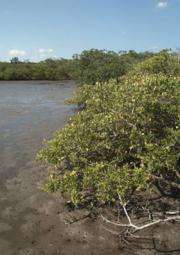
Mangroves growing in tidal flats in Florida provide wildlife habitat, erosion control and protection against storm surges. (US Geological Service)

(PhysOrg.com) -- A new study of storm-related deaths from a super cyclone that hit the eastern coast of India in 1999 finds that villages shielded from the storm surge by mangrove forests experienced significantly fewer deaths than villages that were less protected.

The study, conducted by researchers at the University of Delhi and Duke University, analyzed deaths in 409 villages in the poor, mostly rural Kendrapada District of the Indian state of Orissa, just north of the cyclone’s landfall.

“Our analysis shows a clear inverse relationship between the number of deaths per village and the width of the mangroves located between those villages and the coast,” said Jeffrey R. Vincent, Clarence F. Korstian Professor of Forest Economics and Management at Duke’s Nicholas School of the Environment.

“Taking other environmental and socioeconomic factors into account, villages with wider mangroves suffered significantly fewer deaths than ones with narrower or no mangroves,” Vincent said. “We believe this is the first robust evidence that mangroves can protect coastal villages against certain types of .”

Vincent conducted the analysis with Saudamini Das of the University of Delhi’s Swami Shradanand College. Their findings appear in a paper in this week’s online early edition of The .

Mangroves are dense forests of and shrubs that grow in brackish, low-lying coastal swamps in the tropics and subtropics. In 1944, mangroves covered nearly 31,000 hectares of land in Kendrapada District and the average village had 5.1 kilometers of mangroves between it and the coast. Since then, nearly half the area has been cleared, mostly for rice production. Today, the average width of mangroves between the villages and the coast has shrunk to 1.2 kilometers.

The 1999 storm, which made landfall on Oct. 29, killed nearly 10,000 people, more than 70 percent of whom drowned in its surge.

Using statistical models, Das and Vincent predicted there would have been 1.72 additional deaths per village within 10 kilometers of the coast if the mangrove width had been reduced to zero.

“This is a measure of the life-saving impact of the mangroves that remained in 1999,” Vincent said. “It implies that they cut the death toll by about two-thirds.”

Although mangroves evidently saved fewer lives than an early warning issued by the Indian government, the retention of the remaining mangroves in Orissa is economically justified, Vincent believes, even without considering the many other environmental benefits they provide, such as acting as nurseries for economically and environmentally vital fisheries, or sites for ecotourism. Previously published estimates of Indians’ willingness to pay to reduce the risk of accidental deaths are higher than Das and Vincent’s estimate of the cost of saving lives in Orissa by retaining mangroves.

The study does not assess mangroves’ ability to reduce deaths from tsunamis, Vincent cautions, because of key differences in their wave dynamics. Storm surges have shorter wave lengths than tsunamis, and relatively more of their energy is found near the surface of the water. Mangroves’ ability to protect villages against tsunamis has been a point of controversy in the scientific and policy communities since the 2004 Indian Ocean tsunami. Das and Vincent designed their study to overcome criticism leveled at studies examining the effects of mangroves on that disaster.

Provided by Duke University (news : web)

Filter


Move the slider to adjust rank threshold, so that you can hide some of the comments.


Display comments: newest first

Birger
Apr 15, 2009

Rank: not rated yet
Since storms are expected to become more intense due to global warming, it would make sense to "design" GM mangrove trees able to live further north, outside the subtropic zone. Simply by reducing costal erosion such GM coastal forests would recoup the initial cost...
Rank 5 /5 (2 votes)
Related Stories
Relevant PhysicsForums posts
  • Discrepancy between oxygen and carbon-dioxide levels
    createdFeb 09, 2012
  • where gems are found in the world
    createdFeb 09, 2012
  • Wind Waves in Reservoir ~ Wind run-up and Wind set-up
    createdFeb 08, 2012
  • Balance of oxygen in the atmosphere
    createdFeb 01, 2012
  • The case for a methanol-based economy
    createdJan 30, 2012
  • Weather in a rotating cylinder
    createdJan 25, 2012
  • More from Physics Forums - Earth

More news stories

Humans may have helped the decline of African rainforests 3000 years ago

(PhysOrg.com) -- Large areas of rainforests in Central Africa mysteriously disappeared over three thousand years ago, to be replaced by savannas. The prevailing theory has been that the cause was a change ...

Space & Earth / Environment

created 17 hours ago | popularity 4.2 / 5 (9) | comments 11 | with audio podcast report

Could Venus be shifting gear?

(PhysOrg.com) -- ESA’s Venus Express spacecraft has discovered that our cloud-covered neighbour spins a little slower than previously measured. Peering through the dense atmosphere in the infrared, the ...

Space & Earth / Space Exploration

created 13 hours ago | popularity 5 / 5 (7) | comments 7 | with audio podcast

NASA sees wide-eyed cyclone Jasmine

Cyclone Jasmine's eye has opened wider on NASA satellite imagery, as it moves through the Southern Pacific Ocean.

Space & Earth / Earth Sciences

created 5 hours ago | popularity 3.5 / 5 (2) | comments 1

NASA budget will axe Mars deal with Europe: scientists

US President Barack Obama's budget proposal to be submitted next week for 2013 will cut NASA's budget by 20 percent and eliminate a major partnership with Europe on Mars exploration, scientists said Thursday.

Space & Earth / Space Exploration

created 16 hours ago | popularity 5 / 5 (2) | comments 18

Mars Science Laboratory computer issue resolved

(PhysOrg.com) -- Engineers have found the root cause of a computer reset that occurred two months ago on NASA's Mars Science Laboratory and have determined how to correct it.

Space & Earth / Space Exploration

created 14 hours ago | popularity 4.7 / 5 (6) | comments 3 | with audio podcast


Google users warned of threat to smartphone wallets

Users of Google smartphone wallets were being warned on Friday that there is a way to crack pass codes intended to thwart thieves from going on illicit shopping sprees.

Anonymous knocks CIA website offline (Update)

The website of the Central Intelligence Agency was inaccessible on Friday after the hacker group Anonymous claimed to have knocked it offline.

Complex wiring of the nervous system may rely on a just a handful of genes and proteins

Researchers at the Salk Institute have discovered a startling feature of early brain development that helps to explain how complex neuron wiring patterns are programmed using just a handful of critical genes. ...

New error-correcting codes guarantee the fastest possible rate of data transmission

Error-correcting codes are one of the triumphs of the digital age. They’re a way of encoding information so that it can be transmitted across a communication channel — such as an optical fiber o ...

The power of estrogen -- male snakes attract other males

A new study has shown that boosting the estrogen levels of male garter snakes causes them to secrete the same pheromones that females use to attract suitors, and turned the males into just about the sexiest ...

New power source discovered

(PhysOrg.com) -- Researchers at the Massachusetts Institute of Technology (MIT) and RMIT University have made a breakthrough in energy storage and power generation.