Corn, soy yields gain little from genetic engineering: study
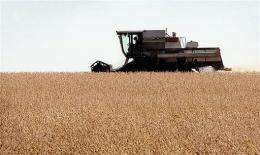
April 14, 2009 A farmer harvests his soybean crop near Ottawa, Illinois

Enlarge

A farmer harvests his soybean crop near Ottawa, Illinois in 2007. The use of genetically engineered corn and soybeans in the United States for more than a decade has had little impact on crop yields despite claims that they could ease looming food shortages, a study released on Tuesday concluded.

The use of genetically engineered corn and soybeans in the United States for more than a decade has had little impact on crop yields despite claims that they could ease looming food shortages, a study released on Tuesday concluded.

"A hard-nosed assessment of this expensive technology's achievements to date gives little confidence that it will play a major role in helping the world feed itself in the forseeable future," said the report by the Union of Concerned Scientists.

The study evaluated the effect on corn and soybean crop yields of genetically engineered varieties commercialized in the United States over the past 13 years, examining peer-reviewed academic studies that date back to the early 1990s.

"Based on that record, we conclude that GE () has done little to increase overall crop yields," it said.

The report said genetically engineered soybeans account for 90 percent of soybeans grown in the United States, while genetically engineered corn accounts for 63 percent of the US corn crop.

"Overall, corn and soybean yields have risen substantially over the last 15 years, but largely not as a result of the GE traits," the report said. "Most of the gains are due to traditional breeding or improvement of other agricultural practices."

It found that corn and soybeans that were genetically modified to increase their tolerance to herbicides "have not increased operational yields, whether on a per acre or national basis, compared to conventional methods that rely on other available herbicides."

Corn modified with genes from Bt, or Bacillus thuringienisis, bacteria for resistance to several kinds of insects did provide higher yields, but the study estimated the increase at between 0.2 and 0.3 percent a year on average over the past 13 years.

Overall corn yields in the United States have increased an average of about one percent a year, it said.

"More specifically, US Department of data indicate that the average corn production per acre nationwide over the past five years (2004-2008) was about 28 percent higher than for the five-year period 1991-1995," it said.

"But our analysis of specific yield studies concludes that only 4-5 percent of that increase is attributable to Bt, meaning an increase of about 24-25 percent must be due to other factors such as conventional breeding," it said.

(c) 2009 AFP


print this article email this article download pdf blog this article bookmark this article     Stumble it Digg this share on Facebook retweet share on Reddit add to delicious
Rate this story - 4.4 /5 (7 votes)


April 14, 2009 all stories

Comments: 0

4.4 /5 (7 votes)
  • Stumble this up

  • Digg this

  • share this

  • hide
  • Related Stories


  • hide
  • Relevant PhysicsForums posts

Other News

Scientists visualize how bacteria talk to one another

Scientists visualize how bacteria talk to one another

Biology / Cell & Microbiology

created 3 hours ago | popularity 4.7 / 5 (3) | comments 0

Using imaging mass spectrometry, researchers at the University of California, San Diego have developed tools that will enable scientists to visualize how different cell populations of cells communicate. Their ...


W. Africa's last giraffes make surprising comeback (AP)

W. Africa's last giraffes make surprising comeback

Biology / Ecology

created 11 hours ago | popularity not rated yet | comments 0

(AP) -- A crisp African dawn is breaking overhead, and Zibo Mounkaila is on the back of a pickup truck bounding across a sparse landscape of rocky orange soil.


W. Africa's last giraffes make surprising comeback (AP)

China sends panda expert to Taiwan to aid breeding

Biology / Plants & Animals

created 11 hours ago | popularity not rated yet | comments 0

(AP) -- Nothing like a little time apart to rekindle the affections that could lead to a baby panda.


Laser etching safe alternative for labeling grapefruit

Laser etching safe alternative for labeling grapefruit

Biology / Other

created Nov 03, 2009 | popularity 4.4 / 5 (14) | comments 8

Laser labeling of fruit and vegetables is a new, patented technology in which a low-energy carbon dioxide laser beam is used to label, or "etch" information on produce, thereby eliminating the need for common ...


Wolves, moose and biodiversity: An unexpected connection

Wolves, moose and biodiversity: An unexpected connection

Biology / Ecology

created Nov 02, 2009 | popularity 4.8 / 5 (6) | comments 4

Moose eat plants; wolves kill moose. What difference does this classic predator-prey interaction make to biodiversity?