One-story masonry building survives strong jolts during seismic tests (w/Video)
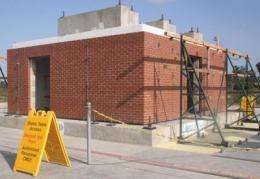
A one-story masonry structure survived two days of intense earthquake jolts after engineering researchers at the University of California, San Diego put it to the test. The series of tests, performed at UC San Diego's Englekirk Structural Engineering Center, which has the largest outdoor shake table in the world. The tests were part of a collaborative research project between the University of Texas at Austin, UC San Diego, Washington State University, and North Carolina Agricultural and Technical State University.
Researchers subjected the reinforced concrete masonry structure with clay masonry veneer to a series of simulated earthquakes, starting with a 5.0 magnitude and ending with an 8.0. The jolts were based on ground motions measured during the 1994 Northridge, Calif. earthquake, which registered a 6.7 magnitude.
Researchers used this test to study the different types of shear reinforcement and different types of veneer connectors and how they react to earthquakes. Concrete masonry with clay masonry veneer is used for commercial construction throughout the United States.
"The goal of this test is to evaluate the current building code previsions and look at ways to improve the seismic safety of these kinds of structures," said Benson Shing, a structural engineering professor at the UC San Diego Jacobs School of Engineering and the co-principal investigator for the research project.
During the first set of tests, the concrete masonry and brick veneer structure suffered minor damage, with just a few cracks. On the second day, with more intense shaking, the corner of one of the structure's walls began to pull apart.
"The structure was designed according to current code provisions, and it performed very well,' Shing said. "The building's performance exceeded our expectations."
Researchers will now analyze the data collected from the tests to develop analytical models and use them to project the performance of such structures.
"The lessons we learned from the extreme shaking of this structure will help us evaluate some structural design details, like how to do the connectors. It will also help us refine the computer tools we use to analyze structures," said Richard Klingner, a civil engineering professor at the University of Texas at Austin and the lead researcher for the tests. "When we design buildings like this we want to be able to provide detailed information to the design engineers. To do that we have to use sophisticated computer tools. Basic information about this particular structure has already been sent to engineers all over the world; it has allowed them to evaluate what they are currently doing, and they are saying, 'Maybe we should keep doing it.'"
In January, the same group of researchers tested the seismic response of a wood-stud structure with brick veneer. Results of all these tests will be used to provide design recommendations for new masonry buildings, including concrete masonry shear walls, concrete masonry walls with clay masonry veneer, and clay masonry veneer over wood-frame construction.
Source: University of California - San Diego (news : web)


