US scientists plan greenhouses on the Moon
April 15, 2009 by Bryn Bailer
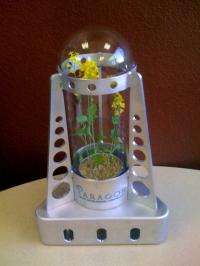
A Paragon Space Development Corp. handout of a plant growing in a space container. Astronauts' meals have come a long way from the freeze-dried powders and semi-liquid pastes of decades ago: now US scientists want to grow vegetables in mini-greenhouses on the Moon
Astronauts' meals have come a long way from the freeze-dried powders and semi-liquid pastes of decades ago: now US scientists want to grow vegetables in mini-greenhouses on the Moon.
Although space fare has steadily improved over time, a team of scientists says the best is yet to come.
They look forward to when residents of future lunar or even Martian outposts can dine on luxuries such as fresh vegetables.
Paragon Space Development Corporation has unveiled what it called the first step toward growing flowers -- and eventually food -- on the Moon.
Paragon, an Arizona company that has partnered with NASA in previous experiments on the Space Shuttle and International Space Station, calls it a "Lunar Oasis".
This is a sealed greenhouse that looks like a bell jar encased in a 1.5 foot (46-centimetre) tall triangular aluminum frame.
It is designed to safely land a laboratory plant on the lunar surface, and protect it while it grows.
The miniature greenhouse is to be launched into space by Odyssey Moon Ltd, a participant in the Google Lunar X Prize. This competition offers 20 million dollars to any entrant who can launch, land and operate a rover on the lunar surface.
Paragon officials say future testing of the "Lunar Oasis" will be driven by Odyssey's flight schedule, which will not happen until 2012 at the earliest.
When it does lift off the greenhouse will contain the seeds of Brassica, a hardy plant related to Brussels sprouts and cabbage and used in the production of cooking oil and livestock feed.
Because Brassica goes from seed to flower in just 14 days, it can complete its life cycle in a single lunar night.
"Colonizing the Moon or Mars seems so far away, but it is important that we do this research now," Paragon president Jane Poynter told AFP.
"It takes a long time to get a lot of research, and to get integrated, reliable efficient systems" before colonists move in, she said.
NASA, which will retire its Space Shuttle fleet at the end of 2010, has committed to two new goals: returning astronauts to the Moon by 2020, and a manned mission to Mars by 2030.
"I was pleased to see this (project) put together by Paragon," said Gene A. Giacomelli, a professor at the University of Arizona Department of Plant Sciences.
"NASA has pulled back on funding for bio-regenerative life support systems, and most of the centers in the US that had been doing that research had stopped."
Giacomelli and students at the university's Controlled Environment Agriculture Center (CEAC) are working on their own as-yet-unfunded lunar greenhouse.
The agriculture center also makes remote operational improvements to its existing, state-of-the-art hydroponic "growth chamber" at the National Science Foundation's new Amundsen-Scott South Pole Station in Antarctica.
Conditions at the South Pole, which include a high-altitude, low air-pressure environment, and wind-chill factors of minus 100 C, make the project a "good analog" to conditions at a lunar outpost, Giacomelli said.
The South Pole greenhouse, now in its fifth year, allows workers living in the coldest place on Earth to dine on tomatoes, peppers, lettuce, strawberries and fragrant herbs.
It produces about 27 kilos (60 pounds) each week, enough to provide each of the 75 scientists there with two salads per day.
"This isn't science fiction," Giacomelli said. "We have the technology to sustain life on the other planets right now, if we could get there."
There are many challenges to growing plants in space, but the biggest is finding enough water on site to support a permanent outpost.
An expedition to Mars will take three years to complete, so plants must multi-task: remove toxins from the space facility air, recycle wastes, generate oxygen, provide nutrients for future crops, and produce food.
"Colonies need a bio-regenerative program," Poynter emphasized. "A colony is there to stay. It's not like you can just pack up your picnic basket and go home."
(c) 2009 AFP
-
Lunar Outpost Plans Taking Shape
Oct 01, 2007 |
not rated yet |
0
-
NASA Moon-Impactor Mission Passes Major Review
Feb 02, 2007 |
not rated yet |
0
-
NASA Spacecraft to Carry Russian Science Instruments
Oct 03, 2007 |
not rated yet |
0
-
NASA Ames Leads Robotic Lunar Exploration Program
Nov 17, 2005 |
not rated yet |
0
-
NASA joins Google in mapping the moon
Sep 19, 2007 |
not rated yet |
0
-
Engineers build first sub-10-nm carbon nanotube transistor
Feb 01, 2012 |
4.9 / 5 (31) |
30
-
Something old, something new: Evolution and the structural divergence of duplicate genes
Jan 31, 2012 |
4.6 / 5 (7) |
1
-
The hidden nanoworld of ice crystals: Revealing the dynamic behavior of quasi-liquid layers
Jan 30, 2012 |
5 / 5 (3) |
1
-
Stock market network reveals investor clustering
Jan 27, 2012 |
3.9 / 5 (23) |
8
-
Of microchemistry and molecules: Electronic microfluidic device synthesizes biocompatible probes
Jan 26, 2012 |
5 / 5 (1) |
0
-
Never ending outer space.....
11 hours ago
-
Neutron Star fragments?
13 hours ago
-
stationary or not?
17 hours ago
-
Scale of the Universe
Feb 10, 2012
-
Titan's lack of impact craters
Feb 09, 2012
-
Real pictures of black hole eating a star?
Feb 08, 2012
- More from Physics Forums - General Astronomy
More news stories
Latin America mining boom clashes with conservation
Latin America is experiencing a mining boom as prices rise fuelled by a hike in global demand, but the region is also being hit by a wave of violent protests, strikes and rallies by environmentalists.
4 hours ago |
not rated yet |
0
Europe stakes billion-dollar bet on new rocket
A pencil-slim rocket is scheduled to lift into space from South America on Monday, carrying a billion-dollar bet that Europe can grab a juicy slice of the market to place satellites in low orbit.
Space & Earth / Space Exploration
23 hours ago |
4 / 5 (3) |
0
Political leaders play key role in how worried Americans are by climate change: study
More than extreme weather events and the work of scientists, it is national political leaders who influence how much Americans worry about the threat of climate change, new research finds.
Feb 06, 2012 |
5 / 5 (6) |
72
NASA budget will axe Mars deal with Europe: scientists
US President Barack Obama's budget proposal to be submitted next week for 2013 will cut NASA's budget by 20 percent and eliminate a major partnership with Europe on Mars exploration, scientists said Thursday.
Space & Earth / Space Exploration
Feb 10, 2012 |
5 / 5 (3) |
55
Humans may have helped the decline of African rainforests 3000 years ago
(PhysOrg.com) -- Large areas of rainforests in Central Africa mysteriously disappeared over three thousand years ago, to be replaced by savannas. The prevailing theory has been that the cause was a change ...
Google might launch Drive for cloud storage soon
(PhysOrg.com) -- Google's next big move, according to the Wall Street Journal, is a cloud storage service called Drive. Hardly first to the plate, Google is simply catching up to introducing its cloud reposi ...
Walney offshore wind farm is world's biggest (for now)
(PhysOrg.com) -- The Walney wind farm on the Irish Sea--characterized by high tides, waves and windy weather--officially opened this week. The farm is treated in the press as a very big deal as the Walney ...
Love a click away in Indonesia's Twitter Republic
He was a geeky kid from Yogyakarta, she a glamorous city girl in Jakarta. In a country with one of the world's most vibrant social networking scenes they fell in love on Twitter.
GPS court ruling leaves US phone tracking unclear
A US Supreme Court decision requiring a warrant to place a GPS device on the car of a criminal suspect leaves unresolved the bigger issue of police tracking using mobile phones, legal experts say.
Europeans protest controversial Internet pact
Tens of thousands of people marched in protests in more than a dozen European cities Saturday against a controversial anti-online piracy pact that critics say could curtail Internet freedom.
Study finds that anti-diabetic medication can prevent the long-term effects of maternal obesity
In a study to be presented today at the Society for Maternal-Fetal Medicine's annual meeting, The Pregnancy Meeting, in Dallas, Texas, researchers will report findings that show that short therapy with the anti-diabetic medication ...
Apr 15, 2009
Rank: not rated yet
Moon Beans!