Study confirms 3 Neanderthal sub-groups
April 15, 2009 Neanderthal

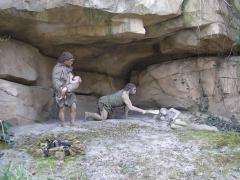
The Reconstruction of the Funeral of Homo neanderthalensis. Captured in the Hannover Zoo. (Via Wikipedia)

The Neanderthals inhabited a vast geographical area extending from Europe to western Asia and the Middle East 30,000 to 100,000 years ago. Now, a group of researchers are questioning whether or not the Neanderthals constituted a homogenous group or separate sub-groups (between which slight differences could be observed). A new study published April 15 in the online, open-access, peer-reviewed journal PLoS ONE may provide some answers.

Paleoanthropological studies based on morphological skeletal evidence have offered some support for the existence of three different sub-groups: one in Western Europe, one in southern Europe and another in the Levant.

Researchers Virginie Fabre, Silvana Condemi and Anna Degioanni from the CNRS Laboratory of Anthropology (UMR 6578) at the University of Marseille, France, have given further consideration to the question of diversity of Neanderthals by studying the genetic structure of the mitochondrial DNA (mtDNA) and by analyzing the genetic variability, modeling different scenarios. The study was possible thanks to the publication, since 1997, of 15 mitochondrial DNA (mtDNA) sequences (the mtDNa is maternally transmitted) that originated from 12 Neanderthals.

The new study confirms the presence of three separate sub-groups and suggests the existence of a fourth group in western Asia. According to the authors, the size of the Neanderthal population was not constant over time and a certain amount of migration occurred among the sub-groups. The variability among the Neanderthal population is interpreted to be an indirect consequence of the particular climatic conditions on their territorial extension during the entire middle Pleistocene time period.

Degioanni and colleagues obtained this result by using a new methodology derived from different biocomputational models based on data from genetics, and paleoanthropology. The adequacy of each model was measured by comparing the simulated results obtained using BayesianSSC software with those predicted based on nucleotide sequences.

The researchers hope that one day this methodology might be applied to questions concerning Neanderthal cultural diversity (for example the lithic industry) and to the availability of natural resources in the territory. This could provide new insights into the history and extinction of the Neanderthals.

More information: Fabre V, Condemi S, Degioanni A (2009) Genetic Evidence of Geographical Groups among . 4(4): e5151. doi:10.1371/journal.pone.0005151, http://dx.plos.org/10.1371/journal.pone.0005151

Source: Public Library of Science (news : web)


print this article email this article download pdf blog this article bookmark this article     Stumble it Digg this share on Facebook retweet share on Reddit add to delicious
Rate this story - 4.7 /5 (6 votes)

Rank Filter

Move the slider to adjust rank threshold, so that you can hide some of the comments.


Display comments: newest first

  • DaveD - Apr 15, 2009
    • Rank: not rated yet
    I vote we name the possible Asian 4th group Athenus Cylonus

April 15, 2009 all stories

Comments: 1

4.7 /5 (6 votes)
  • Stumble this up

  • Digg this

  • share this

  • hide
  • Related Stories

  • Neanderthal/human relationship questioned
    created Sep 12, 2005 | popularity not rated yet | comments 0
  • Inconsistencies with Neanderthal genomic DNA sequences
    created Oct 13, 2007 | popularity not rated yet | comments 0
  • Study shows competition, not climate change, led to Neanderthal extinction
    created Dec 29, 2008 | popularity not rated yet | comments 0
  • Neanderthal Man Was An Innovator, Study Says
    created Jun 19, 2007 | popularity not rated yet | comments 0
  • New evidence on the role of climate in Neanderthal extinction
    created Sep 12, 2007 | popularity not rated yet | comments 0


  • hide
  • Relevant PhysicsForums posts

Other News

Jellyfish swarm northward in warming world (AP)

Jellyfish swarm northward in warming world

Biology / Ecology

created 12 hours ago | popularity 3.9 / 5 (8) | comments 2

(AP) -- A blood-orange blob the size of a small refrigerator emerged from the dark waters, its venomous tentacles trapped in a fishing net. Within minutes, hundreds more were being hauled up, a pulsating ...


Federal agencies not taking chances to keep carp from invading Great Lakes

Biology / Ecology

created 15 hours ago | popularity not rated yet | comments 0

A group of federal agencies criticized in the past for failing to move quickly to stop Asian carp from entering the Great Lakes announced Friday that they're taking every precaution to keep them out, even poisoning thousands ...


Salmon migration mystery explored on Idaho's Clearwater River

Salmon migration mystery explored on Idaho's Clearwater River

Biology / Ecology

created 19 hours ago | popularity not rated yet | comments 0

(PhysOrg.com) -- Temperature differences and slow-moving water at the confluence of the Clearwater and Snake rivers in Idaho might delay the migration of threatened juvenile salmon and allow them to grow larger ...


Ancient penguin DNA raises doubts about accuracy of genetic dating techniques

Ancient penguin DNA raises doubts about accuracy of genetic dating techniques

Biology / Evolution

created Nov 10, 2009 | popularity 4.7 / 5 (23) | comments 13

Penguins that died 44,000 years ago in Antarctica have provided extraordinary frozen DNA samples that challenge the accuracy of traditional genetic aging measurements, and suggest those approaches have been ...


Rasberry crazy ant

Rapacious Rasberry ants march north

Biology / Plants & Animals

created Nov 13, 2009 | popularity 4.3 / 5 (7) | comments 10

Poor Texas. First it was killer bees, then fire ants. Now, it's the Rasberry ants.