Microbes point to method for isolating harmful forms of drugs
April 15, 2009 Two-handed microbes point to new method for isolating harmful forms of chemicals

Enlarge

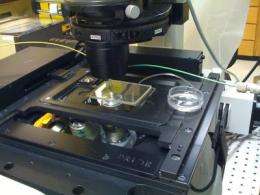
Using microfluidics and a microscope, MIT researchers were able to see the results of a sharp change in current on chiral microbes. Credit: Photo / Marcos, MIT Dept. of Civil and Environmental Engineering

(PhysOrg.com) -- Scientists at MIT and Brown University studying how marine bacteria move recently discovered that a sharp variation in water current segregates right-handed bacteria from their left-handed brethren, impelling the microbes in opposite directions.

This finding and the possibility of quickly and cheaply implementing the of two-handed objects in the laboratory could have a big impact on industries like the pharmaceutical industry, for which the separation of right-handed from left-handed molecules can be crucial to a drug's safety.

While single-celled bacteria do not have hands, their helical-shaped flagella spiral either clockwise or counter-clockwise, making opposite-turning flagella similar to human hands in that they create mirror images of one another that cannot be superimposed.

This two-handed quality is called chirality, and in a molecule, it can make the difference between healing and harming the human body.

"This discovery could impact our understanding of how water currents affect ocean , particularly with respect to their ability to forage for food, since chiral effects make them drift off-course. But it is also important for several industries that rely upon the ability to separate two-handed molecules." said Roman Stocker, the Doherty Assistant Professor of Ocean Utilization in the MIT Department of Civil and Environmental Engineering, and a principal investigator of the research.

One of the best-known instances of a chiral molecule causing widespread harm occurred in the 1950s, when the drug thalidomide was given to pregnant women to prevent . One naturally occurring form—or isomer—of thalidomide reduces nausea; the other causes birth defects. In another commonly used chiral drug, naproxen, one isomer is analgesic; the other causes liver damage.

Stocker and graduate student Marcos, along with co-authors Henry Fu and Professor Thomas Powers of Brown University, published their findings in the April 17 issue of Physical Review Letters.

In the paper, the researchers describe how they designed a microfluidic environment—a device about the size of an iPod nano that has channels containing water and bacteria—to create a "shear" flow of adjacent layers of water moving at different speeds. In their tests, Stocker and Marcos used a non-motile mutant of the bacterium Leptospira biflexa, whose entire body has the shape of a right-handed helix. They injected the Leptospira into the center of the microfluidic device and demonstrated that they drift off-course in a direction dictated by their chirality.

But the researchers did much more than observe the microbes under a microscope. In addition to the experimental data they gathered, with their Brown colleagues the MIT researchers also developed a rigorous mathematical model of the process. They are currently implementing this new approach to separate objects at molecular scales.

"The methods currently used to separate chiral molecules are far more expensive and far slower than the microfluidic option. While we still have some way to go to separate actual chiral molecules, we think our work is very promising for the agriculture, food and pharmaceutical industries." said Marcos.

Source: Massachusetts Institute of Technology (news : web)


print this article email this article download pdf blog this article bookmark this article     Stumble it Digg this share on Facebook retweet share on Reddit add to delicious
Rate this story - 5 /5 (2 votes)


April 15, 2009 all stories

Comments: 0

5 /5 (2 votes)
  • Stumble this up

  • Digg this

  • share this

  • hide
  • Related Stories

  • Results promising for computational quantum chemical methods for drug development
    created Dec 20, 2007 | popularity not rated yet | comments 0
  • Tiny ecosystem may shed light on climate change
    created Dec 15, 2008 | popularity not rated yet | comments 0
  • Chemists develop new method for synthesizing anti-cancer flavonoids
    created Apr 04, 2007 | popularity not rated yet | comments 0
  • Everything starts with recognition
    created Apr 23, 2007 | popularity not rated yet | comments 0
  • Scientists watch on the atomic level how individual molecules recognize each other
    created May 02, 2007 | popularity not rated yet | comments 0


  • hide
  • Relevant PhysicsForums posts

  • Elementary question involving turkey thaw process!
    created 4 hours ago
  • Spin Polarization
    created 5 hours ago
  • Entropy
    created 5 hours ago
  • Bicycle wheel size question.
    created 6 hours ago
  • More from Physics Forums - General Physics

Other News

Scientists react as they stand in front of a screen at CERN

First atoms reported smashed in Large Hadron Collider (Update)

Physics / General Physics

created Nov 23, 2009 | popularity 4.6 / 5 (29) | comments 21

Two circulating beams on Monday produced the first particle collisions in the world's biggest atom smasher, the Large Hadron Collider (LHC), three days after its restart, scientists announced.


Restored machine to explore mysteries of Big Bang (AP)

Restored machine to explore mysteries of Big Bang

Physics / General Physics

created Nov 21, 2009 | popularity 4.6 / 5 (18) | comments 26

(AP) -- Scientists are preparing the world's largest atom smasher to explore the depths of matter after successfully restarting the $10 billion machine following more than a year of repairs.


In the Brain, Seven Is A Magic Number

In the Brain, Seven Is A Magic Number

Physics / General Physics

created Nov 23, 2009 | popularity 4.5 / 5 (32) | comments 9

Having a tough time recalling a phone number someone spoke a few minutes ago or forgetting items from a mental grocery list is not a sign of mental decline; in fact, it's natural.


nuclear power plant

Doubts raised on nuclear industry viability

Physics / General Physics

created Nov 19, 2009 | popularity 3.1 / 5 (21) | comments 19

(PhysOrg.com) -- The investment in nuclear power has been growing around the world over the last few years, being viewed as a means for countries to control their energy security, avoid the price fluctuations ...


Proton's party pals may alter its internal structure

Proton's party pals may alter its internal structure

Physics / General Physics

created Nov 18, 2009 | popularity 4.6 / 5 (20) | comments 9

A recent experiment at the DOE's Thomas Jefferson National Accelerator Facility has found that a proton's nearest neighbors in the nucleus of the atom may modify the proton's internal structure.