Satellites show how Earth moved during Italy quake
April 15, 2009 Satellites show how Earth moved during Italy quake

Enlarge

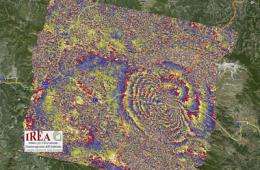
An Envisat Advanced Synthetic Aperture Radar (ASAR) interferogram over the L’Aquila area in central Italy showing the deformation pattern caused by the seismic events in early April 2009. This interferogram was generated by Italy’s Istituto per il Rilevamento Elettromagnetico dell’ Ambiente (IREA-CNR) in Naples, Italy just a few hours after Envisat’s acquisition on 12 April 2009. It combines that acquisition with a pre-seismic acquisition on 1 February 2009, with an estimated baseline (separation between the two Envisat orbital positions) of about 154 m. The satellite’s right-looking angle is 23 degrees. Each fringe of the interferogram, corresponding to a colour cycle, is equivalent to an Earth surface displacement of 2.8 cm along the satellite direction. Credits: IREA-CNR

(PhysOrg.com) -- Studying satellite radar data from ESA's Envisat and the Italian Space Agency's COSMO-SkyMed, scientists have begun analysing the movement of Earth during and after the 6.3 earthquake that shook the medieval town of L'Aquila in central Italy on 6 April 2009.

Scientists from Italy's Istituto per il Rilevamento Elettromagnetico dell' Ambiente (IREA-CNR) and the Istituto Nazionale di Geofisica e Vulcanologia (INGV) are studying Synthetic Aperture Radar (SAR) data from these satellites to map surface deformations after the earthquake and the numerous aftershocks that have followed.

The scientists are using a technique known as SAR Interferometry (InSAR), a sophisticated version of 'spot the difference'. InSAR involves combining two or more radar images of the same ground location in such a way that very precise measurements - down to a scale of a few millimetres - can be made of any ground motion taking place between image acquisitions.

The InSAR technique merges data acquired before and after the earthquake to generate 'interferogram' images that appear as rainbow-coloured interference patterns. A complete set of coloured bands, called 'fringes', represents ground movement relative to the spacecraft of half a wavelength, which is 2.8 cm in the case of Envisat's ASAR.
Satellites show how Earth moved during Italy quake
Enlarge

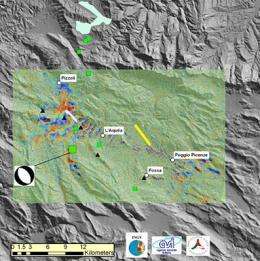
COSMO-SkyMed interferogram using data from 19 February 2009 and 9 April 2009. Perpendicular baseline is 480 m, and the satellite’s right-looking angle is 37 degrees. The large green square represents the Mw 6.3 main shock, smaller green squares represent the Mw > 5 aftershocks, the yellow line marks the observed co-seismic surface breaks and the black triangles represent GPS stations used for SAR validation. Credits: INGV, ASI (Italian Space Agency)

The first Envisat data, acquired after the earthquake on 12 April, were made immediately available to the scientists.

"We produced an interferogram just a few hours after the Envisat acquisition by combining these data with data acquired before the earthquake on 1 February. We were pleased that we were able to immediately see the pattern of the earthquake," said Riccardo Lanari of IREA-CNR in Naples, Italy.

The Envisat interferogram, as explained by Stefano Salvi from INGV's Earthquake Remote Sensing Group, shows nine fringes surrounding a maximum displacement area located midway between L'Aquila and Fossa, where the ground moved as much as 25 cm (along a line between the satellite's orbital position and the earthquake area).

"By using available 3D ground displacements from five GPS location sites around the affected area, we were able to confirm the preliminary results obtained with Envisat data," Salvi said.

The COSMO-SkyMed constellation, which is currently made up of three satellites, allows for frequent data. This means new interferograms can be calculated every few days.

The COSMO-SkyMed data together with the Envisat data and possibly SAR data from other satellites will ensure a dense sampling of the ground deformation around the L'Aquila area in the next months, which could make this earthquake one of the most covered by SAR Interferometry measurements.

To ensure all scientists are able to contribute to the analysis of the , ESA is making its Earth observation dataset collected over the L'Aquila area freely accessible with an innovative fast data download mechanism. The dataset will be continuously updated with the newest Envisat acquisitions.

Source: European Space Agency (news : web)


print this article email this article download pdf blog this article bookmark this article     Stumble it Digg this share on Facebook retweet share on Reddit add to delicious
Rate this story - 4.6 /5 (7 votes)


April 15, 2009 all stories

Comments: 0

4.6 /5 (7 votes)
  • Stumble this up

  • Digg this

  • share this

  • hide
  • Related Stories


  • hide
  • Relevant PhysicsForums posts

  • cycles
    created Nov 08, 2009
  • The Origin of the term 'fossil' fuels
    created Nov 05, 2009
  • co2
    created Nov 03, 2009
  • Early Earths Sulfidic Ocean Conditions
    created Oct 30, 2009
  • vegetation
    created Oct 29, 2009
  • climate change
    created Oct 29, 2009
  • More from Physics Forums - Earth

Other News

Antarctica glacier retreat creates new carbon dioxide store

Antarctica glacier retreat creates new carbon dioxide store

Space & Earth / Earth Sciences

created 2 hours ago | popularity 5 / 5 (1) | comments 0

Large blooms of tiny marine plants called phytoplankton are flourishing in areas of open water left exposed by the recent and rapid melting of ice shelves and glaciers around the Antarctic Peninsula. This ...


Deep creep means milder, more frequent earthquakes along Southern California's San Jacinto fault

Deep creep means milder, more frequent earthquakes along Southern California's San Jacinto fault

Space & Earth / Earth Sciences

created 23 hours ago | popularity 4.5 / 5 (4) | comments 0

With an average of four mini-earthquakes per day, Southern California's San Jacinto fault constantly adjusts to make it a less likely candidate for a major earthquake than its quiet neighbor to the east, the ...


Success in 'space elevator' competition (AP)

Success in 'space elevator' competition (Update 3)

Space & Earth / Space Exploration

created Nov 05, 2009 | popularity 4.3 / 5 (33) | comments 53

(AP) -- A robot powered by a ground-based laser beam climbed a long cable dangling from a helicopter on Wednesday to qualify for prize money in a $2 million competition to test the potential reality of the ...


In a Galaxy Far, Far Away...

In a Galaxy Far, Far Away...

Space & Earth / Astronomy

created Nov 06, 2009 | popularity 4.8 / 5 (5) | comments 15

(PhysOrg.com) -- Astronomers have published the discovery of the farthest known object in the cosmos: a star that exploded when the universe was only 630 million years old -- only 4.6% of its current age. ...


'Dropouts' pinpoint earliest galaxies

'Dropouts' pinpoint earliest galaxies

Space & Earth / Astronomy

created Nov 06, 2009 | popularity 4.2 / 5 (10) | comments 13

Astronomers, conducting the broadest survey to date of galaxies from about 800 million years after the Big Bang, have found 22 early galaxies and confirmed the age of one by its characteristic hydrogen signature ...