Space-Based Solar Power Coming to California in 2016
April 15, 2009 by Lisa Zyga
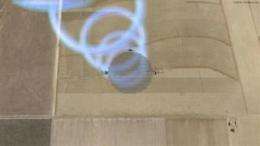
The microwave beam is targeted at a rectifying antenna array on Earth. Designers say the beam would have about one-sixth the intensity of noon sunlight. Image credit: Mafic Studios Inc.
(PhysOrg.com) -- In the near future, a solar power satellite may be supplying electricity to 250,000 homes around Fresno County, California. Unlike ground-based solar arrays, satellites would be unaffected by cloudy weather or night, and could generate power 24 hours a day. If successful and affordable, the project could mark the beginning of space-based solar power in other locations, as well.
Solaren Corp., a solar power start-up, has convinced Pacific Gas & Electric (PG&E), California's largest utility company, to purchase 200 megawatts of electricity when its system is in place, which is expected to be 2016. According to Solaren, the system could generate 1.2 to 4.8 gigawatts of power at a price comparable to that of other renewable energy sources.
In Solaren's proposal, solar power satellites would be positioned in stationary orbit about 22,000 miles above the equator. The satellites - whose arrays of mirrors could be several miles across - would collect the sun's rays on photoelectric cells and convert them into radio waves. The radio waves would then be beamed to a receiving station on the ground, where they would be converted into electricity and delivered to PG&E's power grid. Because the radio beam is spread out over a wide area, it would not be dangerous to people, airplanes, or wildlife.
The plan requires a large area of land to host the ground receiving station's antenna array, and several square miles of scrubland in western Fresno County could provide an ideal location. In addition to being sparsely populated, the region is also near transmission lines and a load center. While many of today's land-based solar stations are located far out in the desert, a station closer to customers could offer greater convenience and economic advantages.
Gary Spirnak, CEO of Solaren Corp. and a former aerospace engineer, noted that the project will cost more than $2 billion, mostly going toward engineering development and building of the ground station, as well as launching four or five satellites. So far, Solaren has raised an undisclosed sum from private investors.
"While a system of this scale and exact configuration has not been built, the underlying technology is very mature and is based on communications satellite technology," Spirnak said.
Solaren's project is not the only space-based solar system in the works; Japan's space agency, JAXA, has recently begun testing a space-based solar array that beams energy to Earth in the form of microwaves. If the tests are successful, the agency plans to launch an array of satellites that would transmit power to a 1.8-mile-wide receiving station, which would generate enough electricity to power about half a million homes.
More information: Q&A with Gary Spirnak
via: MSNBC and Fresno Bee
© 2009 PhysOrg.com


if anything we should be working on how to transport power up to space sattelites from planet earth, not the other way around. that way the sattelities could bring less fuel, less solar panels for the iss, and less of everthing during launch. this idea has been around for a long time, it is not news, it should NOT be on physorg.
Seems to me an energy generation technology not based on nuclear or fossil fuel, and not subject to the usual weaknesses of "alternative fuels" (dependent on wind, lack of clouds, facing the sun, etc) would satisfy both those concerned with global warming and also those just generally concerned with the long term viability of nuclear energy (radioactive waste and byproduct, security) and fossil fuels (scarce resource, security, environmentla impact).
Its a win-win from those aspects, in what way is it a losing proposition to you?
Plus solar farms with around 6 to 9 solar panels per pole, could feed into the national grid.
Is this satellite just a cover for a more sinister militarised approach, a death ray in space.
But no, really, 2 billion would build a fucklot of solar panels for housing and solar farms.
Plus "a price comparable" doesn't really say much. The price of a Bentley is also comparable to the price of a bicycle. It's a lot bigger.
I disagree. Basing the system in space gives a direct view of the sun, regarding of planetside weather, time of day, etc. What you lose in efficiencies switching back and forth between wavelengths you make up for in steady supply, which has been the weak spot in solar energy up till now.
Sloar farms get the attention (and the following wrath) of the NIMBY environmentalists. aka "we want alternative energy, as long as it doesn't have ANY visual or environmental impact. At all."
You were doing so well until you went all paranoid on us.
Agreed. Concentrating solar panels are the way to go.
Exactly. Terrestrial solar can utilize existing electrical infrastructure.
It is a perfect death ray. The microwaves could be tuned to affect specific materials. The only catch is that the beam is wide so it would be good to clear an entire sector of life/electronics on the ground.
I would also add that converting gigawatts of solar energy to microwave energy would generate a massive amount of heat. The satellite is located in a vacuum which is a wonderful insulator. So you have huge overheating problems. Add to that the exhorbitant cost of putting the satellites into a geostationary (Clark) orbit (> $10,000 per Kg)and keeping them there. Large solar panels act like solar sails.
IMHO the only way to go is to set up massive terrestrial solar concentrator farms. Reflectors are cheaper to produce that the photovoltaics. There are vast tracts of inhospitible desert in the USA bathed in intense sunlight.
Duh, why not use sunlight which is 6 times more intense?!*#
Anyone want to invest in my machine that transmutes poo into gold? No prototype yet. I just need a few billion to construct a massive neutron bombardment facility. And for those who worry about all of the radioactivity - don't worry you can't see radioactivity so it is harmless. We will locate the facility in some city center to make it easy to carry the gold to the banks.
;-P
The costs of putting this array into space will take decades to pay for.
And exactly what do you think they are going to do when they start building this massive radio reception array??????
"webadmin.registerapi.com uses an invalid security certificate. The certificate expired on 8/27/2008 7:27 PM."
Doesn't really inspire a lot of trust. The third link leads to a completely unrelated Armenian company with a very similar name.
Also, if solar becomes inexpensive enough in the future for middle-income homeowners to have installed, it would remove the monthly expense and would render the bulk of satellites useless.
Enough doom and gloom...it sounds exciting anyway!
In 2016 this great idea will be like what turning corn to fuel is now, stupid and very expensive.
If a government was talking about building this, I might be concerned about ulterior motives, but not private enterprise. We're not talking about some James Bond villain here. This is a company of forward thinking individuals trying to profit by providing a service. If it doesn't work, or it doesn't get built, it is their loss (with the possible exception of some hefty tax write-offs.) If it does work, then they will have advanced the technology by a great leap and we all reap the benefits.
In addition to the stated purpose, this thing could also be "rented" to feed power to other satelittes, a fledgling space station or moonbase, until they can get their own facilities built. Yeah, you'd need a tighter beam and a very precise antenna, like the one they used to beam power across a room and power a 60 watt bulb, but it might make some projects possible that would otherwise languish in the planning stages.
great, by the time it gets to Earth it will be 100
miles across. They haven't figured out many of the
technical issues.
Annoucing garbage to be announcing garbage doesn't
place you in any higher order. It just makes you
look like a clown.
Please be aware this project involves extreme high-frequency radio waves (aka microwaves as in souped-up radar) that can fry pigeons, people aboard aircraft and anything else caught in the microwave transmission beam to Earth.
The microwave intensities involved are approx. 23 milliwatts per square centimeter, enough to cook biological material according to US EPA stats on the proposed project. The microwave transmission beam also is expected to disrupt communications (cell phones, TV, radio). Late US Senator Barry Goldwater (R, AZ) reviewed the concept and refused to allow the rectenna (receiving antenna) to be located in Arizona.
The definitive book on beaming space solar power to Earth via high-intensity microwaves is titled Sunstroke, written by author David Kagan, a US aerospace engineer. Sunstroke describes in detail the precise technology behind this project as well as the inherent environmental hazards. Sure hope Solaren Corp. has a more efficient "fail-safe" mechanism that shuts off the beam in an emergency than what's been promulgated by past space solar power enthusiasts.
After reading Sunstroke I wouldn't want to live anywhere near the designated ground zero rectenna site for receiving the microwave beam. However, wireless power transmission (WPT) from space deserves a good feasibility test.
for example the answer of environmentalists to the oil crises was all this nonsense solutions instead of admitting we need to raise gas taxes and reduce consumption while increasing oil production (already accounted for by private interests) and increasing research funding for substitutes to oil. instead...they swoon on about global warmings imminent destructiveness and produce outrageous solutions like pumping dust and sun blockers into our atmosphere, or even more ridiculous, 'scrubbing' the air of carbon, as if it were some type of dirt.
the reasons the above posted idea is not worth the server space its stored on is because outerspace is too expensive to commerialize for a massive project of ANY reasonable scale. the ONLY industry to prove itself profitable using space is the communications industry and man companies....for example irididium, have still had legendary failures in this area because space is just so expensive to get to and then to stay in. not only is this idea old, but its shameful that people still consider it news worthy. its like hafnium, its nonsense. and at somepoint, people will realize that this isnt even worth dignifying with a response.
space is not commerially viable. not for energy production not for just about anything. you want commerciall viability for space, the answer is a fully function scram jet. when that happens, space will become commercially viable for other industries. some people are betting on space elevators, or richard bramson. but i wouldnt bet on a stairway to heaven or a virgin megastore ceo whose franchise seems to be going bankrupt in the u.s.
"Encouragingly, there has recently been a flurry of interest in organisations other than space agencies - notably Welsom Inc, Space Island Group and NSSO - in developing an orbiting SPS demonstrator. Peter Glaser must be very disappointed not to have seen an SPS demonstrator in 40 years, but in the long run his 1968 vision of a large-scale, space-based solar energy industry may well turn out to have been correct."
http://www.spacef...sary_SPS
Don't forget the powerful greenhouse gases released into the atmosphere by the manufacture and cleaning of solar cells used in such projects. We are talking about gases capable of up to 17,000 times the radiative forcing of CO2!
Talk about destroying the planet to save it! :)
1.8 square miles = 4.66 million square meters
4.8 GW/ 4.66million sqare meters = 1030 Watt/m^2
Hm... less than we would get from sunlight, but lets assume it's always on, round the clock. (satellites can still see the sun when its night time here)
So you actually get over twice the energyper square foot because it's always on. Oh and it makes for BASELOAD too :)
Part 2:
Cost per Watt: Solar panels on earth are readily available for $800/100W (180W really, but lets talk likely output power)
So for $2 billion you get 2.5 million pannels or 250MW of power generated when and where they are needed the most - hot summer days when the AC's are cranking, but only during the day... (also not counting infrastructure to mount all these pannels. )
The math sense checks out, but are their numbers accurate?
$2 billion sound awfully tiny for a solar array "several miles across" let alone 5-6 sattelite launches (aren't they about a billion each?) Maybe $2 billion for the ground station and someone else takes care of the sattelite?
Oh and one small storm of micro-meteors and your satellite array is swiss cheese? One happens about once/year
It costs $11 000 per kg to place something in geostationary orbit.
The most promissing power transmission technology put forth by proponents is a 2.45 GHz microwave antenna about a km across in space and the reciever on Earth about 10 km across. It doesn't matter if you're sending 1 W or 1 TW, the antenna has to be that big if you want to reduce losses to 20% or less.
The energy density hitting the Earth based antenna will only be ~100 W/m^2 for an insane 100 GW of solar cells in space. That's over 10 times the solar cells produced anywhere in the world to date.
There are too many steps and you lose power at each one. First you convert from low voltage DC to low voltage AC, then from low voltage AC to high voltage AC, transmit it several kilometers across the array to the antenna; convert from high voltage AC to low voltage AC, convert from low voltage AC to low voltage DC, convert from low voltage DC to microwaves in a microwave antenna, beam it 36 000 km from geosynchronous orbit to an antenna on Earth, convert back to low voltage DC, convert to low voltage AC, convert to high voltage AC and send it into the grid.
The photovoltaics will be bathing in ionizing radiation and will age faster than on Earth.
Then again, assuming they're talking about keeping the satellite in the same spot relative to the sun and Earth(I'm not entirely sure how that would work other than continually adjusting the orbit or Lagrange points), that would mean a great deal of precision would be required. Also, there are a lot of possible disturbance factors, from weather to air/space traffic, which would limit the already small window of time in which the power could be transferred. The receiving station would most likely have to be linear in shape, what with the beam moving constantly.
Well, I'm not convinced. Perhaps it'd be a good means of powering other space constructs, and it's hard to ignore the military possibilities, as previous posters said, but the means of transporting the energy back down is too risky for the time being. I don't understand why so many resources are spent idiotically on satellites and space exploration probes when we're still launching them with the same centuries old technology. The new space race should be an endurance one, or no race at all.
The Earth's rotational axis is tilted and you're orbiting so far away from the Earth that you're only going to be in the Earth's shadow for up to 70 minutes per day.
More importantly you know exactly when and exactly how long this will occur; there are no seasons or weather that can screw things up.
Reality is closer to the Chernobyl exclusion zone. It would be a zone ~30 km across with an antenna ~10 km across in the center. The zone would be uninhabited because the microwave power exceeds legal tolerances(whether a few watts per metre is harmful or not is a completely different question).
Hmm...And I suppose that's the optimal period for the transfer to occur, since the satellite would otherwise be idling.
The solar panels themselves wouldn't be affected, true, but what about the ground station and the microwave beam? This might be a stupid question, but how does refraction fit into all of this? The beam would traverse air of different densities(and other properties, maybe) on its way down, and these properties are in fact weather-dependent, right?
With developments in electrical storage we don't need sunlight 24/7. This is just an excuse for political and military agendas.
http://en.wikiped...ted).gif
The microwave spectrum is very wide and isn't just the 2.45 GHz that a microwave oven uses. Wouldn't they choose a wavelength that had high transmittance through the atmosphere (and hence low dielectric heating losses)?
You couldn't even build such a massive storage system on Earth, you're not going to do it in space.
Power must be continuously transmitted the very millisecond it's produced.
Carefull googleplex, The great inventor Neil Farbstein has already invented this. He may sue you for stealing his idea.
Do it.
1/6th of the sun's intensity(which makes the recieving antenna very costly).
The radiation pattern is an airy disk, and fairly significant "lobes" extends several times the diameter of the recieving antenna.
Microwaves are in the evil part of the electromagnetic spectrum know to its frantic opponent as radiation(the only non-evil part of the EM spectrum is visible light; it is of course also EM radiation but no one calls it that). As such it will be visciously opposed by the chronically ignorant and a safety distance several times the diameter of the reciever will be imposed whether or not it makes any sense.
Shadow? This thing is several Earth radii away!
Tesla did this almost 100 years ago from a transmitter on the ground delivering power 20 miles away. The only thing wrong with his idea at the time was that Edison could not figure out how to put a meter to charge people for the electricity delvered without wires.
To get that much energy out of radio waves they need to be eXtremely intense.
I guess we'll find out in 15 years after we've been running them.
I'd rather spend the money on a terrestrial farm. We shouldn't be clogging up outer space more than we need to. Besides one well aimed coronal mass ejection and the whole thing is toast.
No. Microwaves heat flesh and that's all they're capable of doing.
If half a century of research on the biological effects of high power microwave and radiowave transmitters in all possible frequency ranges didn't silence the tinfoil hat crowd who thinks cell phones give them brain cancer, nothing ever will.
They do sell microwave radiation detectors for home use, by the way.
Decimal dust.
I have this amazing cooling device called a circulatory system and sweat glands that allow me to keep thermal homeostasis.
Even when I directly expose my head to 1000 W/m^2 of UV, visible and infrared radiation for hours on end it has negligible effect.
I'm even capable of submersing myself in 45 degrees celsius hot water for long periods of time without experiencing anything worse than a bit of fatigue.
No, that is why quacks recommend replacing microwave ovens when they leak a few hundred milliwatts of evil, evil microwaves. Did I mention that microwaves are invisible and they're evil?
"They" are quacks who prey on the ignorance of their audience to sell overpriced crap they do not need and do not understand how to interpret.
Seriously though, I do enjoy your posts. It's nice to know other people are proponents of the scientific method.
I have run the microwave on full with the door open back when el cheap-o microwaves didn't have a switch to turn it off integrated into the door mechanism. That's about 1000 times more leakage than the leakiest microwave you can find.
What the hell for? It's not cummulative.
The Marine Corps has a microwave device which causes significant pain just below the skin's surface but causes no permanent damage. They use it for non-lethal crowd control.
What is the band width of 'microwaves', 30 um and up?
They still sell those? We had one of those when we got our first microwave oven. We used it (the detector) obsessively at first, then periodically when we thought of it, then eventually when we changed the batteries on the smoke detectors we would check the mocrowave for leaks... when we upgraded to a newer microwave we tag saled the detector. The newer models have safety features and we now better understand what appliance generated microwaves can and can't do to you if you are exposed to them.
The most common effects of microwave oven leaking radiation is damage to the corneas and cataracts that can develop from as short as two minutes exposure. That has been proved in countless cases.
There is a big possibility that long term exposure to microwaves near a satellite electricity plant might cause cancer, cataracts, neuro symptoms, etc. The EPA should hold up their project.
Ok, I see you are afraid to try the experiment....