Rice researchers unzip the future
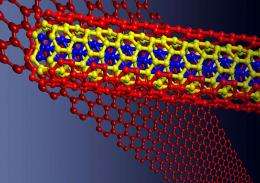
April 15, 2009 Nanoribbon

Enlarge

Nanoribbon. Courtesy of Hongjie Dai

Scientists at Rice University have found a simple way to create basic elements for aircraft, flat-screen TVs, electronics and other products that incorporate sheets of tough, electrically conductive material.

And the process begins with a zipper.

Research by the Rice University lab of Professor James Tour, featured on the cover of the April 16 issue of the journal Nature, has uncovered a room-temperature chemical process that splits, or unzips, carbon nanotubes to make flat nanoribbons. The technique makes it possible to produce the ultrathin ribbons in bulk quantities.

These ribbons are straight-edged sheets of , the single-layer form of common found in pencils. You'd have to place thousands of them side by side to equal the width of a human hair, but tests show graphene is 200 times stronger than steel.

"If you want to make conductive film, this is what you want," said Tour, Rice's Chao Professor of Chemistry and also a professor of mechanical engineering and materials science and computer science. "As soon as we started talking about this process, we began getting calls from manufacturers that recognized the potential."

The process involves sulfuric acid and potassium permanganate, which have been in common use since the 1890s. This chemical one-two punch attacks single and multiwalled carbon nanotubes, reacting with the carbon framework and unzipping them in a straight line.

The unzipping action can start on the end or in the middle, but the result is the same - the tubes turn into flat, straight-edged, water-soluble ribbons of graphene. When produced in bulk, these microscopic sheets can be "painted" onto a surface or combined with a polymer to let it conduct electricity.

Nanotubes have been used for that purpose already. "But when you stack two cylinders, the area that is touching is very small," Tour said. "If you stack these ribbons into sheets, you have very large areas of overlap. As an additive for materials, it's going to be very large, especially for conductive materials."

He credited Rice postdoctoral research associate Dmitry Kosynkin with the discovery. Kosynkin is lead author of the Nature paper, with contributions from graduate students Amanda Higginbotham, Jay Lomeda and B. Katherine Price, postdoctoral researcher Alexander Sinitskii, visiting scientist Ayrat Dimiev and Tour.

Kosynkin made the find while studying oxidation processes involving nanotubes. "Dmitry came to me and said he had nanoribbons," recalled Tour. "It took a while to convince me, but as soon as I saw them I realized this was huge."

Nearly all of the nanotubes subjected to unzipping turn into graphene ribbons, Tour said, and the basic process is the same for single or multiwalled tubes. Single-walled carbon nanotubes convert to sheets at room temperature and are good for small electronic devices because the width of the unzipped sheet is highly controllable. But the multiwalled nanotubes are much cheaper starting materials, and the resulting nanoribbons would be useful in a host of applications.

That's why Tour is banking on bulk, made possible by processing multiwalled tubes, which unzip in one hour at 130 to 158 degrees Fahrenheit. (Until now, making such material in more than microscopic quantities has involved a chemical vapor deposition process at more than 1,500 F.) "Multiwalled carbon nanotubes are concentric tubes, like Russian nesting dolls," he said. "We cut through 20 walls, one at a time, during the reaction process."

At first, the process of isolating nanoribbons "involved a lot of excruciating washing," he said. "But we've found a much easier way, which we needed to do to get industry to start taking it from here.

"If a company wants to produce these, they could probably start selling small quantities within six months. To scale it up and sell ton quantities, it might take a couple of years. That's just a matter of having the right reactors. But the chemistry is all there. It's very simple."

Tour is excited by the possibility that conductive nanoribbons could replace indium tin oxide (ITO), a material commonly used in flat-panel displays, touch panels, electronic ink and solar cells. "ITO is very expensive, so lots of people are looking for substitutes that will give them transparency with conductivity," he said.

"People have made thin films of nanotubes that fit the bill, but I think this will enable even thinner films, with the equivalent conductivity or better."

He envisioned nanoribbon-coated paper that could become a flexible electronic display, and he's already experimenting with nanoribbon-infused ink for ink-jet printers. "We're printing transistors and radio-frequency identification tags, printing electronics with these inks," he said.

"This is going to be the new material for many applications."

Tour said discussions are already underway with several companies looking into large-scale production of nanoribbons and with others interested in specific applications for nanoribbons in their core product technologies. Formal industrial partnering has already begun through Rice's Office of Technology Transfer.

Source: Rice University (news : web)


print this article email this article download pdf blog this article bookmark this article     Stumble it Digg this share on Facebook retweet share on Reddit add to delicious
Rate this story - 5 /5 (11 votes)

Rank Filter

Move the slider to adjust rank threshold, so that you can hide some of the comments.


Display comments: newest first

  • NeilFarbstein - Apr 15, 2009
    • Rank: 1 / 5 (3)
    Since nanotubes cost ten times what graphene platelts cost it seems wasteful to make nanotubes then to break them down into graphene.
  • fmfbrestel - Apr 15, 2009
    • Rank: not rated yet
    The big difference between directly making the graphene and unzipping some nanotubes, is control. there is a ton of research on how to make nanotubes of very specific dimensions, this process uses two cheap chemicals at near room temp to turn those fine-tuned nanotubes into fine-tuned graphene sheets.
    And then like the articles says, if you dont need tight control, you can bake up some cheap multi-walled tubes and unzip them en-mass.
  • fmfbrestel - Apr 15, 2009
    • Rank: 5 / 5 (1)
    Seriously, Farbstein -- if your process is so superior and so much cheaper, then why are vulvox isnt getting any industry love while "Formal industrial partnering has already begun through Rice's Office of Technology Transfer." is already going on with this process.
  • NOM - Apr 16, 2009
    • Rank: not rated yet
    Seriously, Farbstein -- if your process is so superior and so much cheaper, then why are vulvox isnt getting any industry love while "Formal industrial partnering has already begun through Rice's Office of Technology Transfer." is already going on with this process.

    The answer to this is easy. Farbstein is a lying fraud.
    His claims are amusing though. Sadly, Neil thinks he is the world's most famous inventor. Several years ago he was claiming to have solved nuclear fusion.

    ... and there's always Neil's famous butt-glue.

April 15, 2009 all stories

Comments: 4

5 /5 (11 votes)
  • Stumble this up

  • Digg this

  • share this

  • hide
  • Related Stories

  • Nano World: Composites with nano-graphite
    created Jul 24, 2006 | popularity not rated yet | comments 0
  • Carbon nanoribbons could make smaller, speedier computer chips
    created May 27, 2008 | popularity not rated yet | comments 0
  • Carbon nanotube 'ink' may lead to thinner, lighter transistors and solar cells
    created Jan 08, 2009 | popularity not rated yet | comments 0
  • Breakthrough for carbon nanotube materials
    created Sep 29, 2008 | popularity not rated yet | comments 0
  • Nanotube ink: Desktop printing of carbon nanotube patterns
    created Aug 30, 2006 | popularity not rated yet | comments 0


  • hide
  • Relevant PhysicsForums posts

  • Fatigue Properties of Chinese steel
    created Nov 04, 2009
  • Finding Hardness values
    created Nov 04, 2009
  • Fluid flow, pressure drop simulation in Comsol
    created Nov 04, 2009
  • units of vickers,brinell and rockwell . . .
    created Nov 04, 2009
  • Slip in a single crystal
    created Nov 02, 2009
  • Flicks 2nd law?
    created Nov 02, 2009
  • More from Physics Forums - Materials & Chemical Engineering

Other News

Findings show nanomedicine promising for treating spinal cord injuries

Findings show nanomedicine promising for treating spinal cord injuries

Nanotechnology / Bio & Medicine

created 5 hours ago | popularity 5 / 5 (1) | comments 0

(PhysOrg.com) -- Researchers at Purdue University have discovered a new approach for repairing damaged nerve fibers in spinal cord injuries using nano-spheres that could be injected into the blood shortly ...


New Digital 'Electronics' Concept May Continue Moore's Law

New Digital 'Electronics' Concept May Continue Moore's Law

Nanotechnology / Nanophysics

created Nov 05, 2009 | popularity 4.6 / 5 (52) | comments 9

(PhysOrg.com) -- Computers of the future could be operating not on electrons, but on tiny waves traveling through an electron "fluid," if a new proposal is successful. The new circuit design, recently introduced ...


Nanoparticles for gene therapy improve

Nanoparticles for gene therapy improve

Nanotechnology / Bio & Medicine

created Nov 06, 2009 | popularity 5 / 5 (4) | comments 3

(PhysOrg.com) -- About five years ago, Professor Janet Sawicki at the Lankenau Institute in Pennsylvania read an article about nanoparticles developed by MIT's Robert Langer for gene therapy, the insertion ...


Breakthrough in industrial-scale nanotube processing

Breakthrough in industrial-scale nanotube processing

Nanotechnology / Nanomaterials

created Nov 02, 2009 | popularity 4.9 / 5 (20) | comments 3

(PhysOrg.com) -- Rice University scientists today unveiled a method for the industrial-scale processing of pure carbon-nanotube fibers that could lead to revolutionary advances in materials science, power ...


Scientists witness nature's complexity unfold in self-assembling quasicrystals

Scientists witness nature's complexity unfold in self-assembling quasicrystals

Nanotechnology / Nanomaterials

created Oct 31, 2009 | popularity 4.9 / 5 (16) | comments 3

(PhysOrg.com) -- Just a few decades ago, scientists believed that all ordered matter consists of self-repeating building blocks -- atoms, ions or molecules. In this view, the ordinary solids of everyday life ...