Prehistoric turtle goes to hospital for CT scan in search for skull, eggs, embryos
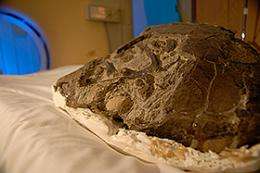
(PhysOrg.com) -- Michael Knell carried a 75-million-year-old turtle into Bozeman Deaconess hospital recently, then laid it carefully on the bed that slides into the CT scanner.
Hardly an ordinary patient, the turtle fossil was only the second in the world found with eggs inside it, said Knell, a Montana State University graduate student in earth sciences. His turtle (from the genus Adocus) came from the Grand Staircase-Escalante National Monument in Kanab, Utah. The previously described turtle, which was found in Alberta, is also an Adocus and lived about the same time. Knell wanted his fossil scanned to see if he could find a skull and more eggs and learn whether or not the eggs contained embryos.
"It allows us to peer inside without digging into it," Knell said. "It gives us a hands-off look without having to break anything."
"It's very cool," added Frankie Jackson, an MSU paleontologist who specializes in eggs.
The CT machine looks like a giant doughnut with a narrow bed attached. Patients normally lay on the bed, then ride through the scanner while it takes images of a particular area. In this case, Knell wanted to scan the entire turtle. Although the edges of its shell were missing, the fossil measured about one foot across and weighed 40 to 50 pounds.
"It's a lot easier than scanning people," said CT technician Tanya Spence,
Spence, who has scanned dinosaur fossils for MSU's Museum of the Rockies, said she didn't need to tell the fossil what it would experience during the CT scan. She didn't need to ask the turtle to hold her breath. She didn't worry about IV tubes or claustrophobia.
"We get to see bodies everyday, but not these," Spence said. "It's fun."
Spence operated the scanner from an adjoining room while Knell and Jackson looked over her shoulders. As the CT scanner took cross-sections of the fossil, white images appeared -- slice by slice -- on Spence's computer screen.
"It's very, very dense," Spence said of the shell. "You can lose some detail when that happens. You have to penetrate enough to see, but you can sometime lose detail that way."
Jackson said CT scans generally work better on fossils than X-rays and MRIs do.
"Usually embryo bone doesn't show up too well on a CT scan, so we might no be able to see embryos very well, but it could clue you in that you need to look at the eggs a little closer," Jackson added.
As time went by, the scientists realized that the eggs weren't showing up as clearly as they'd expected and they'd need to examine the images more closely. As a result, Spence saved her images to a disc and gave it to Knell. He and Jackson said they would contact the Museum of the Rockies, which has special software for looking at CT images from a variety of angles. The researchers expect to present their findings during the fourth international Symposium on Dinosaur Eggs and Babies. Knell's adviser, David Varricchio, and Jackson are organizing the event, which will be held Aug. 8-10 at MSU.
Knell said paleontologists have found about 10 different species of turtles and many fossilized egg shells in the hard sandstone of southern Utah. The team that found this Adocus in 2006 was led by Alan Titus, paleontologist at the Grand Staircase-Escalante National Monument, and Barry Albright, a researcher from the University of Northern Florida. Preparators learned that the turtle contained eggs after removing a section of its shell.
"It was kind of a happy accident," Knell said.
Adocus turtles generally laid small round eggs, about the same size as modern turtle eggs, Knell said. Based on what he knows about prehistoric turtles and living turtles, Knell said his Adocus was about a week away from laying the eggs when she died.
He added that it's rare to find turtle heads because the joint that connects them to the vertebrae is weak. Heads often get swept away and don't stay with the bodies. Knell was hoping that his turtle's skull had gone inside the shell before death.
Source: Montana State University (news : web)


