Researchers create novel nanotechnique to sequence human genome
April 15, 2009 Brown researchers create novel technique to sequence human genome

Enlarge

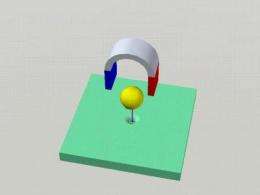
In this illustration, a DNA strand is leashed to a magnetized, iron-oxide bead, with a magnet hovering over it. As the bead moves toward the magnet, the DNA strand passes through nano-sized opening slowly enough that its base pairs can be read. Credit: Hongbo Peng/IBM Research

Since the human genome was sequenced six years ago, the cost of producing a high-quality genome sequence has dropped precipitously. More recently, the National Institutes of Health called for cutting the cost to $1,000 or less, which may enable sequencing as part of routine medical care.

The obstacles to reaching that goal have been primarily technological: Scientists have struggled to figure out how to accurately read the 3 billion base pairs - the amount of DNA found in humans and other mammals - without time-consuming, inefficient methods.

Physicists at Brown University may have an answer. They introduce a novel procedure to vastly slow the DNA's movement through openings that are used to read the code. In the journal Nanotechnology, the physicists report the first experiment to move DNA through a solid-state nanopore using magnets. The approach is promising because it allows multiple segments of a DNA strand to be threaded simultaneously through numerous tiny pores and for each fragment to move slowly enough through the opening so that the base pairs can be accurately read.

"When it comes to sequencing anyone's genome, you need to do it cheaply, and you need to do it quickly," explained Xinsheng Sean Ling, professor of physics, who joined the Brown faculty in 1996. "This is a step in that direction."

The idea of reading DNA by threading strands through tiny openings is not new. Scientists have shown that an applied electric field can drive the DNA molecules through a nanopore, a tiny hole in a membrane. But in those experiments, the base pairs moved too quickly through the openings for the code to be read accurately. So, while a large electric field is needed to draw the into the pore, Ling explained, the same field moves the DNA too quickly, a classic scientific Catch-22.

The trick is to figure out how to slow the strands' movement through the opening so the base pairs (A, T, C, and G) can be read. To solve that, Ling and Hongbo Peng, the lead author who performed the work as a graduate student at Brown and who now works at IBM, attached the DNA strand to a bead using a streptavidin-biotin bond. Like previous researchers, they used an electric field to drive the DNA strand toward the pore. But while the strand could pass through the pore, the bead, with a 2.8-micron diameter, was too large for the pore, which has a diameter of only 10 nanometers. So the bead was stuck in the hole with the attached DNA strand suspended on the other side of the membrane.

The Brown researchers then used magnets — they call them "magnetic tweezers" — to draw the iron-oxide bead away from the pore. As the bead moves toward the magnets, the attached DNA strand moves through the — slowly enough so that the base pairs can be read.

The scientists named their process "reverse DNA translocation" because, as Ling explained, "the DNA is essentially caught in a tug-of-war. And the speed of translocation will be controlled not solely by the but by striking some balance between the magnetic and the electric fields. From there, we can tune it to dictate the speed."

The scientists report their technique reduces the average speed of the DNA strand's passage by more than 2,000-fold. "It can be slower even. There is no limit," Ling said.

A similar experiment has been done using optical tweezers, Ling said, but it involves only one DNA strand at a time. The Brown method sends multiple strands through the nanopores simultaneously. "It is scalable," Ling said.

The researchers expect to test their technique in experiments using bacterial DNA.

Source: Brown University (news : web)


print this article email this article download pdf blog this article bookmark this article     Stumble it Digg this share on Facebook retweet share on Reddit add to delicious
Rate this story - 5 /5 (3 votes)

Rank Filter

Move the slider to adjust rank threshold, so that you can hide some of the comments.


Display comments: newest first

  • KBK - Apr 26, 2009
    • Rank: 1 / 5 (1)
    Geeez. Magnetism to mess with the flow and motion of DNA.

    Who'da thunk it?

    I wonder what other aspects of electrical function mess with the proper motion and behavior of DNA?

    Cell phones?

    Power lines?

    Dr. Royal Raymond Rife?

    How big of a list does there have to be before people willingly take note of such important things in a meaningful way?

    Hmmm..DNA...electrochemical activity, anyone? And on the near quantum level. Yet, in another article here, we have 'extraordinarily sensitive' quantum organized structures that are EXCRUCIATINGLY sensitive to any magnetic field.

    Now, what is DNA?

    It is a quantum level organized electrochemical organic structure.

    Now go read about DR. Royal Raymond Rife.
  • KBK - Apr 26, 2009
    • Rank: not rated yet
    Here be the sensitivity/entanglement article. DNA has many similar aspects:

    http://www.physor...100.html

April 15, 2009 all stories

Comments: 2

5 /5 (3 votes)
  • Stumble this up

  • Digg this

  • share this

  • hide
  • Related Stories

  • Nanopore Method Could Revolutionize Genome Sequencing
    created Apr 06, 2006 | popularity not rated yet | comments 0
  • New technique could dramatically lower costs of DNA sequencing
    created Dec 12, 2007 | popularity not rated yet | comments 0
  • Nanopore Sequencing Could Slash DNA Analysis Costs
    created Mar 27, 2009 | popularity not rated yet | comments 0
  • Researchers use 'nanopore channels' to precisely detect DNA
    created Apr 05, 2007 | popularity not rated yet | comments 0
  • Genetic Material under a Magnifying Glass
    created Jan 28, 2008 | popularity not rated yet | comments 0


  • hide
  • Relevant PhysicsForums posts

  • What is transpulmonary pressure?
    created Nov 24, 2009
  • Is there a gay gene?
    created Nov 23, 2009
  • Super quick question about Starling forces?
    created Nov 22, 2009
  • Questions about diffusion
    created Nov 22, 2009
  • More from Physics Forums - Biology

Other News

Fast, easy, and highly sensitive arsenic detection with gold nanoparticles

Nanotechnology / Nanomaterials

created 5 hours ago | popularity 5 / 5 (1) | comments 0

(PhysOrg.com) -- Mention of arsenic poisoning usually brings to mind underhanded murder. However, the danger of arsenic poisoning from contaminated drinking water is far greater. Low concentrations of arsenic are found in ...


Nanotech in Space: Experiment To Weather the Trials of Orbit

Nanotech in Space: Experiment To Weather the Trials of Orbit

Nanotechnology / Nanomaterials

created 17 hours ago | popularity 4 / 5 (2) | comments 0

Novel nanomaterials developed at Rensselaer were sent into orbit on Nov. 16 aboard Space Shuttle Atlantis.


Water droplets direct self-assembly process in thin-film materials

Nanotechnology / Nanomaterials

created Nov 23, 2009 | popularity 5 / 5 (4) | comments 2

You can think of it as origami - very high-tech origami. Researchers at the University of Illinois have developed a technique for fabricating three-dimensional, single-crystalline silicon structures from thin films by coupling ...


Nanotube defects equal better energy and storage systems

Nanotube defects equal better energy and storage systems

Nanotechnology / Nanomaterials

created Nov 19, 2009 | popularity 4.4 / 5 (10) | comments 2

(PhysOrg.com) -- Most people would like to be able to charge their cell phones and other personal electronics quickly and not too often. A recent discovery made by UC San Diego engineers could lead to carbon ...


Peptides control crystal growth with 'switches, throttles and brakes'

Peptides control crystal growth with 'switches, throttles and brakes'

Nanotechnology / Bio & Medicine

created Nov 23, 2009 | popularity 5 / 5 (3) | comments 0

(PhysOrg.com) -- By producing some of the highest resolution images of peptides attaching to mineral surfaces, scientists have a deeper understanding how biomolecules manipulate the growth crystals. This research ...