The MAGIC-II Telescope is ready to team up
April 15, 2009
The MAGIC-II Telescope is ready to team up

Enlarge

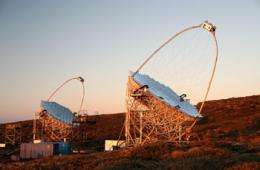
The 2 telescopes await the night: then astronomers can use MAGIC-I (left) and MAGIC-II (right) to observe the Universe stereoscopically. This will allow new possibilities for astrophysical research. Image: Max Planck Institute for Physics/R. Wagner

(PhysOrg.com) -- Together with the MAGIC-I telescope, MAGIC-2 allows stereoscopic observations using these two largest gamma-ray telescopes. Astronomers can explore sources of very-high energy gamma rays. The astrophysical study of particle acceleration processes in celestial objects could lead to fundamental insights into the dynamics of the so-called non-thermal Universe.

The MAGIC collaboration will celebrate the first light of their second MAGIC (Major Atmospheric Gamma-ray Imaging Cherenkov) on the Canary island of La Palma on 24 and 25 April 2009. The event will mark the completion of the second telescope and the startup of the second phase of the experiment, MAGIC-II.

The mission of MAGIC-II is to discover astrophysical sources of very-high energy gamma radiation. This radiation traces the most violent processes in the Universe, and originates from, e.g., supernova remnants, pulsars, and active galactic nuclei. Profiting from the excellent atmospheric conditions at the Roque de los Muchachos observatory at 2200 meters above sea level, the two MAGIC telescopes are able to detect the gamma rays through short, faint blue flashes of the so-called Cherenkov light, which are produced when gamma-rays enter the Earth’s atmosphere. With two 17-m diameter mirrors, the MAGIC telescopes are the largest Cherenkov gamma-ray telescopes in the world.

Already the first MAGIC telescope, in operation since 2004, could establish a wealth of outstanding results, including the detection of the two extremely distant gamma-ray emitting active galactic nuclei, and limits on the gamma-ray emission of the mysterious gamma-ray bursts. MAGIC also recently established pulsed very-high energy gamma-ray emission from the Crab pulsar.

To study very high energy gamma-rays with an even higher sensitivity and resolution, the MAGIC Collaboration began the construction of MAGIC-II in 2005. MAGIC-II is similarly constructed as the first MAGIC telescope. The new telescope consists of a tessellated mirror of 247 square meters. The mirrors are supported by a light-weight carbon fiber reinforced plastic tube structure. Together with a powerful drive system, this permits MAGIC-II to be directed in any direction of the sky within 40 seconds, allowing the fast follow-up of gamma-ray bursts. The telescopes are situated 85 meters apart, allowing them to be operated stereoscopically.

The scientists expect to find many more and exciting sources of gamma-radiation. Apart from studying the sources themselves, they will also be able to contribute to a deeper understanding of the evolution of the Universe, and to the advance of fundamental physics, by searches for Dark Matter or the existence of Quantum Gravity. First results of MAGIC-II are expected in the early summer 2009.

The MAGIC telescopes were built and are operated by a large international collaboration, currently including about 150 scientists from Germany, Italy, Spain, Switzerland, Poland, Finland, Croatia, Bulgaria and the United States of America.
They have shared the construction costs of approximately 4 million Euros. Besides the Max Planck Institute for Physics (Munich), which has a leading role in MAGIC, the Universities of Würzburg and Dortmund, and the Deutsches Elektronen-Synchrotron (Zeuthen) are further German partners.

The first light ceremony of MAGIC-II on La Palma will include a half-day scientific seminar on 24 April 2009 on the MAGIC Project. The ceremony at the MAGIC site will take place on 25 April 2009.

More information: MAGIC Collaboration: http://wwwmagic.mpp.mpg.de/

Provided by Max Planck Institute

4.5 /5 (2 votes)  

Rank 4.5 /5 (2 votes)
Related Stories
Relevant PhysicsForums posts
  • Never ending outer space.....
    createdFeb 11, 2012
  • Neutron Star fragments?
    createdFeb 11, 2012
  • stationary or not?
    createdFeb 11, 2012
  • Scale of the Universe
    createdFeb 10, 2012
  • Titan's lack of impact craters
    createdFeb 09, 2012
  • Real pictures of black hole eating a star?
    createdFeb 08, 2012
  • More from Physics Forums - General Astronomy

More news stories

Latin America mining boom clashes with conservation

Latin America is experiencing a mining boom as prices rise fuelled by a hike in global demand, but the region is also being hit by a wave of violent protests, strikes and rallies by environmentalists.

Space & Earth / Environment

created 20 hours ago | popularity 5 / 5 (1) | comments 1

Salvage workers begin pumping fuel from Italian shipwreck

Salvage workers Sunday began pumping fuel from the shipwrecked Italian cruise liner Costa Concordia, a day ahead of schedule, officials said.

Space & Earth / Environment

created 12 hours ago | popularity 5 / 5 (2) | comments 0

Political leaders play key role in how worried Americans are by climate change: study

More than extreme weather events and the work of scientists, it is national political leaders who influence how much Americans worry about the threat of climate change, new research finds.

Space & Earth / Environment

created Feb 06, 2012 | popularity 5 / 5 (8) | comments 75

NASA budget will axe Mars deal with Europe: scientists

US President Barack Obama's budget proposal to be submitted next week for 2013 will cut NASA's budget by 20 percent and eliminate a major partnership with Europe on Mars exploration, scientists said Thursday.

Space & Earth / Space Exploration

created Feb 10, 2012 | popularity 5 / 5 (4) | comments 58

Humans may have helped the decline of African rainforests 3000 years ago

(PhysOrg.com) -- Large areas of rainforests in Central Africa mysteriously disappeared over three thousand years ago, to be replaced by savannas. The prevailing theory has been that the cause was a change ...

Space & Earth / Environment

created Feb 10, 2012 | popularity 4.1 / 5 (14) | comments 21 | with audio podcast report


Scientists discover molecular secrets of 2,000-year-old Chinese herbal remedy

For roughly two thousand years, Chinese herbalists have treated Malaria using a root extract, commonly known as Chang Shan, from a type of hydrangea that grows in Tibet and Nepal. More recent studies suggest that halofuginone, ...

New method to examine batteries -- MRI from the inside

There is an ever-increasing need for advanced batteries for portable electronics, such as phones, cameras, and music players, but also to power electric vehicles and to facilitate the distribution and storage of energy derived ...

A mitosis mystery solved: How chromosomes align perfectly in a dividing cell

Although the process of mitotic cell division has been studied intensely for more than 50 years, Whitehead Institute researchers have only now solved the mystery of how cells correctly align their chromosomes during symmetric ...

Google might launch Drive for cloud storage soon

(PhysOrg.com) -- Google's next big move, according to the Wall Street Journal, is a cloud storage service called Drive. Hardly first to the plate, Google is simply catching up to introducing its cloud reposi ...

Lab study raises questions over nano-particle impact

Tests involving chickens have raised questions about the impact on health from engineered nano-particles, the ultra-fine grains commonly used in drugs and processed foods, scientists said on Sunday.

Starve a virus, feed a cure? Findings show how some cells protect themselves against HIV

A protein that protects some of our immune cells from the most common and virulent form of HIV works by starving the virus of the molecular building blocks that it needs to replicate, according to research published online ...