Honeybees not fooled by cheating flowers
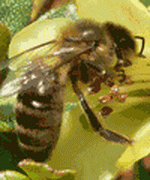
April 15, 2009 Honeybee

(PhysOrg.com) -- Flowers that want to cheat pollinators by not paying them for their services shouldn’t try to lure them in using floral scents, scientists at Newcastle University have shown.

Pollinators such as the honeybee are important to because they help to ensure that cross-fertilisation takes place, which is essential for plant sexual reproduction.

But producing nectar for pollinators is a costly business. Instead, some plants try to cheat a pollinator - enticing it to visit and then failing to pay for its services - and getting sexual reproduction for free.

New research, published today in the academic journal , shows if a honeybee is faced with two similar smelling plants it quickly learns which scent is associated with the ‘sweetest’ nectar and makes a beeline for it.

Led by Newcastle University’s Dr Jeri Wright, the study suggests that a bee’s ability to associate floral scent with the best nectar may be the key to understanding how floral scent has evolved in flowering plants.

Biologist Dr Wright explains: “Our research shows that because bees can learn about the signals associated with nectar quality they have the means of avoiding floral ‘cheaters’ , preferring instead to visit the floral scents they’ve learned to associate with profitable rewards.

“This ability to learn forces to be honest about the rewards they advertise and may even select for plants both with scented flowers and with high quality nectar because these plants out-compete others in a floral marketplace."

Plants advertise food rewards using colour, shape and scent as signals for enticing pollinators to visit them.

Nectar production uses vital energy and nutrients and some plants have learnt to falsely advertise the nectar they have on offer, enticing the pollinators to visit and then offering no payment - or poor payment - in return.

This latest research shows that floral signals associated with the best quality nectar cause to become biased towards these signals and steer away from flowers with poor quality nectar or no nectar at all.

Dr Wright said the research suggests that a bee’s ‘sweet-tooth’ is likely to be affecting the floral signals that plants use to advertise nectar.

“This is extremely important to the plants because it affects whether or not bees visit them and, therefore, whether or not plants sexually reproduce,” she explains.

More information: Reward quality influences the development of learned olfactory biases in honeybees Geraldine A. Wright*, Amir F. Choudhary, and Michael A. Bentley. Published in: Proceedings of the Royal Society B.

Provided by Newcastle University


print this article email this article download pdf blog this article bookmark this article     Stumble it Digg this share on Facebook retweet share on Reddit add to delicious
Rate this story - 3.3 /5 (3 votes)


April 15, 2009 all stories

Comments: 0

3.3 /5 (3 votes)
  • Stumble this up

  • Digg this

  • share this

  • hide
  • Related Stories

  • Detecting poisons in nectar is an odour-ous task for honeybees
    created Apr 01, 2007 | popularity not rated yet | comments 0
  • Nectar is not a simple soft drink
    created Feb 27, 2007 | popularity not rated yet | comments 0
  • Probing Question: Why are flowers beautiful?
    created Jan 24, 2008 | popularity not rated yet | comments 0
  • Fast learning bumblebees reap greater nectar rewards
    created Jan 16, 2008 | popularity not rated yet | comments 0
  • Bitter-tasting nectar and floral odors optimize outcrossing for plants
    created Aug 28, 2008 | popularity not rated yet | comments 0


  • hide
  • Relevant PhysicsForums posts

Other News

Scientists visualize how bacteria talk to one another

Scientists visualize how bacteria talk to one another

Biology / Cell & Microbiology

created 13 hours ago | popularity 4.9 / 5 (8) | comments 1

Using imaging mass spectrometry, researchers at the University of California, San Diego have developed tools that will enable scientists to visualize how different cell populations of cells communicate. Their ...


W. Africa's last giraffes make surprising comeback (AP)

W. Africa's last giraffes make surprising comeback

Biology / Ecology

created 21 hours ago | popularity not rated yet | comments 0

(AP) -- A crisp African dawn is breaking overhead, and Zibo Mounkaila is on the back of a pickup truck bounding across a sparse landscape of rocky orange soil.


W. Africa's last giraffes make surprising comeback (AP)

China sends panda expert to Taiwan to aid breeding

Biology / Plants & Animals

created 21 hours ago | popularity not rated yet | comments 0

(AP) -- Nothing like a little time apart to rekindle the affections that could lead to a baby panda.


Laser etching safe alternative for labeling grapefruit

Laser etching safe alternative for labeling grapefruit

Biology / Other

created Nov 03, 2009 | popularity 4.4 / 5 (14) | comments 8

Laser labeling of fruit and vegetables is a new, patented technology in which a low-energy carbon dioxide laser beam is used to label, or "etch" information on produce, thereby eliminating the need for common ...


Wolves, moose and biodiversity: An unexpected connection

Wolves, moose and biodiversity: An unexpected connection

Biology / Ecology

created Nov 02, 2009 | popularity 4.9 / 5 (7) | comments 4

Moose eat plants; wolves kill moose. What difference does this classic predator-prey interaction make to biodiversity?