Cool product: $20 artificial knee for patients in the developing world
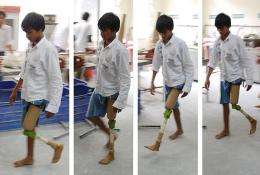
(PhysOrg.com) -- Last year Joel Sadler and his classmates faced a daunting challenge in their Biomedical Device Design and Evaluation course: Create a low-cost, high-performance prosthetic knee joint for amputees in the developing world. Dubbed the JaipurKnee Project, the team aimed to help rectify lives ravaged by war and diseases such as diabetes.
Over the course of a year, the team manufactured a prosthetic that cost only $20.
"I came in to Stanford really hungry to find projects like the JaipurKnee Project," said Sadler, now a lecturer and d'Arbeloff Fellow in the Hasso Plattner Institute of Design at Stanford. As a mechanical engineer, Sadler has made it his goal to bring technology to those in need. His project is named after the JaipurFoot prosthetics charity, a partner in the effort.
The JaipurKnee was on display recently at Stanford's annual Cool Product Expo, rubbing elbows with magnetic tool belts and humanoid robots. The event sparked the imaginations of an estimated 1,300 guests at the Arrillaga Alumni Center. Roughly a third of the 51 exhibitors had personal ties to Stanford.
The effects of the global financial crisis were not lost on event organizers. Rather than ignore the crisis, this year's expo tackled it, with the overarching theme of "Do More with Less." The sponsors—the Product Design and Manufacturing Club in the Graduate School of Business and the Product Realization Network—sought technology that is economically efficient and environmentally sustainable.
"We really want to focus on products that are being much more thoughtful and productive with the resources that we've got," said Erin Nixon, an officer of the design club. To that end, several Stanford alumni and current students participated in the expo with cheap technologies designed to serve basic needs in the developing world.
"I think it's a reflection of the concerns of the Stanford community," Nixon said. "It's not just about what you can buy in the stores here in the U.S., but how you can have an impact on people who need it."
Sadler, who earned his master's degree in mechanical engineering in January, brought the JaipurKnee project to the expo to inspire people who want to put their knowledge to good use in the world.
"We're doing magical things in these classes," Sadler said. The project's presence at the expo was "a callout to our students to be thinking in the mode of, 'What am I doing in my education? How can I apply this to what I want to do in my life?'"
Old models of low-cost knee joints used a single-axis joint, which rotated like a door hinge. They were unstable and unsafe for India's varied terrain; the joint tended to buckle under weight, which could be physically as well as psychologically painful for a freshly fitted amputee.
To build a better model, Sadler and his team studied the mechanics of high-end titanium knee joints in the United States, which cost from $10,000 to $100,000, he said. The team also surveyed the materials used to build cheap prosthetics for developing countries. Armed with this information, the team designed a versatile knee joint made from an oil-filled nylon polymer. The self-lubricating joint has greater flexibility, demonstrating a much higher performance. The team has fitted 43 of these joints to date in India, where the team is conducting field tests to improve their model. With a preliminary goal to mass-produce and distribute 100,000 joints in the next three years, Sadler said he expects the $20 production cost can be driven down further.
Some Stanford alumni are taking conscientious design to an entrepreneurial scale. Heather Fleming runs Catapult Design, a consulting firm that serves charitable projects in developing countries.
"Each of our clients pays for our services, but because we're a nonprofit, we can also apply for grants as well as accept donations," said Fleming, who graduated in 2002 with a bachelor's degree in product design. "All of those things help subsidize our rates."
Like Sadler, Fleming brought Catapult to the expo to show people how they can pursue engineering work through philanthropy. The team consists of engineers, educators and designers, including several Stanford graduates and one current student.
Catapult supports the design and marketing of affordable products for everyday needs, such as water filtration and power generation. Catapult emphasizes the use (and reuse) of local resources and design concepts instead of creating new technology from scratch. This approach makes products cheaper and more acceptable from a cultural perspective, Fleming said.
One current project for Catapult is the design of compact vertical-axis wind turbines. The turbines are meant to power small appliances, such as lights and cell phones, in rural households in Guatemala. Because they are manufactured locally with cheap materials, the current prototypes are more affordable, at $100, than similar American turbines, which sell for $250, Fleming said.
Nixon, the design club officer, deems this year's expo a huge success; she's already looking ahead to next year's expo, but with hope that the global market will be more accommodating.
"I'm hoping that environmental efficiency is something that we will always care about, but I'm also hoping that next year, we won't be in this recession," she said. "Maybe we can also look more toward expansion and innovation instead of just productivity and efficiency."
Provided by Stanford University (news : web)


