Chemists synthesize herbal alkaloid
April 15, 2009
Chemists synthesize herbal alkaloid

Enlarge

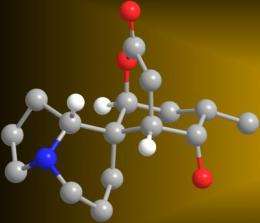
A 3-D model of the alkaloid serratezomine A shows the molecule's complex ring structure. Credit: Johnston Group

The club moss Lycopodium serratum is a creeping, flowerless plant used in homeopathic medicine to treat a wide variety of ailments. It contains a potent brew of alkaloids that have attracted considerable scientific and medical interest. However, the plant makes many of these compounds in extremely low amounts, hindering efforts to test their therapeutic value.

That is no longer a problem for what is arguably the most complex of these alkaloids, a compound called Serratezomine A: an alkaloid that could have anti-cancer properties and may combat memory loss. A team of synthetic chemists at Vanderbilt University report in the March 18 issue of the that they have created an efficient way to make this molecule from scratch.

It took six years to develop the process because the researchers had to invent some entirely new chemical methods to complete the synthesis. These methods should make it easier to synthesize other Lycopodium alkaloids as well as other natural compounds with therapeutic potential.

In addition to their therapeutic possibilities, the Vanderbilt chemists were attracted to these compounds because they are among the most intricately structured and functionally dense of all the small molecules produced by . The compounds consist of carbon and nitrogen atoms assembled in unique ring structures.

"This was a challenging problem," says Professor of Chemistry Jeffrey Johnston, who led the research effort. 'It takes years to develop a new chemical reaction and then apply it to the natural product target. So, once we start, we don't stop."

In the world of total synthesis chemistry, it is not enough to figure out a way to synthesize a naturally occurring molecule. The process has to produce large enough quantities of the molecule that it can be tested for biological activity. That means that the number of sequential steps in the process - what chemists refer to as the longest linear sequence - should be as small as possible to maximize production. For example, if a sequence has 30 steps and each step has an 80 percent yield, the overall yield of the sequence is about one-tenth of a percent. At the same time, one low-yield step will knock a process out of contention.

The longest linear sequence in the Serratezomine A synthesis is 15 steps and it has an overall yield of 1.7 percent, Johnston says. That is an average yield of 77 percent per step. The chemists kept the sequence this short by using a strategy called convergence. They prepared one of the key fragments in the synthesis in parallel to the main sequence.

Johnston has handed over the Serratezomine A that his group has produced to Vanderbilt's drug discovery program, which identifies novel agents suitable for preclinical testing, in order to evaluate its therapeutic value.

Source: Vanderbilt University (news : web)

4.8 /5 (5 votes)  

Rank 4.8 /5 (5 votes)
Relevant PhysicsForums posts
  • Stoichiometry
    created22 hours ago
  • Boiling and melting point of impure substances
    created23 hours ago
  • Safe nitrogen compound to decompose a 500 deg C in a furnace?
    createdFeb 09, 2012
  • [ask]electron inside drinking water
    createdFeb 08, 2012
  • How to avoid formation of Lithium Chromate ???
    createdFeb 08, 2012
  • how to choose a reduced or oxidated form in a redox
    createdFeb 08, 2012
  • More from Physics Forums - Chemistry

More news stories

Fool's gold may prove an unlikely alternative to overexploited catalytic materials

Catalytic materials, which lower the energy barriers for chemical reactions, are used in everything from the commercial production of chemicals to catalytic converters in car engines. However, with current catalytic materials ...

Chemistry / Materials Science

created 13 hours ago | popularity 4.3 / 5 (7) | comments 5 | with audio podcast

Unpicking HIV’s invisibility cloak

Drug researchers hunting for alternative ways to treat human immunodeficiency virus (HIV) infections may soon have a novel target—its camouflage coat. HIV hides inside a cloak unusually rich in a sugar ...

Chemistry / Biochemistry

created 13 hours ago | popularity 5 / 5 (4) | comments 0

No entry without protein recycling: Researchers discover new coherence in enzyme transport

The group of Prof. Dr. Ralf Erdmann at the Ruhr-Universität Bochum, Germany, discovered a connection of peroxisomal protein import and receptor export. In the Journal of Biological Chemistry, they disclo ...

Chemistry / Biochemistry

created 13 hours ago | popularity not rated yet | comments 0

Hydrogen from acidic water: Researchers develop potential low cost alternative to platinum for splitting water

A technique for creating a new molecule that structurally and chemically replicates the active part of the widely used industrial catalyst molybdenite has been developed by researchers with the Lawrence Berkeley ...

Chemistry / Materials Science

created Feb 09, 2012 | popularity 5 / 5 (12) | comments 13 | with audio podcast

Under the microscope #7

In this video Dr Ingrid Graz shows us a thin layer of gold on top of rubber. Cracks in the gold allow it to stretch and we can use this for stretchable electronics.

Chemistry / Other

created 15 hours ago | popularity not rated yet | comments 0


Anonymous knocks CIA website offline (Update)

The website of the Central Intelligence Agency was inaccessible on Friday after the hacker group Anonymous claimed to have knocked it offline.

Google users warned of threat to smartphone wallets

Users of Google smartphone wallets were being warned on Friday that there is a way to crack pass codes intended to thwart thieves from going on illicit shopping sprees.

New error-correcting codes guarantee the fastest possible rate of data transmission

Error-correcting codes are one of the triumphs of the digital age. They’re a way of encoding information so that it can be transmitted across a communication channel — such as an optical fiber o ...

Humans may have helped the decline of African rainforests 3000 years ago

(PhysOrg.com) -- Large areas of rainforests in Central Africa mysteriously disappeared over three thousand years ago, to be replaced by savannas. The prevailing theory has been that the cause was a change ...

Complex wiring of the nervous system may rely on a just a handful of genes and proteins

Researchers at the Salk Institute have discovered a startling feature of early brain development that helps to explain how complex neuron wiring patterns are programmed using just a handful of critical genes. ...

The power of estrogen -- male snakes attract other males

A new study has shown that boosting the estrogen levels of male garter snakes causes them to secrete the same pheromones that females use to attract suitors, and turned the males into just about the sexiest ...