Astronomers find most crowded collision of galaxy clusters
April 16, 2009
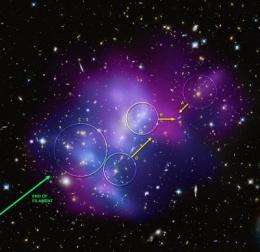
A labeled version of the MACSJ0717 image shows the galaxies in the four different clusters -- identified by the letters "A," "B," "C," and "D" -- involved in the collision, plus the direction of motion for the three fastest moving clusters. The length of the arrow shows the approximate speed in a direction perpendicular to the line of sight. Note that the direction of motion of the clusters is roughly parallel to the direction of the filament. Data from Keck Observatory was used to derive the speed of the clusters along the line of sight, allowing the three-dimensional geometry and dynamics of MACSJ0717 to be derived. The cooler (redder) region of gas towards the lower left of the cluster labeled "D" has likely survived from before the collision. Cluster A is likely falling back into the main cluster after already having passed through once in the opposite direction. Both of these clusters probably originated from the filament. Cluster B, however, has a much higher speed than the other clusters along the line of sight and its origin is unclear. It may have fallen along the outer edge of the filament, causing its infall trajectory to curve, or it may be falling in along another, smaller filament. The good alignment between the galaxies and hot gas for cluster C. along with its motion compared to MACSJ0717 as a whole makes this system a good candidate for the core of the main cluster. The large region of relatively hot gas (shown in blue) that extends from the left side of cluster C to the right side of region D may be caused by heating as significant quantities of gas from the filament plough into the main cluster. Credit: X-ray: NASA/CXC/IfA/C. Ma et al. Optical: NASA/STScI/IfA/C. Ma et al.
The most crowded collision of galaxy clusters has been identified by combining information from three different telescopes. This result gives scientists a chance to learn what happens when some of the largest objects in the Universe go at each other in a cosmic free-for-all.
Using data from NASA's Chandra X-ray Observatory, Hubble Space Telescope and the Keck Observatory on Mauna Kea, Hawaii, astronomers were able to determine the three-dimensional geometry and motion in the system MACSJ0717.5+3745 (or MACSJ0717 for short) located about 5.4 billion light years from Earth.
The researchers found that four separate galaxy clusters are involved in a triple merger, the first time such a phenomenon has been documented. Galaxy clusters are the largest objects bound by gravity in the Universe.
In MACSJ0717, a 13-million-light-year-long stream of galaxies, gas and dark matter - known as a filament - is pouring into a region already full of galaxies. Like a freeway of cars emptying into a full parking lot, this flow of galaxies has caused one collision after another.
"In addition to this enormous pileup, MACSJ0717 is also remarkable because of its temperature," said Cheng-Jiun Ma of the University of Hawaii and lead author of the study. "Since each of these collisions releases energy in the form of heat, MACS0717 has one of the highest temperatures ever seen in such a system."
While the filament leading into MACJ0717 had been previously discovered, these results show for the first time that it was the source of this galactic pummeling. The evidence is two-fold. First, by comparing the position of the gas and clusters of galaxies, the researchers tracked the direction of clusters' motions, which matched the orientation of the filament in most cases. Secondly, the largest hot region in MACSJ0717 is where the filament intersects the cluster, suggesting ongoing impacts.
"MACSJ0717 shows how giant galaxy clusters interact with their environment on scales of many millions of light years," said team member Harald Ebeling, also from University of Hawaii. "This is a wonderful system for studying how clusters grow as material falls into them along filaments."
Computer simulations show that the most massive galaxy clusters should grow in regions where large-scale filaments of intergalactic gas, galaxies, and dark matter intersect, and material falls inward along the filaments.
"It's exciting that the data we get from MACSJ0717 appear to beautifully match the scenario depicted in the simulations," said Ma.
Multiwavelength data were crucial for this work. The optical data from Hubble and Keck give information about the motion and density of galaxies along the line of sight, but not about their course perpendicular to that direction. By combining the X-ray and optical data, scientists were able to determine the three-dimensional geometry and motion in the system.
In the future, Ma and his team hope to use even deeper X-ray data to measure the temperature of gas over the full 13-million-light-year extent of the filament. Much remains to be learned about the properties of hot gas in filaments and whether its infall along these structures can significantly heat the gas in clusters over large scales.
"This is the most spectacular and most disturbed cluster I have ever seen," says Ma, "and we think that we can learn a whole lot more from it about how structure in our Universe grows and evolves."
-
Motions in nearby galaxy cluster reveal presence of hidden superstructure
Sep 10, 2004 |
not rated yet |
0
-
Dark matter mystery deepens in cosmic 'train wreck'
Aug 16, 2007 |
not rated yet |
0
-
A Matter of Fact: NASA Finds Direct Proof of Dark Matter
Aug 21, 2006 |
not rated yet |
0
-
Chandra catches 'piranha' black holes
Jul 24, 2007 |
not rated yet |
0
-
Survey Reveals Building Block Process For Biggest Galaxies
Apr 12, 2006 |
not rated yet |
0
-
Engineers build first sub-10-nm carbon nanotube transistor
Feb 01, 2012 |
4.9 / 5 (31) |
30
-
Something old, something new: Evolution and the structural divergence of duplicate genes
Jan 31, 2012 |
4.6 / 5 (7) |
1
-
The hidden nanoworld of ice crystals: Revealing the dynamic behavior of quasi-liquid layers
Jan 30, 2012 |
5 / 5 (3) |
1
-
Stock market network reveals investor clustering
Jan 27, 2012 |
3.9 / 5 (23) |
8
-
Of microchemistry and molecules: Electronic microfluidic device synthesizes biocompatible probes
Jan 26, 2012 |
5 / 5 (1) |
0
-
Never ending outer space.....
15 hours ago
-
Neutron Star fragments?
17 hours ago
-
stationary or not?
21 hours ago
-
Scale of the Universe
Feb 10, 2012
-
Titan's lack of impact craters
Feb 09, 2012
-
Real pictures of black hole eating a star?
Feb 08, 2012
- More from Physics Forums - General Astronomy
More news stories
Salvage workers begin pumping fuel from Italian shipwreck
Salvage workers Sunday began pumping fuel from the shipwrecked Italian cruise liner Costa Concordia, a day ahead of schedule, officials said.
2 minutes ago |
not rated yet |
0
Latin America mining boom clashes with conservation
Latin America is experiencing a mining boom as prices rise fuelled by a hike in global demand, but the region is also being hit by a wave of violent protests, strikes and rallies by environmentalists.
8 hours ago |
not rated yet |
0
Political leaders play key role in how worried Americans are by climate change: study
More than extreme weather events and the work of scientists, it is national political leaders who influence how much Americans worry about the threat of climate change, new research finds.
Feb 06, 2012 |
5 / 5 (6) |
73
NASA budget will axe Mars deal with Europe: scientists
US President Barack Obama's budget proposal to be submitted next week for 2013 will cut NASA's budget by 20 percent and eliminate a major partnership with Europe on Mars exploration, scientists said Thursday.
Space & Earth / Space Exploration
Feb 10, 2012 |
5 / 5 (3) |
55
Humans may have helped the decline of African rainforests 3000 years ago
(PhysOrg.com) -- Large areas of rainforests in Central Africa mysteriously disappeared over three thousand years ago, to be replaced by savannas. The prevailing theory has been that the cause was a change ...
Scientists discover molecular secrets of 2,000-year-old Chinese herbal remedy
For roughly two thousand years, Chinese herbalists have treated Malaria using a root extract, commonly known as Chang Shan, from a type of hydrangea that grows in Tibet and Nepal. More recent studies suggest that halofuginone, ...
New method to examine batteries -- MRI from the inside
There is an ever-increasing need for advanced batteries for portable electronics, such as phones, cameras, and music players, but also to power electric vehicles and to facilitate the distribution and storage of energy derived ...
A mitosis mystery solved: How chromosomes align perfectly in a dividing cell
Although the process of mitotic cell division has been studied intensely for more than 50 years, Whitehead Institute researchers have only now solved the mystery of how cells correctly align their chromosomes during symmetric ...
Starve a virus, feed a cure? Findings show how some cells protect themselves against HIV
A protein that protects some of our immune cells from the most common and virulent form of HIV works by starving the virus of the molecular building blocks that it needs to replicate, according to research published online ...
Researchers find extensive RNA editing in human transcriptome
In a new study published online in Nature Biotechnology, researchers from BGI, the world's largest genomics organization, reported the evidence of extensive RNA editing in a human cell line by analysis of RNA-seq data, demons ...
The proteins ensuring genome protection
Researchers from the University of Geneva (UNIGE), Switzerland, have discovered the crucial role of two proteins in developing a cell 'anti-enzyme shield'. This protection system, which operates at the level of molecular ...
Apr 16, 2009
Rank: not rated yet
if singel clusters, i had a few triple mergers on galaxyzoo that i classified (out of 17000 )...so not a first by any means...
Apr 16, 2009
Rank: 1 / 5 (1)
a.) Is the cosmos coalescing?
b.) Or is the cosmos fragmenting?
It seems that b.) may be the correct answer, although a.) might be expected to follow if a Big Bang first filled the cosmos with Hydrogen.
With kind regards,
Oliver K. Manuel
http://myprofile....anuelo09
Apr 16, 2009
Rank: 5 / 5 (1)
Apr 16, 2009
Rank: 5 / 5 (1)
Apr 17, 2009
Rank: 1 / 5 (1)
If on the other hand, the universe is not expanding and is infinite, then colliding galaxies is no great problem.
I have put my dots on the balloon and blown into it. No matter how many times I did that, I did not get any of my dots to collide.
Apr 17, 2009
Rank: not rated yet
Consider tying knots in the surface of the balloon. While at first, the knots may move away from each other, at some point they will begin to move closer to each other as the unknotted areas of the balloon expand easier, faster, and more readily than the knotted areas. And remember, in reality the knots would be accelerating in increasing density.
Apr 18, 2009
Rank: not rated yet
I like earls example too...and his is easier and cheaper :)