Scientists using Second Life island to help high school students learn earth science
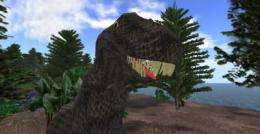
A mysterious island that moves through time. Travelers in search of answers. It sounds something like the science fiction television show "Lost," but it also describes a new approach to teaching earth sciences to high school students.
Iris Totten, an associate professor of geology at Kansas State University, and Molly Davies, an associate professor of geology at University of Missouri at Kansas City, designed TerraWorld, an island in Second Life, to help students learn geology in an interactive way. It is part of the larger GeoWorlds project.
"In geology, the only way we can talk about past times is to look at the fossil record," Totten said. "So this tool is especially useful. Through their avatars, the students can see that the biota are different and know that they're in a different geologic time period. They may see flying pterodactyls. They can click on different organisms and bring up more information about them. They can watch videos from the Chicago Field Museum, the Discovery Channel or National Geographic."
Totten and Davies are working with Stacey Fox, a visiting assistant professor of art at the University of Kansas. Initial parts of the project included involvement from iVersity, a company that designs virtual worlds.
Totten and collaborators received a $700,000 grant from the Ewing Marion Kauffman Foundation to study the impact that TerraWorld and the coming WaterWorld have on student learning and attitudes about science. The programs are being piloted at Tolbert and Brookside charter high schools in Kansas City, Mo. In the fall, about 400 ninth-grade students at Junction City High School will start using the program.
Creating TerraWorld meant that Totten had to do in-depth research about the types of animals and plants that existed in each geologic time period. Using a computer-sculpting program, Fox brought the plants and animals to life. Totten and Davies provide the content and design, and Fox assembles the worlds.
To get the students to explore the worlds through their avatars, they complete quests and scavenger hunts. The program is paperless. If there is an assignment students need to turn in, they can put it on a note card in Second Life and drop it in a box, where it goes to the instructor's management system on the GeoWorld's Web site. Teachers can assess all of their student's assignments on the Web site.
The avatars' locations on the island are monitored, which lets the teacher see if students are exploring the worlds and will help the designers make the island more efficient.
The designers also are developing two artificial intelligence bots that will help students answer questions and help them with the scavenger hunts. The bots will be able to learn from each question they are asked and will recognize if a similar question is repeated. Totten said the bots will look like young female geologists and serve as science role models for young women.
"We talked about having Darwin, but we decided that was something we as scientists would want to see, not high school kids," Totten said.
Totten has presented the work at Tulane University, the International Conference on Digital Game and Intelligent Toy Enhanced Learning, and the Education Grantmakers Conference.
She said that Second Life is being used to teach other science disciplines like genetics, by using virtual fruit flies, and chemistry, by showing lab experiments such as the Redi Experiment that are not easily done in the high school classroom.
Second Life has a special role to teach geology to students on the Great Plains, Totten said.
"Living in the Midwest, we don't have a lot of geologic structures that show any kind of deformation," she said. "You have two-dimensional images online, but Second Life is a great option."
Source: Kansas State University (news : web)


