Scorpion venom with nanoparticles slows spread of brain cancer
April 16, 2009 Scorpion venom with nanoparticles slows spread of brain cancer

Enlarge

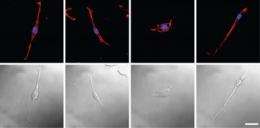
Tumor cells treated with nanoparticles plus chlorotoxin were the only ones unable to elongate and slip through the body, as shown in the third column. The other columns show cancer cells that are: untreated; treated with chlorotoxin alone; and treated with nanoparticles alone. (The upper and lower rows use different types of imaging.) Credit: University of Washington

By combining nanoparticles with a scorpion venom compound already being investigated for treating brain cancer, University of Washington researchers found they could cut the spread of cancerous cells by 98 percent, compared to 45 percent for the scorpion venom alone.

"People talk about the treatment being more effective with but they don't know how much, maybe 5 percent or 10 percent," said Miqin Zhang, professor of materials science and engineering. "This was quite a surprise to us." She is lead author of a study recently published in the journal Small.

For more than a decade scientists have looked at using chlorotoxin, a small peptide isolated from scorpion venom, to target and treat cancer cells.

Chlorotoxin binds to a surface protein overexpressed by many types of tumors, including brain cancer. Previous research by Zhang's group combined chlorotoxin with nanometer-scale particles of , which fluoresce at that size, for both magnetic resonance and optical imaging.

Chlorotoxin also disrupts the spread of invasive tumors - specifically, it slows , the ability of the cancerous cell to penetrate the protective matrix surrounding the cell and travel to a different area of the body to start a new cancer. The MMP-2 on the cell's surface, which is the for chlorotoxin, is hyperactive in highly invasive tumors such as brain cancer. Researchers believe MMP-2 helps the cancerous cell break through the protective matrix to invade new regions of the body. But when chlorotoxin binds to MMP-2, both get drawn into the cancerous cell.

Other researchers are currently conducting human trials using chlorotoxin to slow cancer's spread.

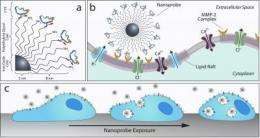
Zhang's group investigated chlorotoxin action when it is attached to nanoparticles and found the resultant complex doubles the therapy's effect compared to chlorotoxin alone. Adding nanoparticles often improves a therapy, partly because the combination lasts longer in the body and so has a better chance of reaching the tumor. Combining also boosts the effect because therapeutic molecules clump around each nanoparticle. In the newly published study an average of 10 chlorotoxin molecules were attached to each nanoparticle. Each clump thus offers many therapeutic molecules that can simultaneously latch on to many MMP-2 proteins.
Scorpion venom with nanoparticles slows spread of brain cancer
Enlarge

In a, chlorotoxin molecules, colored blue and green, attach themselves to a central nanoparticle. In b, each nanoprobe offers many chlorotoxin molecules that can simultaneously latch on to many MMP-2s, depicted here in yellow, which are thought to help tumor cells travel through the body. In c, over time nanoprobes draw more and more of the MMP-2 surface proteins into the cell, slowing the tumor's spread. Credit: University of Washington

Experiments were performed using mouse brain-cancer cells that were grown in the lab. The imaging results confirm that adding nanoparticles means more of the MMP-2 ends up safely tucked away inside the cell, thus preventing MMP-2 from helping the cancer spread.

Further images showed that the cells containing nanoparticles plus chlorotoxin were unable to elongate, whereas cells containing only nanoparticles or only chlorotoxin could stretch out. This suggests that the nanoparticle-plus-chlorotoxin disabled the machinery on the cell's surface that allows cells to change shape, yet another step required for a tumor cell to slip through the body.

"We hypothesized the mechanism and we have all the data to prove our hypothesis," Zhang said. Further experiments will involve testing on mice.

So far most cancer research has combined nanoparticles either with chemotherapy that kills cancer cells, or therapy seeking to disrupt the genetic activity of a cancerous cell. This is the first time that nanoparticles have been combined with a therapy that physically stops cancer's spread.

Slowing the spread of cancer would be especially useful for treating highly invasive tumors such as . MMP-2 also shows signs of being overactive in cancers of the breast, colon, skin, lung, prostate and ovaries, and researchers believe that the technique could slow the spread of these other tumors.

Source: University of Washington (news : web)


print this article email this article download pdf blog this article bookmark this article     Stumble it Digg this share on Facebook retweet share on Reddit add to delicious
Rate this story - 4.6 /5 (10 votes)

Rank Filter

Move the slider to adjust rank threshold, so that you can hide some of the comments.


Display comments: newest first

  • weewilly - Apr 16, 2009
    • Rank: 5 / 5 (1)
    How much do these little creatures sell for in research dollars? We have plenty of them were I live and we have to spray all the time to kill off their food supplies and hopefully they will then leave and go back to the desert from whence they came. Hope this works for medical science. It could help a lot of people. I've worked with kids who had brain cancer and it tears your heart out.
  • E_L_Earnhardt - Apr 17, 2009
    • Rank: 1 / 5 (4)
    "Toxin, toxin"! Get OFF the killing spree! Cancer is a MALFUNCTION producing accelerated mitosis. It could be as simple as "OVERHEATING". We already know "COOLING" can slow, or stop the process. This should lead to ELECTRONIC causes! HELLO, HELLO!
  • Fakeer - Apr 17, 2009
    • Rank: 5 / 5 (2)
    The previous reader either did not read the article or derailed just on seeing the word 'toxin'. Toxins are not equivalent as chemicals used in chemotherapy. The venom derivative is doing quite the opposite of mass killing of cells. They are saying that it blocks the surface proteins that signal overactive cell division and thus rendering the tumor less aggressive. This is definitely a significant finding while also illustrating the ever-widening applications of scorpion venom.

April 16, 2009 all stories

Comments: 3

4.6 /5 (10 votes)
  • Stumble this up

  • Digg this

  • share this

  • hide
  • Related Stories

  • Nanotechnology Advances Brain Cancer Detection and Therapy
    created Feb 15, 2008 | popularity not rated yet | comments 0
  • Iron oxide nanoparticles may help detect, treat tumors
    created May 01, 2006 | popularity not rated yet | comments 0
  • Study provides clues to prevent spread of ovarian cancer
    created Mar 13, 2008 | popularity not rated yet | comments 0
  • Multifunctional Nanoparticles Image and Treat Brain Tumors
    created Dec 04, 2006 | popularity not rated yet | comments 0
  • RNA interference toward MMP-2 may be an effective therapeutic strategy for cancer
    created Mar 09, 2009 | popularity not rated yet | comments 0


  • hide
  • Relevant PhysicsForums posts

Other News

Findings show nanomedicine promising for treating spinal cord injuries

Findings show nanomedicine promising for treating spinal cord injuries

Nanotechnology / Bio & Medicine

created 16 hours ago | popularity 4.5 / 5 (4) | comments 0

(PhysOrg.com) -- Researchers at Purdue University have discovered a new approach for repairing damaged nerve fibers in spinal cord injuries using nano-spheres that could be injected into the blood shortly ...


New Digital 'Electronics' Concept May Continue Moore's Law

New Digital 'Electronics' Concept May Continue Moore's Law

Nanotechnology / Nanophysics

created Nov 05, 2009 | popularity 4.6 / 5 (55) | comments 9

(PhysOrg.com) -- Computers of the future could be operating not on electrons, but on tiny waves traveling through an electron "fluid," if a new proposal is successful. The new circuit design, recently introduced ...


Nanoparticles for gene therapy improve

Nanoparticles for gene therapy improve

Nanotechnology / Bio & Medicine

created Nov 06, 2009 | popularity 5 / 5 (4) | comments 3

(PhysOrg.com) -- About five years ago, Professor Janet Sawicki at the Lankenau Institute in Pennsylvania read an article about nanoparticles developed by MIT's Robert Langer for gene therapy, the insertion ...


Breakthrough in industrial-scale nanotube processing

Breakthrough in industrial-scale nanotube processing

Nanotechnology / Nanomaterials

created Nov 02, 2009 | popularity 4.9 / 5 (20) | comments 3

(PhysOrg.com) -- Rice University scientists today unveiled a method for the industrial-scale processing of pure carbon-nanotube fibers that could lead to revolutionary advances in materials science, power ...


Scientists witness nature's complexity unfold in self-assembling quasicrystals

Scientists witness nature's complexity unfold in self-assembling quasicrystals

Nanotechnology / Nanomaterials

created Oct 31, 2009 | popularity 4.9 / 5 (17) | comments 3

(PhysOrg.com) -- Just a few decades ago, scientists believed that all ordered matter consists of self-repeating building blocks -- atoms, ions or molecules. In this view, the ordinary solids of everyday life ...