Shedding some light on Parkinson's treatment
April 16, 2009 Shedding some light on Parkinson's treatment

Enlarge

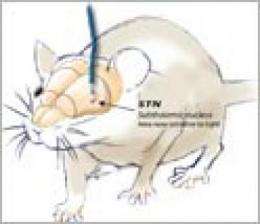
Optogenetics helps identify cellular targets of deep brain stimulation. Credit: Zina Deretsky, National Science Foundation

A research team lead by Karl Deisseroth in the bioengineering department at Stanford University has developed a technique to systematically characterize disease circuits in the brain. By precisely controlling individual components of the circuit implicated in Parkinson's disease, the team has identified a specific group of cells as direct targets of deep brain stimulation (DBS), a Parkinson's treatment.

Termed optogenetics, the NSF-funded technology uses light-activated proteins, originally isolated from , in combination with genetic approaches to control specific parts of the brain. The technique is a vast improvement over previous methods because it allows researchers to precisely stimulate neurons and measure the effect of treatment simultaneously in animals with Parkinson's-like symptoms.

Published in the April 17 issue of Science, Deisseroth's team found they could reduce disease symptoms by preferentially activating neurons that link to the region of the brain. First, these specific cells were treated in a way that made them sensitive to stimulation by blue light, then the team implanted an in the brain.

When researchers rapidly flashed blue light inside the animals' brains the disease symptoms improved. In contrast, treating with slower flashes of light actually made the symptoms worse, and targeting other kinds of cells had no effect at all, indicating both proper cell type and stimulation frequency are crucial components of effective treatment. Flashing blue light on portions of the same neurons found closer to the outer surface of the brain had an effect similar to treatment deep within the brain, raising the possibility that researchers may be able to develop treatments that are less invasive than current options.

Approved as a medical treatment in 1997, DBS remains controversial because it doesn't work on all patients. Used to treat Parkinson's disease, depression and movement disorders, DBS involves surgical implantation of a brain pacemaker, which sends electrical impulses into the brain. In the past, researchers have been unable to understand the effective mechanism of DBS because the electrical signal emitted by DBS devices interferes with the ability to observe brain activity.

Explains Deisseroth, "The brain is an electrical device, but it is a very complicated device. Think of it as an orchestra without sections: all of the types of instruments, or cells, are mixed together. Treatments like DBS are unrefined, in that they stimulate all of the cells or instruments. The optogenetic approach allows us to control stimulation of specific cells in the brain on the appropriate timescale, much like a conductor directing specific sections of an orchestra at the appropriate time."

Production of new therapies is always a long-term goal, but for now Deisseroth and his group are focused on mapping disease circuits and understanding function. "We need to understand the players before we can develop effective treatment strategies," he stated.

Source: National Science Foundation (news : web)


print this article email this article download pdf blog this article bookmark this article     Stumble it Digg this share on Facebook retweet share on Reddit add to delicious
Rate this story - 5 /5 (2 votes)

Rank Filter

Move the slider to adjust rank threshold, so that you can hide some of the comments.


Display comments: newest first

  • E_L_Earnhardt - Apr 17, 2009
    • Rank: 1 / 5 (1)
    "UNDERSTANDING" is, indeed, the key. No computer known can compare with the human brain! We must learn to request "self-analysis" and how to "read"
    its reply!

April 16, 2009 all stories

Comments: 1

5 /5 (2 votes)
  • Stumble this up

  • Digg this

  • share this

  • hide
  • Related Stories


  • hide
  • Relevant PhysicsForums posts

  • How to prevent another stroke?
    created Nov 11, 2009
  • Swine flu vaccination
    created Nov 10, 2009
  • Improving the brain through chemistry
    created Nov 07, 2009
  • Sleep / REM Sleep and homeostasis
    created Nov 07, 2009
  • More from Physics Forums - Medical Sciences

Other News

Largest gene study of childhood IBD identifies 5 new genes

Medicine & Health / Genetics

created 5 hours ago | popularity not rated yet | comments 0

In the largest, most comprehensive genetic analysis of childhood-onset inflammatory bowel disease (IBD), an international research team has identified five new gene regions, including one involved in a biological pathway ...


Researchers find potential treatment for Huntington's disease (w/ Video)

Medicine & Health / Research

created 5 hours ago | popularity not rated yet | comments 0

Investigators at Burnham Institute for Medical Research, the University of British Columbia's Centre for Molecular Medicine and Therapeutics and the University of California, San Diego have found that normal synaptic activity ...


Heart and bone damage from low vitamin D tied to declines in sex hormones

Medicine & Health / Research

created 4 hours ago | popularity not rated yet | comments 0

Researchers at Johns Hopkins are reporting what is believed to be the first conclusive evidence in men that the long-term ill effects of vitamin D deficiency are amplified by lower levels of the key sex hormone estrogen, ...


Young athletes need dual screening tests for heart defects, study suggests

Medicine & Health / Health

created 5 hours ago | popularity not rated yet | comments 0

To best detect early signs of life-threatening heart defects in young athletes, screening programs should include both popular diagnostic tests, not just one of them, according to new research from heart experts at Johns ...


Postmortem genetic tests after sudden death may provide less expensive way to identify risk

Medicine & Health / Research

created 5 hours ago | popularity not rated yet | comments 0

Targeted postmortem testing to identify genetic mutations associated with sudden unexplained death (SUD) is an effective and less expensive way to determine risk to relatives than comprehensive cardiac testing of first degree ...