A step closer to an ultra precise atomic clock
April 16, 2009 A step closer to an ultra precise atomic clock

Enlarge

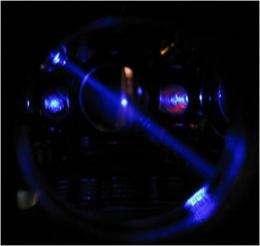
These are ultracold strontium atoms. Credit: University of Colorado

A clock that is so precise that it loses only a second every 300 million years - this is the result of new research in ultra cold atoms. The international collaboration is comprised of researchers from the University of Colorado, USA and the Niels Bohr Institute at the University of Copenhagen and the results have just been published in the prestigious scientific journal, Science.

An atomic clock consists of gas atoms captured in a magnetic field where they are held stationary with precise and are cooled down to near absolute zero, minus 273 degrees Celsius. In this state the researchers can use the quantum properties of the atoms and get them to function as a clock movement with a pendulum.

"An atom consists of a nucleus and some electrons that spin in clearly defined orbits around the nucleus. By using the focused laser light one can make the electron swing back and forth in a clearly defined way between these orbits, and it is that which forms the pendulum in the atomic clock", explains nuclear physicist at the Niels Bohr Institute at the University of Copenhagen, Jan W. Thomsen, who has worked with the new experiments together with researchers at the University of Colorado in Boulder, USA.
A step closer to an ultra precise atomic clock
Enlarge

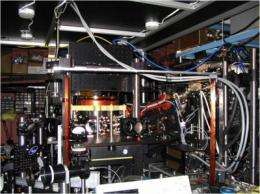
This is a strontium atomic clock operating at JILA, University of Colorado. Laser light is used to cool and manipulate the atoms for optimal operation of the clock. Carefully designed magnetic field coils compensate for the Earth magnetic field. Credit: University of Colorado

Disobedient atoms

Atomic clocks are not really anything new and are already used to make the most precise calculations in physics. But there was something the researchers did not understand, that they ran into a barrier in their endeavours to make the atomic clock even more precise. They could not get the precision better than the loss of one second every 150 million years.

"The problem was that the atoms did not behave as they should according to the theory of ", tells Jan W. Thomsen and explains, that atoms have two fundamental states - they either rotate a complete revolution around themselves and are then called bosons or they rotate half-integers (½ or 1½) around themselves and are then called fermions. These two types behave completely differently. The bosons clump tightly together, while the fermions are repelled by each other and it is impossible to get them near to each other.

Journey into the quantum world

For atomic clocks one uses fermions because they do not interact - according to the theory of physics of . Yet they did, as it turned out. And what was the reason? The researchers wanted to find out what was really happening and they started a colossal series of time consuming experiments that have given a whole new insight into how cold atoms behave.

"It was an fascinating journey into the world of quantum mechanics. We found out that not all fermions were the same. At the very low temperatures the fermions begin to 'see' each other and interact and then the atomic clock begins to go awry", explains Jan W. Thomsen. The experiments showed that the fermion's quantum properties were being affected by the exposure to light itself and this lead to the loss of precision in the atomic clock. By tuning the light frequency in a certain way one could control the fermions and avoid the loss of precision.

Great potential

The result is that an atomic clock is now three times more precise than before and that the clock now loses only one second per 300 million years as opposed to one second per 150 million years. Even though it is only small fraction of a second, it has great potential in the application in areas having to do with the determination of great distances, for example, measuring the distance to distant galaxies in space. If one looks back towards the Earth one could measure the tiny movements in the continental drift and that can perhaps give geophysicists a new tool to work with to predict earthquakes.

The question is whether they are now satisfied with the atomic clock's precision? "Not completely", answers Jan W. Thomsen, "we dream of getting an atomic clock with perfect precision". So the research in the world of quantum mechanics continues towards a new goal.

Source: University of Copenhagen


print this article email this article download pdf blog this article bookmark this article     Stumble it Digg this share on Facebook retweet share on Reddit add to delicious
Rate this story - 4.6 /5 (14 votes)

Rank Filter

Move the slider to adjust rank threshold, so that you can hide some of the comments.


Display comments: newest first

  • Mercury_01 - Apr 16, 2009
    • Rank: 5 / 5 (1)
    Well its about time! I'm tired of having to set my watch every time it's a trillionth of a second slow.
  • jeffsaunders - Apr 17, 2009
    • Rank: not rated yet
    "Perfect precision", nice idea. Is it even possible?

    Do we not have a problem with time as well as space when we get to a particular small size?

    Then we have the other problem. Making sense of discrepancies in behaviour in regard to fermians.
    For atomic clocks one uses fermions because they do not interact - according to the theory of physics of quantum mechanics. Yet they did, as it turned out.


    I am still more interested in the exceptions to the rule. It is the exceptions that will make the new rule. One that makes sense to thick headed people like myself that consider the currently accepted model of behaviour to be wrong. Since there are so many cases that have cropped up lately that enforce modifications to the current model, soon the mainstream will get on board and agree that the current model is based on false premises.
  • tkjtkj - Apr 17, 2009
    • Rank: not rated yet
    "The researchers wanted to find out what was really happening and they started a colossal series of time consuming experiments that have given a whole new insight into how cold atoms behave."
    Was that terrible pun intentional??

    Also, isnt 1sec/300 mill. yrs. TWICE as accurate as 1sec/150 ??
    How is it '3 times more accurate'??
  • moj85 - Apr 17, 2009
    • Rank: not rated yet
    Because according to time-dilation theory, anything they say that occurs in a 300 million year time spread doesn't matter in the least. To us.
  • georgert - Apr 17, 2009
    • Rank: not rated yet
    I take that to mean one second of error over nine quintillion, four-hundred-sixty quadrillion, eight hundred trillion seconds: 9,460,800,000,000,000.
    Wait, we're talking time right, not the national debt?
  • tkjtkj - Apr 22, 2009
    • Rank: not rated yet
    moj85 re:

    Because according to time-dilation theory, anything they say that occurs in a 300 million year time spread doesn't matter in the least. To us.


    haha yes of course .. At least 'time dilation' is accepted, Einstein, again, was right ;)


  • FredB - May 12, 2009
    • Rank: not rated yet
    "By tuning the light frequency in a certain way one could control the fermions and avoid the loss of precision. "
    tune how? so close to communicating the important idea behind the whole article, yet so far away.

April 16, 2009 all stories

Comments: 7

4.6 /5 (14 votes)
  • Stumble this up

  • Digg this

  • share this

  • hide
  • Related Stories

  • Optical Atomic Clock: A long look at the captured atoms
    created Feb 05, 2008 | popularity not rated yet | comments 0
  • Portable Precision: A New Type of Atomic Clock
    created Dec 10, 2008 | popularity not rated yet | comments 0
  • A Quantum Mechanical 'Tune Up' for Better Measurement
    created Jun 05, 2004 | popularity not rated yet | comments 0
  • Ultra-cold temperature physics opens way to understanding and applications
    created Feb 21, 2005 | popularity not rated yet | comments 0
  • Experimental atomic clock uses ytterbium 'pancakes'
    created Mar 06, 2006 | popularity not rated yet | comments 0


  • hide
  • Relevant PhysicsForums posts

  • Going to CERN in December! can anybody help?
    created 45 minutes ago
  • Concept of 3 balls falling from building at different angles
    created 54 minutes ago
  • "Pendulum"
    created 56 minutes ago
  • Passage principle
    created 1hour ago
  • is weight universal?
    created 2 hours ago
  • Noether's Theorem
    created 2 hours ago
  • More from Physics Forums - General Physics

Other News

First Neutrino Events Observed at T2K Near Detector

First Neutrino Events Observed at T2K Near Detector

Physics / General Physics

created 16 minutes ago | popularity not rated yet | comments 0

(PhysOrg.com) -- Physicists from the Japanese-led multi-national T2K neutrino collaboration announced today that over the weekend they detected the first events generated by their newly built neutrino beam ...


In the Brain, Seven Is A Magic Number

In the Brain, Seven Is A Magic Number

Physics / General Physics

created 22 hours ago | popularity 4.4 / 5 (28) | comments 10

Having a tough time recalling a phone number someone spoke a few minutes ago or forgetting items from a mental grocery list is not a sign of mental decline; in fact, it's natural.


New tool for helping pediatric heart surgery

Physics / General Physics

created 9 hours ago | popularity not rated yet | comments 0

A team of researchers at the University of California, San Diego and Stanford University has developed a way to simulate blood flow on the computer to optimize surgical designs. It is the basis of a new tool that may help ...


A mechanical model of vocalization

Physics / General Physics

created 21 hours ago | popularity not rated yet | comments 0

When people speak, sing, or shout, they produce sound by pushing air over their vocal folds -- bits of muscle and tissue that manipulate the air flow and vibrate within it. When someone has polyps or some other problem with ...


Scientists react as they stand in front of a screen at CERN

First atoms reported smashed in Large Hadron Collider (Update)

Physics / General Physics

created Nov 23, 2009 | popularity 4.7 / 5 (25) | comments 18

Two circulating beams on Monday produced the first particle collisions in the world's biggest atom smasher, the Large Hadron Collider (LHC), three days after its restart, scientists announced.