Megadroughts in sub-Saharan Africa normal for the region
April 16, 2009
Megadroughts in sub-Saharan Africa normal for the region

Enlarge

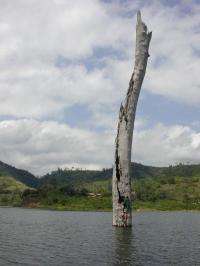
Winston Wheeler, a researcher at the University of Arizona, collecting tree cores from a partially submerged tropical tree at Lake Bosumtwi, Ghana. A submerged forest in the lake provides evidence for severe and long-lasting droughts in West Africa just a few centuries ago. This tree grew at a time of prolonged drought when the lake level was tens of meters lower than today. Tree rings in the core sample were used to date the age of the tree and provide an additional line of evidence about megadroughts in the past. Credit: Jonathan T. Overpeck.

Devastating droughts worse than the infamous Sahel drought are part of the normal climate regime for sub-Saharan West Africa, according to new research.

For the first time, researchers have developed an almost year-by-year record of the last 3,000 years of West Africa's climate. In that period, catastrophic droughts occurred every 30 to 65 years, and the pattern can be expected to continue in the future, the team reports.

"What's disconcerting about this record is that it suggests that the most recent drought was relatively minor in the context of the West African drought history," said first author Timothy M. Shanahan, who conducted the research while he was a doctoral student at The University of Arizona in Tucson.

The Sahel drought, which began in the late 1960s and continued for several decades, killed at least 100,000 people and displaced many more.

"What's really striking about droughts in this area is that they last such a long time," he said. "You have droughts that last 30 to 60 years, and then some that last four times as long."

The region has undergone multicentury droughts, most recently from 1400 A.D. to 1750 A.D., the researchers found.

"If we were to switch into one of these century-scale patterns of drought, it would be a lot more severe, and it would be very difficult for people to adjust to the change," said Shanahan, now an assistant professor of geosciences at the University of Texas at Austin.

Changes in the North Atlantic have a significant effect on the West African , which is a climate pattern of alternating wet-and-dry periods, the scientists found.

"This area switched between very long wet periods and long, very severe dry periods," he said.
Megadroughts in sub-Saharan Africa normal for the region
Enlarge

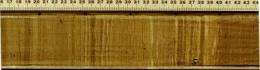
This sediment core taken from Lake Bosumtwi, Ghana has annually deposited layers. These layers provide a high-resolution chronology for the sediments and a means of reconstructing past climate variations. A meter stick lies alongside the core for scale. Credit: T.M. Shanahan and W. Wheeler.

As global warming progresses, the increases in temperature may exacerbate the normal climate pattern, producing even more severe and prolonged droughts than those of the past, said co-author Jonathan T. Overpeck, a UA professor of geosciences.

"We also know that global warming will make these droughts a lot hotter. This could be devastating," said Overpeck, co-director of UA's Institute for Environment and Society.

The research team figured out the region's past climate by analyzing the annual layers of sediment deposited in Ghana's Lake Bosumtwi, geological records of the lake level and other climate indicators.

Paul Filmer, the National Science Foundation program director who funded the study, said, "This project is a good example of how work in the tropics on sediment records provides more detailed insight into climate patterns that affect millions of people in a highly vulnerable area of the world."

Shanahan, Overpeck and their colleagues will publish their paper, "Atlantic forcing of persistent drought in West Africa," in the April 17 issue of the journal Science. A complete list of authors is at the bottom of this release. The National Science Foundation funded the research.

Many of the Earth's climate patterns are influenced by sea-surface temperatures.

Climate scientists have proposed that temperatures in the North Atlantic rise and fall naturally in an approximately 60-year cycle called the Atlantic Multidecadal Oscillation. Some computer models and tree-ring data from around the North Atlantic support this hypothesis.

If it exists, the oscillation should have a strong effect on the West African monsoon.

But an accurate annual record of Atlantic sea-surface temperatures exists only for the last 80 to 100 years, and the tree-ring data going farther back in time is patchy. Therefore, up until now, it has been hard to tell whether there is a long-term cyclical pattern or only a shorter-term trend.

The new reconstruction of the West African Monsoon by Shanahan and his colleagues shows a close match between the 350-year-old paleoclimate record of sea-surface temperatures and the wet-dry cycles of the monsoon.

"This paper provides a long-term context suggesting that the Atlantic Multidecadal Oscillation does actually exist," says Shanahan.

"Our rainfall records are strongly related to these really distant sea-surface temperature reconstructions, at least on this multidecadal time scale. It suggests that the rainfall patterns are being generated by the sea-surface temperature patterns and not by some other influence."

Some current climate models have forecast a wetter climate for West Africa, while others have forecast a drier one. Armed with this new information, scientists who create climate models will be better equipped to sort out some of the conflicting predictions for West Africa.

More information: "Atlantic forcing of persistent in West Africa" Science, April 17, 2009.

Source: University of Arizona (news : web)

4.3 /5 (8 votes)  

Filter


Move the slider to adjust rank threshold, so that you can hide some of the comments.


Display comments: newest first

GrayMouser
Apr 16, 2009

Rank: 3.3 / 5 (3)
They could have left out the reference to "global warming" and just left it to the reader to understand that natural climate shifts could change this cycle in various ways (more or less severe, longer or shorter time spans, etc.).
Fazer
Apr 16, 2009

Rank: 4 / 5 (4)
I agree. Must every single article be colored by the authors opinions on climate change? Just report the facts, and the facts are very interesting.
mikiwud
Apr 17, 2009

Rank: 5 / 5 (1)
The region has undergone multicentury droughts, most recently from 1400 A.D. to 1750 A.D., the researchers found.

This coincides with the Little Ice Age (unless your name is Mann). It used to be accepted that generally warm is wet and cold is dry, with exceptions. 1000s sqkms of the Sahara has greened in the last century.(more warmth,water and CO2?)
PStrand
Apr 17, 2009

Rank: 3 / 5 (2)
A hypothetical question?
And a not political correct question.
What if drought conditions in sub-Saharan Africa as well as in similar subtropical regions like the Indian subcontinent are more susceptive to droughts during colder climate events such as has been recorded in periods of solar inactivity such as during Dalton, Maunder, Spörer and Wolf solar minimum which are well documented at least when it comes to the Subcontinent of India, then a repeat of such an event in the future will also create similar droughts.
And what if to the Sun enters a prolong period of inactivity in the coming years?
Then because a cold spell in northern latitudes will also affect crop yields in both types of regions it will help reduce the number of %u201Csurplus people in the third world%u201D through famine.
That I think is what many enviro wackos and global warmers deep inside want.
It looks to me that is what is soon going to happen, from just looking at the current state of Sun.
But of course you don't get research grant if you anticipate imminent global cooling instead of AGW.
GrayMouser
Apr 17, 2009

Rank: 3 / 5 (2)
... What if drought conditions in sub-Saharan Africa as well as in similar subtropical regions like the Indian subcontinent are more susceptive to droughts during colder climate events such as has been recorded in periods of solar inactivity such as during Dalton, Maunder, Sp%uFFFDrer and Wolf solar minimum which are well documented at least when it comes to the Subcontinent of India, then a repeat of such an event in the future will also create similar droughts.

And what if to the Sun enters a prolong period of inactivity in the coming years?

Then because a cold spell in northern latitudes will also affect crop yields in both types of regions it will help reduce the number of %u201Csurplus people in the third world%u201D through famine.

Another interesting question would be, provided that climate is chaos driven, will the same starting conditions ever lead to the same final conditions?
Probably not. Which makes any kind of climate prediction suspect.
Fazer
Apr 19, 2009

Rank: 5 / 5 (1)
Cross reference this story with the one below:

http://www.physor...515.html

Something to think about: What if we were headed for the same interglacial peak temperatures as the last IG period, only this time around, coal burning delayed it? Now that we have cleaned up our act somewhat, it could continue on to a comparable peak.
Rank 4.3 /5 (8 votes)
Relevant PhysicsForums posts
  • Do some geologists actually act a lot like Randy Marsh?
    createdFeb 11, 2012
  • Discrepancy between oxygen and carbon-dioxide levels
    createdFeb 09, 2012
  • where gems are found in the world
    createdFeb 09, 2012
  • Wind Waves in Reservoir ~ Wind run-up and Wind set-up
    createdFeb 08, 2012
  • Balance of oxygen in the atmosphere
    createdFeb 01, 2012
  • The case for a methanol-based economy
    createdJan 30, 2012
  • More from Physics Forums - Earth

More news stories

Latin America mining boom clashes with conservation

Latin America is experiencing a mining boom as prices rise fuelled by a hike in global demand, but the region is also being hit by a wave of violent protests, strikes and rallies by environmentalists.

Space & Earth / Environment

created 7 hours ago | popularity not rated yet | comments 0

Political leaders play key role in how worried Americans are by climate change: study

More than extreme weather events and the work of scientists, it is national political leaders who influence how much Americans worry about the threat of climate change, new research finds.

Space & Earth / Environment

created Feb 06, 2012 | popularity 5 / 5 (6) | comments 73

NASA budget will axe Mars deal with Europe: scientists

US President Barack Obama's budget proposal to be submitted next week for 2013 will cut NASA's budget by 20 percent and eliminate a major partnership with Europe on Mars exploration, scientists said Thursday.

Space & Earth / Space Exploration

created Feb 10, 2012 | popularity 5 / 5 (3) | comments 55

Humans may have helped the decline of African rainforests 3000 years ago

(PhysOrg.com) -- Large areas of rainforests in Central Africa mysteriously disappeared over three thousand years ago, to be replaced by savannas. The prevailing theory has been that the cause was a change ...

Space & Earth / Environment

created Feb 10, 2012 | popularity 4.1 / 5 (14) | comments 20 | with audio podcast report

Study shows global glaciers, ice caps, shedding billions of tons of mass annually

Earth's glaciers and ice caps outside of the regions of Greenland and Antarctica are shedding roughly 150 billion tons of ice annually, according to a new study led by the University of Colorado Boulder.

Space & Earth / Earth Sciences

created Feb 08, 2012 | popularity 4.4 / 5 (9) | comments 14 | with audio podcast


Injured boomers beware: Know when to see doctor

(AP) -- It happened to nurse Jane Byron years after an in-line skating fall, business owner Haralee Weintraub while doing "men's" push-ups, and avid cyclist Gene Wilberg while lifting a heavy box.

Google might launch Drive for cloud storage soon

(PhysOrg.com) -- Google's next big move, according to the Wall Street Journal, is a cloud storage service called Drive. Hardly first to the plate, Google is simply catching up to introducing its cloud reposi ...

Love a click away in Indonesia's Twitter Republic

He was a geeky kid from Yogyakarta, she a glamorous city girl in Jakarta. In a country with one of the world's most vibrant social networking scenes they fell in love on Twitter.

Europeans protest controversial Internet pact

Tens of thousands of people marched in protests in more than a dozen European cities Saturday against a controversial anti-online piracy pact that critics say could curtail Internet freedom.

Walney offshore wind farm is world's biggest (for now)

(PhysOrg.com) -- The Walney wind farm on the Irish Sea--characterized by high tides, waves and windy weather--officially opened this week. The farm is treated in the press as a very big deal as the Walney ...

Navy to begin tests on electromagnetic railgun prototype launcher

The Office of Naval Research (ONR)'s Electromagnetic (EM) Railgun program will take an important step forward in the coming weeks when the first industry railgun prototype launcher is tested at a facility ...