Ancient ecosystem thrives millions of years below Antarctic glacier
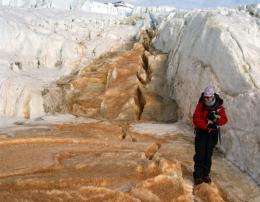
April 16, 2009 by Steve Bradt
Mikucki on the job in Antarctica (courtesy of Jill Mikucki)
(PhysOrg.com) -- A reservoir of briny liquid buried deep beneath an Antarctic glacier supports hardy microbes that have lived in isolation for millions of years, researchers report this week in the journal Science.
The discovery of life in a place where cold, darkness and lack of oxygen would previously have led scientists to believe nothing could survive comes from a team led by researchers at Dartmouth and Harvard. Their work was funded by the National Science Foundation, NASA, and Harvard's Microbial Sciences Initiative.
Despite their profound isolation, the microbes are remarkably similar to species found in modern marine environments, suggesting that the organisms now under the glacier are the remnants of a larger population that once occupied an open fjord or sea.
"It's a bit like finding a forest that nobody has seen for 1.5 million years," says Ann Pearson, Thomas D. Cabot Associate Professor of Earth and Planetary Sciences in Harvard's Faculty of Arts and Sciences. "Intriguingly, the species living there are similar to contemporary organisms, and yet quite different -- a result, no doubt, of having lived in such an inhospitable environment for so long."
"This briny pond is a unique sort of time capsule from a period in Earth's history," says lead author Jill Mikucki, now a research associate in the Department of Earth Sciences at Dartmouth and visiting fellow at Dartmouth's Dickey Center for International Understanding and its Institute of Arctic Studies. "I don't know of any other environment quite like this on Earth."
Chemical analysis of effluent from the inaccessible subglacial pool suggests that its inhabitants have eked out a living by breathing iron leached from bedrock with the help of a sulfur catalyst. Lacking any light to support photosynthesis, the microbes have presumably survived by feeding on the organic matter trapped with them when the massive Taylor Glacier sealed off their habitat an estimated 1.5 to 2 million years ago.
Mikucki, Pearson, and colleagues based their analysis on samples taken at Antarctica's Blood Falls, a frozen waterfall-like feature at the edge of the Taylor Glacier whose striking red appearance first drew early explorers' attention in 1911. Those "Heroic Age" adventurers speculated that red algae might have been responsible for the bright color, but scientists later confirmed that the coloration was due to rust, which the new research shows was likely liberated from subglacial bedrock by microorganisms.
Because water flows unpredictably from below the glacier at Blood Falls, it took Mikucki a number of years to obtain the samples needed to conduct an analysis. Finally, in the right place at the right time, she was able to capture some of the subglacial brine as it flowed out of a crack in the glacial wall, obtaining a sample of an extremely salty, cold, and clear liquid for analysis.
"When I started running the chemical analysis on it, there was no oxygen," she says. "That was when this got really interesting. It was a real 'Eureka!' moment."
The fluid is rich in sulfur, a geochemical signature of marine environments, reinforcing suspicions that the ancestors of the microbes now beneath the Taylor Glacier probably lived in an ocean long ago. When sea level fell more than 1.5 million years ago, they hypothesize, a pool of seawater was likely trapped and eventually capped by the advancing glacier.
The exact size of the subglacial pool remains a mystery, but it is thought to rest under 400 meters of ice some four kilometers from its tiny outlet at Blood Falls.
Mikucki's analysis showed that the sulfur below the glacier had been uniquely reworked by microbes and provides insight into how these organisms have been able to survive in isolation for so long.
The research answers some questions while raising others about the persistence of life in such extreme environments. Life below the Taylor Glacier may help address questions about "Snowball Earth," the period of geological time when large ice sheets covered Earth's surface. But it could also be a rich laboratory for studying life in other hostile environments, and perhaps even on Mars and its ice-covered moon, Europa.
Provided by Harvard University
-
Antarctica's coldest, darkest season draws MSU researchers
Mar 10, 2008 |
not rated yet |
0
-
Montana State University scientists to get new cold lab
Jun 28, 2006 |
not rated yet |
0
-
Robot endures Antarctic cold to prepare for space mission
Dec 26, 2008 |
not rated yet |
0
-
Arctic expedition will investigate alien-like glacier
Jun 13, 2006 |
not rated yet |
0
-
Scientists discover clue to 2 billion year delay of life on Earth
Mar 26, 2008 |
not rated yet |
0
-
Engineers build first sub-10-nm carbon nanotube transistor
Feb 01, 2012 |
4.9 / 5 (29) |
30
-
Something old, something new: Evolution and the structural divergence of duplicate genes
Jan 31, 2012 |
4.6 / 5 (7) |
1
-
The hidden nanoworld of ice crystals: Revealing the dynamic behavior of quasi-liquid layers
Jan 30, 2012 |
5 / 5 (3) |
1
-
Stock market network reveals investor clustering
Jan 27, 2012 |
4 / 5 (22) |
8
-
Of microchemistry and molecules: Electronic microfluidic device synthesizes biocompatible probes
Jan 26, 2012 |
5 / 5 (1) |
0
-
Balance of oxygen in the atmosphere
Feb 01, 2012
-
The case for a methanol-based economy
Jan 30, 2012
-
Weather in a rotating cylinder
Jan 25, 2012
-
Importance of difference between SVP over ice and water?
Jan 19, 2012
-
Ozone and atmosphere sampling
Jan 16, 2012
-
Novel Geothermal Energy Source
Jan 14, 2012
- More from Physics Forums - Earth
More news stories
Mars-bound NASA rover carries coin for camera checkup
(PhysOrg.com) -- The camera at the end of the robotic arm on NASA's Mars rover Curiosity has its own calibration target, a smartphone-size plaque that looks like an eye chart supplemented with color chips ...
Space & Earth / Space Exploration
9 hours ago |
4 / 5 (4) |
5
|
When worlds collide: Researchers harness supercomputers to understand solar storm, magnetosphere
If the sun is anything, it is reassuring. It rises, sets, and rises again, allowing us to grow crops, get tan, and power homes, just to name a few of humanity's most important life-sustaining functions. No ...
Space & Earth / Space Exploration
21 hours ago |
3 / 5 (1) |
6
|
Mars Express radar gives strong evidence for former Mars ocean
(PhysOrg.com) -- ESA's Mars Express has returned strong evidence for an ocean once covering part of Mars. Using radar, it has detected sediments reminiscent of an ocean floor within the boundaries of previously ...
Space & Earth / Space Exploration
19 hours ago |
4.4 / 5 (5) |
3
|
Man who warned of Challenger disaster dies at 73
The man who warned his employer of the equipment quirk that led to the deadly explosion of the space shuttle Challenger has died. Roger Boisjoly was 73.
Space & Earth / Space Exploration
11 hours ago |
5 / 5 (2) |
3
Russia sets its sights on the moon for 2020
Looks like Republican Presidential hopeful Newt Gingrich might have some competition if he wants to be the first to build a base on the Moon. Last week, the Russian Space Agency Roscosmos announced plans to ...
Space & Earth / Space Exploration
19 hours ago |
5 / 5 (4) |
5
Scared of a younger rival? Not for some male songbirds
When mature male white-crowned sparrows duel to win a mate or a nesting territory, a young bird just doesn't get much respect.
Playing school sports affects youths' smoking
Young people's choices about using drugs and alcohol are influenced by peersnot only close friends, but also sports teammates. A new study of middle schoolers and their social networks has found that teammates' smoking ...
New study: Adolescents suffering from depression more likely to be bullied
A new study provides evidence that adolescents who suffer from depression are more likely to develop difficulty in peer relationships including being bullied at school.
Preventing bacteria from falling in with the wrong crowd could help stop gum disease
Stripping some mouth bacteria of their access key to gangs of other pathogenic oral bacteria could help prevent gum disease and tooth loss. The study, published in the journal Microbiology suggests that t ...
New study sheds light on genetics of rice metabolism
A large-scale study analyzing metabolic compounds in rice grains conducted by researchers at the RIKEN Plant Science Center (PSC) and their collaborators has identified 131 rice metabolites and clarified the ...
High-quality child care found good for children -- and their mothers
High-quality early child care isn't important just for children, but for their mothers, too. That's the conclusion of a new study by researchers at the University of Texas at Austin; the study appears in the journal Child De ...
Apr 16, 2009
Rank: 5 / 5 (8)
Um... Europa's not a moon of Mars.
Apr 16, 2009
Rank: 2.5 / 5 (2)
Apr 16, 2009
Rank: 4 / 5 (1)
Apr 17, 2009
Rank: 4 / 5 (3)
LOLOLOL Absolute fail by the article. How could they make such a mistake?
Apr 17, 2009
Rank: 4 / 5 (2)
Epic fail!!!!
Apr 17, 2009
Rank: 1 / 5 (2)
The Biblical model is more logical. Creation scientists would suggest there was 1 Ice Age and this ecosystem described above has existed for just centuries. Furthermore there is absolutely no evidence that there is life outside planet Earth.
Apr 17, 2009
Rank: not rated yet
Agreed, there's considerable speculation here. That's what scientists do - find some data, speculate about it, then test their speculations further.
However, the speculation about 1.5 million years and so on is consistent with the gargantuan preponderance of other physical evidence regarding the age of the Earth and the universe. The Biblical model is at odds with that same gargantuan preponderance of evidence, which is why I think it's a bunch of baloney.
Apr 17, 2009
Rank: not rated yet
On another note. Do we really need evidence? People don't need solid proof of god... Unless you think that's what a banana is. I mean it is shaped perfectly for eating.
Apr 18, 2009
Rank: not rated yet
is nothing sacred?
Apr 19, 2009
Rank: not rated yet
the day that PhysOrg starts posting articles from the Creationist Scientists is the day I stop visiting this site!
Apr 19, 2009
Rank: not rated yet
Apr 19, 2009
Rank: not rated yet
That's a pretty persuasive point. You know what else - yesterday I saw a mud puddle, and the hole it fit into was perfectly shaped to fit it. Coincidence? Or evidence of an intelligence that goes around creating holes perfectly designed for puddles?