Implementing sustainable technology to monitor the integrity of the nation's bridges
April 16, 2009
Implementing sustainable technology to monitor the integrity of the nation's bridges

Enlarge

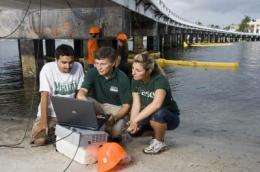
Pictured here are Antonio Nanni (in the middle), with graduate students Rosella Ferraro and Felipe Mejia placing sensors along Miami's Grove Isle Bridge. Credit: Photographer: Richard Patterson

Today, humans perform visual inspections every two years of most of the nation's older bridges. But with a scarcity of inspectors and tens of thousands of bridges, that process can be long and laborious.

While newer bridges have monitoring devices already incorporated into their design, there are thousands of bridges erected during the 1960s and '70s, when much of the nation's infrastructure was built that would benefit from such a system.

To address the issue, a team of University of Miami College of Engineering researchers are implementing a self-powered monitor system for bridges that can continuously check their condition using wireless sensors that "harvest" power from structural vibration and .

"Just as when someone goes to see a doctor and gets all sorts of tests done to see how healthy they are and how long they'll live, we're doing the same with bridges," says Antonio Nanni, professor and chair of the Department of Civil, Architectural, and Environmental Engineering and lead investigator of the nearly $14 million project.

Nanni and his team plan to place newly developed wireless sensors—some as small as a postage stamp, others no longer than a ballpoint pen—along strategic points inside the 27-year-old Long Key , in the Florida Keys and on a Northwest 103rd Street quarter-mile steel overpass that leads into Hialeah, in Florida.

The sensors, developed by project collaborators Virginia Tech University and New Jersey-based Physical Acoustics Corporation, record all sorts of data, from vibrations and stretching to and echoes emitted by flaws such as cracks. Even the alkaline levels in the concrete of bridge supports are being measured.

"The beauty of this project is that the data can be shared with other researchers via a Web site," Nanni says. "We could share information with the department of transportation in the UK and show them what's happening with the Long Key Bridge here in Florida. They would see the data as we see it, in real time."

Once all the information is culled and analyzed, Nanni and his team will form a prognosis of the bridges' health, and should any defects be found, the decision on how to repair the structures will be made by the Florida Department of Transportation. Nanni, who directs a College of Engineering Industry/University Cooperative Research Center supported by the National Science Foundation and called RB2C (Repair of Building and Bridges with Composites), hasn't ruled out the possibility of suggesting how to repair any damage found.

Researchers at the University of South Carolina at Columbia also are partners in the study, monitoring a series of bridges in their state and forming diagnoses jointly with UM engineers.

The project is the second bridge health-monitoring study being undertaken by Nanni and his colleagues. With a group of students, they are also placing sensors along Miami's Grove Isle Bridge as part of a smaller, one-year study funded by the National Science Foundation RB2C.

With the Federal Highway Administration estimating that more than 70,000 of the nation's bridges are structurally deficient, the system Nanni and his team develop could be used as a national model for monitoring the structural integrity of bridges nationwide and alerting bridge owners to potential dangers.

Source: University of Miami (news : web)


Rank 4 /5 (1 vote)
Related Stories
Relevant PhysicsForums posts
  • How to tilt a object
    created7 hours ago
  • How to calculate total compressibility in liquid porous solid system
    created13 hours ago
  • Need help reading 3-D
    createdFeb 11, 2012
  • A way to send and receive wireless data
    createdFeb 11, 2012
  • Calling function with no input argument
    createdFeb 10, 2012
  • Force free body diagram problem on gym equipment
    createdFeb 10, 2012
  • More from Physics Forums - General Engineering

More news stories

Japan's Fukushima reactor may be reheating: operator

Temperature readings at one of the crippled Fukushima nuclear reactors have risen above Japan's stringent new safety standard but there was no immediate danger, its operator said Sunday.

Technology / Energy & Green Tech

created 24 minutes ago | popularity 1 / 5 (1) | comments 0

Google might launch Drive for cloud storage soon

(PhysOrg.com) -- Google's next big move, according to the Wall Street Journal, is a cloud storage service called Drive. Hardly first to the plate, Google is simply catching up to introducing its cloud reposi ...

Technology / Internet

created 21 hours ago | popularity 4.2 / 5 (6) | comments 5 | with audio podcast report

Iran blocks email, restricts net access: reports

Iran has further restricted access to the Internet and blocked popular email services for the past few days, in a move a top lawmaker said could "cost the regime dearly," media reports said on Sunday.

Technology / Internet

created 14 hours ago | popularity 5 / 5 (2) | comments 5

Walney offshore wind farm is world's biggest (for now)

(PhysOrg.com) -- The Walney wind farm on the Irish Sea--characterized by high tides, waves and windy weather--officially opened this week. The farm is treated in the press as a very big deal as the Walney ...

Technology / Energy & Green Tech

created Feb 11, 2012 | popularity 4.1 / 5 (14) | comments 59 | with audio podcast weblog

Navy to begin tests on electromagnetic railgun prototype launcher

The Office of Naval Research (ONR)'s Electromagnetic (EM) Railgun program will take an important step forward in the coming weeks when the first industry railgun prototype launcher is tested at a facility ...

Technology / Engineering

created Feb 06, 2012 | popularity 4.6 / 5 (21) | comments 95 | with audio podcast


Botox developer rues missing out on billions

Botox developer Alan Scott says he rues the day he handed over rights to the best-selling wrinkle-smoothing drug to a US company for just $4.5 million, saying he might have become a billionaire.

Australian women reject 'I love u' texts

Australian women may have embraced the digital era, but they prefer a face-to-face declaration of affection to an "I love u" text and find men addicted to their mobile phones a major turnoff.

Scientists discover molecular secrets of 2,000-year-old Chinese herbal remedy

For roughly two thousand years, Chinese herbalists have treated Malaria using a root extract, commonly known as Chang Shan, from a type of hydrangea that grows in Tibet and Nepal. More recent studies suggest that halofuginone, ...

New method to examine batteries -- MRI from the inside

There is an ever-increasing need for advanced batteries for portable electronics, such as phones, cameras, and music players, but also to power electric vehicles and to facilitate the distribution and storage of energy derived ...

A mitosis mystery solved: How chromosomes align perfectly in a dividing cell

Although the process of mitotic cell division has been studied intensely for more than 50 years, Whitehead Institute researchers have only now solved the mystery of how cells correctly align their chromosomes during symmetric ...

Lab study raises questions over nano-particle impact

Tests involving chickens have raised questions about the impact on health from engineered nano-particles, the ultra-fine grains commonly used in drugs and processed foods, scientists said on Sunday.