Viruses can turn harmless E. coli dangerous
April 16, 2009
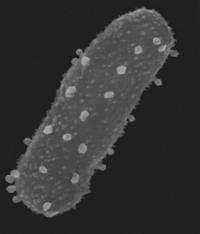
Viruses attacking E. coli, (electron microscopy picture) Photo: Dennis Kunkel Microscopy, Inc.
For her doctorate, Camilla Sekse studied how viral DNA can be transmitted from pathogenic to non-pathogenic E. coli. Viruses that infect bacteria in this way are called bacteriophages. Her findings reveal that such transmission of bateriophage between bacteria can occur, and that in the case of E. coli it can transform a harmless bacterium into one capable of causing disease in man.
Escherichia coli is a complex group of gut bacteria that are found in all warm-blooded animals and are for the most part harmless. A few, however, cause disease in man and animals. The E. coli bacteria that produce a poison called Shiga toxin can produce a range of effects in man. One common effect is bloody diarrhoea followed by complications such as kidney failure (haemolytic uraemic syndrome). The bacteria may be spread through contaminated food or water, or from contact with animals.
A combination of qualities necessary to produce disease
A sequence of favourable circumstances needs to exist before E. coli can produce disease. The most important of these is the ability to produce Shiga toxin. The gene that codes for Shiga toxin is not innate, but is contained within bacteriophages. In other words, the bacterium needs first to be infected by a bacteriophage coding for Shiga toxin in order to produce the toxin itself.
In her work, Camilla Sekse studied E. coli O103:H25 bacteria isolated both from foodstuffs and patients from the E. coli outbreak of 2006. She and her colleagues discovered special features of these E. coli bacteria that separate them from ordinary, benign forms. This discovery lead to it being easier to demonstrate E. coli O103:H25 in suspect food products.
Dangerous bacteria in our environment
It seems that E. coli O103:H25 has existed in Norway for some time, since this bacterium was also found to be a cause of the kidney failure outbreaks both in 2003 and 2005. Studies of the entire genome of this bacterium have shown that it more closely resembles the enteropathogenic E. coli (bacteria that cause diarrhoea) than the more common, Shiga toxin-producing E. coli, namely E. coli O157:H7.
Escherichia coli bacteria that are not disease-causing can absorb and lose bacteriophages coding for Shiga toxin, and can be important in the spread of these bacteriophages in the environment, even though they don't themselves cause disease. It appears that some E. coli bacteria can both more easily absorb and lose bacteriophages that contain the gene for Shiga toxin, and this may well be the case for E. coli O103:H25.
Provided by Norwegian School of Veterinary Science (news : web)
-
Humans not the major target of Shiga toxin
Dec 03, 2007 |
not rated yet |
0
-
New technique puts DNA profiling of E. coli on fast track
Mar 10, 2008 |
not rated yet |
0
-
A long-sought test for direct detection of disease-causing E. coli bacteria
Feb 18, 2008 |
not rated yet |
0
-
GIANT-Coli: A novel method to quicken discovery of gene function
Aug 07, 2008 |
not rated yet |
0
-
Researcher uncovers treatment for E.coli
Oct 29, 2008 |
not rated yet |
0
-
Engineers build first sub-10-nm carbon nanotube transistor
Feb 01, 2012 |
4.9 / 5 (33) |
30
-
Something old, something new: Evolution and the structural divergence of duplicate genes
Jan 31, 2012 |
4.6 / 5 (7) |
1
-
The hidden nanoworld of ice crystals: Revealing the dynamic behavior of quasi-liquid layers
Jan 30, 2012 |
5 / 5 (4) |
1
-
Stock market network reveals investor clustering
Jan 27, 2012 |
3.9 / 5 (23) |
8
-
Of microchemistry and molecules: Electronic microfluidic device synthesizes biocompatible probes
Jan 26, 2012 |
5 / 5 (2) |
0
-
Factors affecting beet root cell membrane
8 hours ago
-
Stem cell question.
Feb 10, 2012
-
Protease cleavage
Feb 10, 2012
-
Pertubance in a model
Feb 10, 2012
-
Cancer drugs and Alzheimer's, Oh my!
Feb 09, 2012
-
Squishing cells
Feb 09, 2012
- More from Physics Forums - Biology
More news stories
A mitosis mystery solved: How chromosomes align perfectly in a dividing cell
Although the process of mitotic cell division has been studied intensely for more than 50 years, Whitehead Institute researchers have only now solved the mystery of how cells correctly align their chromosomes during symmetric ...
4 hours ago |
5 / 5 (6) |
0
|
The proteins ensuring genome protection
Researchers from the University of Geneva (UNIGE), Switzerland, have discovered the crucial role of two proteins in developing a cell 'anti-enzyme shield'. This protection system, which operates at the level of molecular ...
4 hours ago |
5 / 5 (2) |
0
|
Researchers find extensive RNA editing in human transcriptome
In a new study published online in Nature Biotechnology, researchers from BGI, the world's largest genomics organization, reported the evidence of extensive RNA editing in a human cell line by analysis of RNA-seq data, demons ...
4 hours ago |
5 / 5 (3) |
0
|
Entire genome of extinct human decoded from fossil
(PhysOrg.com) -- In 2010, Svante Pääbo and his colleagues presented a draft version of the genome from a small fragment of a human finger bone discovered in Denisova Cave in southern Siberia. The ...
Feb 07, 2012 |
4.7 / 5 (59) |
48
|
Why are there so few fish in the Earth's oceans?
(PhysOrg.com) -- A Stony Brook University researcher has found that, contrary to popular belief, there are not plenty of fish in the sea.
Feb 08, 2012 |
4.2 / 5 (18) |
27
|
Overeating may double risk of memory loss
New research suggests that consuming between 2,100 and 6,000 calories per day may double the risk of memory loss, or mild cognitive impairment (MCI), among people age 70 and older. The study was released today and will be ...
Google might launch Drive for cloud storage soon
(PhysOrg.com) -- Google's next big move, according to the Wall Street Journal, is a cloud storage service called Drive. Hardly first to the plate, Google is simply catching up to introducing its cloud reposi ...
Scientists discover molecular secrets of 2,000-year-old Chinese herbal remedy
For roughly two thousand years, Chinese herbalists have treated Malaria using a root extract, commonly known as Chang Shan, from a type of hydrangea that grows in Tibet and Nepal. More recent studies suggest that halofuginone, ...
New method to examine batteries -- MRI from the inside
There is an ever-increasing need for advanced batteries for portable electronics, such as phones, cameras, and music players, but also to power electric vehicles and to facilitate the distribution and storage of energy derived ...
Injured boomers beware: Know when to see doctor
(AP) -- It happened to nurse Jane Byron years after an in-line skating fall, business owner Haralee Weintraub while doing "men's" push-ups, and avid cyclist Gene Wilberg while lifting a heavy box.
Lab study raises questions over nano-particle impact
Tests involving chickens have raised questions about the impact on health from engineered nano-particles, the ultra-fine grains commonly used in drugs and processed foods, scientists said on Sunday.