Coke Bottle Quantum Physics
April 16, 2009 by Lauren Schenkman Coke Bottle Quantum Physics

Enlarge

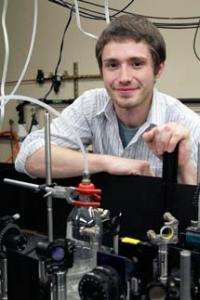
Graduate student James Cryan with his recyclable experimental setup. (Photo by Lauren Schenkman.)

(PhysOrg.com) -- Don't be fooled by the collection of empty soda bottles in James Cryan's office at SLAC National Accelerator Laboratory. Cryan isn't a caffeine fiend—the cola bottles are for science. As a graduate student with the PULSE Institute for Ultrafast Energy Science, he is studying how nitrogen gas responds to stimulation by an optical laser, and he needed a container for the gas. Instead of ordering a cell and waiting for it to arrive, Cryan cast about for something close at hand—and happened upon one of the empty Coke bottles on his desk.

"It only cost us a dollar, so it's probably one of the cheapest things in the lab," Cryan said. "Plus, we recycled."

Nitrogen is a diatomic molecule; in a stick-and-ball picture, it looks like a dumbbell. In a cloud of nitrogen, the sticks aren't aligned in any particular way. But when a short optical pulse blasts the , the nitrogen molecules snap to attention, parallel with the pulse's electric field. Afterward, the molecules keep spinning, but not randomly—in a little while they fall into alignment again. Nitrogen molecules are quantum mechanical objects; their angular momentum, a property related to their rotation, can take on only certain values. If some of the molecules rotate at a certain speed, others are rotating twice as fast, others three times as fast, and so on. As the rotation continues, there are "revivals" of alignment—the molecules line up again and again.

Cryan wondered what would happen if he waited for a revival and kicked the molecules with a second pulse. He found that the effect adds up—the response is just as strong as if a twice-as-powerful pulse hit the molecules just once. This means multiple gentle kicks can create a very strong alignment. To get that same alignment with one kick would require a pulse so powerful it would ionize the molecules. In the past, researchers who want aligned have worked around ionization by cooling the sample. Cryan's setup achieves aligned molecules at room temperature, and in a Coke bottle, no less.

The setup could be a tool for researchers studying coherence and decoherence, or how molecular behavior becomes choreographed and then falls out of synch. At first glance, the alignment, which lasts just one or two picoseconds, seems too short-lived to be caught by the 100-picosecond-long X-ray pulses of facilities like the Stanford Synchrotron Radiation Lightsource. But Cryan has found that the behavior averaged over time is more aligned, which means longer-pulse studies are possible.

For his own research, Cryan will bring his alignment tool to the ultrafast Linac Coherent Light Source once it's fully commissioned, to examine how its X-rays excite a gas. The LCLS will eject an electron from the inner shell of atoms in the gas; when a second electron falls into the vacant space, it releases a burst of energy, triggering the ejection of a third electron. Cryan wants to explore how this phenomenon, called Auger emission, depends on the angle of the incoming X-ray pulse.

"If we can get the aligned, that's one less degree of complication," he said.

But in the state-of-the-art environs of the LCLS, Cryan will contain the gas in a plastic cell that supports variations in pressure.

"The Coke bottle probably won't make it to the LCLS," he said.

SWF video is available at http://today.slac.stanford.edu/feature/2009/coke_bottle_physics.swf

Provided by SLAC Today


print this article email this article download pdf blog this article bookmark this article     Stumble it Digg this share on Facebook retweet share on Reddit add to delicious
Rate this story - 4.1 /5 (12 votes)

Rank Filter

Move the slider to adjust rank threshold, so that you can hide some of the comments.


Display comments: newest first

  • S3ND3R - Apr 16, 2009
    • Rank: 3 / 5 (2)
    I heard these phase resonance experiments were done already in a MOT, glad to see someone has a use for blatant advertising.

    Would be interesting to see what type of nuclear beam kinetic charges inert gases can hold.

    Didn't the scientific societies already study inert gas radioisotope kinemetry in thin films and aerogel substrates in the past decade or so?

April 16, 2009 all stories

Comments: 1

4.1 /5 (12 votes)
  • Stumble this up

  • Digg this

  • share this

  • hide
  • Related Stories

  • Watching Electrons with Lasers
    created Nov 06, 2008 | popularity not rated yet | comments 0
  • Ultrashort light pulse blazes new paths for science, industry
    created May 01, 2007 | popularity not rated yet | comments 0
  • FLASH Imaging Redux: Nano-Cinema is Born
    created Jul 08, 2008 | popularity not rated yet | comments 0
  • Physicist proposes to use femtosecond, chirped laser pulse trains to reduce decoherence
    created Nov 10, 2008 | popularity not rated yet | comments 0
  • Researchers make molecules 'pose' for photograph
    created Oct 20, 2006 | popularity not rated yet | comments 0


Other News

Scientists react as they stand in front of a screen at CERN

First atoms reported smashed in Large Hadron Collider (Update)

Physics / General Physics

created Nov 23, 2009 | popularity 4.5 / 5 (30) | comments 21

Two circulating beams on Monday produced the first particle collisions in the world's biggest atom smasher, the Large Hadron Collider (LHC), three days after its restart, scientists announced.


Restored machine to explore mysteries of Big Bang (AP)

Restored machine to explore mysteries of Big Bang

Physics / General Physics

created Nov 21, 2009 | popularity 4.6 / 5 (18) | comments 26

(AP) -- Scientists are preparing the world's largest atom smasher to explore the depths of matter after successfully restarting the $10 billion machine following more than a year of repairs.


nuclear power plant

Doubts raised on nuclear industry viability

Physics / General Physics

created Nov 19, 2009 | popularity 3.1 / 5 (21) | comments 19

(PhysOrg.com) -- The investment in nuclear power has been growing around the world over the last few years, being viewed as a means for countries to control their energy security, avoid the price fluctuations ...


In the Brain, Seven Is A Magic Number

In the Brain, Seven Is A Magic Number

Physics / General Physics

created Nov 23, 2009 | popularity 4.5 / 5 (33) | comments 9

Having a tough time recalling a phone number someone spoke a few minutes ago or forgetting items from a mental grocery list is not a sign of mental decline; in fact, it's natural.


Proton's party pals may alter its internal structure

Proton's party pals may alter its internal structure

Physics / General Physics

created Nov 18, 2009 | popularity 4.6 / 5 (20) | comments 9

A recent experiment at the DOE's Thomas Jefferson National Accelerator Facility has found that a proton's nearest neighbors in the nucleus of the atom may modify the proton's internal structure.