Researchers tie crest size to seabirds' suitability as a mate
April 16, 2009 Researchers tie crest size to seabirds' suitability as a mate

Enlarge

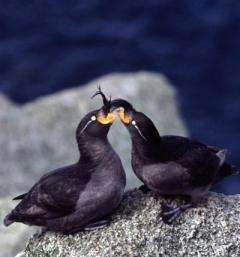
These courting auklets stand on a rock on St. Lawrence Island in June 2007. The male auklet is on the left. Credit: UAF photo by Hector Douglas

A newly released study by researchers at the University of Alaska Fairbanks offers evidence that in one breed of northern seabird, the size of males' feather crests may be more than simple ornamentation.

Their study, published this month in of the Journal of Comparative Physiology B, shows that size may be a physical indicator of a male crested auklet's quality as a mate.

Scientists have long noted that female auklets prefer males with larger crests. But until recently, they did not know why. Low levels of hormones in males with larger crests indicate that they cope better with the stresses of reproduction, such as finding food, competing with thousands of other birds for mates and nest sites, and helping rear chicks.

"Females will divorce shorter-crested mates for the opportunity to mate with longer-crested males. Our study suggests that longer-crested males could contribute more to because they have greater capacity to meet the social and physiological costs," said Hector Douglas, assistant professor of biology at the Kuskokwim Campus in Bethel.

Douglas and collaborator Alexander Kitaysky, an associate professor at the UAF Institute of Arctic Biology, say their results fit into a larger theory about animal societies.

"There appears to be a social hierarchy at the colony which is correlated with the size of the male ornament and this, in turn, is related to the levels of stress hormones," Douglas said. "The cost of attaining and maintaining dominant status is reflected in the animals' physiology and this has a distinct pattern in the society."

Douglas and his field team studied the small, sooty-gray seabirds during fieldwork on Big Koniuji in the Shumagin Islands in the Aleutian Chain during June and July of 2002. They captured and measured the auklets at a mountainside colony and collected blood samples. Kitaysky's lab analyzed the blood samples for the stress hormone corticosterone. They found that larger crests correlated with lower levels of corticosterone in the males' bloodstream.

"Theoretically males that have a lower level of baseline stress hormone have a greater capacity to respond to additional stress," Douglas said. "The with the larger crests had markedly lower levels of corticosterone and therefore they should be better mates. We suspect that crest size is an outward indicator of intrinsic quality, and the data on hormones appears to confirm this."

Source: University of Alaska Fairbanks (news : web)


print this article email this article download pdf blog this article bookmark this article     Stumble it Digg this share on Facebook retweet share on Reddit add to delicious
Rate this story - not rated yet


April 16, 2009 all stories

Comments: 0

not rated yet
  • Stumble this up

  • Digg this

  • share this

  • hide
  • Related Stories

  • Researcher finds amorous avian anointment protects mates
    created Aug 21, 2007 | popularity not rated yet | comments 0
  • The best both of worlds -- how to have sex and survive
    created Sep 20, 2007 | popularity not rated yet | comments 0
  • Mating with showy males may reduce offspring’s ability to fight off pathogens
    created Jan 10, 2007 | popularity not rated yet | comments 0
  • Spider love: Little guys get lots more
    created Dec 08, 2008 | popularity not rated yet | comments 0
  • In the animal world, bigger isn't necessarily better
    created Dec 11, 2008 | popularity not rated yet | comments 0


  • hide
  • Relevant PhysicsForums posts

Other News

What is the meaning of 'one'? Evolutionary biologists argue for new meaning of 'organismality'

Biology / Evolution

created 23 hours ago | popularity 5 / 5 (4) | comments 3

Rice University evolutionary biologists David Queller and Joan Strassmann argue in a new paper that high cooperation and low conflict between components, from the genetic level on up, give a living thing its "organismality," ...


Scientists successfully reprogram blood cells

Biology / Cell & Microbiology

created 20 hours ago | popularity 5 / 5 (4) | comments 0

Researchers have transplanted genetically modified hematopoietic stem cells into mice so that their developing red blood cells produce a critical lysosomal enzyme -preventing or reducing organ and central nervous system damage ...


Study shows that some malignant tumors can be shut down after all

Biology / Cell & Microbiology

created 23 hours ago | popularity 5 / 5 (6) | comments 0

Oncologists have had their hands tied because more than half of all human cancers have mutations that disable a protein called p53. As a critical anti-cancer watchdog, p53 masterminds several cancer-fighting operations within ...


Iowa State University researcher discovers key to vital DNA, protein interaction

Researchers discover key to vital DNA, protein interaction

Biology / Other

created 15 hours ago | popularity 5 / 5 (3) | comments 0

(PhysOrg.com) -- A researcher at Iowa State University has discovered how a group of proteins from plant pathogenic bacteria interact with DNA in the plant cell, opening up the possibility for what the scientist ...


UK starts study on using human DNA in animals

Biology / Biotechnology

created 16 hours ago | popularity 5 / 5 (2) | comments 0

(AP) -- British scientists begin a new study on Tuesday to consider how human DNA is used in animal experiments and to determine what the boundaries of such controversial science might be.