Museum specimens aid conservation effort in Madagascar
There is a new tool for those developing conservation strategies for threatened species and landscapes: museum specimens. Richard Pearson and Christopher Raxworthy of the American Museum of Natural History dusted off a number of collections from Madagascar and used the location information associated with each species to test different ideas regarding the evolution of locally distributed endemism (unique species confined to small regions). The research paper published this month in Evolution found support for alternative hypotheses, suggesting that multiple processes develop local endemism. This improved knowledge of the processes that lead to endemism can help to identify priorities in conservation planning.
"Museum records can be used for conservation purposes, especially because they tie together generations of data," says Pearson, a Biodiversity Scientist at the Museum's Center for Biodiversity and Conservation. "Madagascar is a unique natural laboratory for this project because of the large amount of local endemism and because the government's decision to set aside land has spurred an effort to prioritize the location of reserves within the landscape."
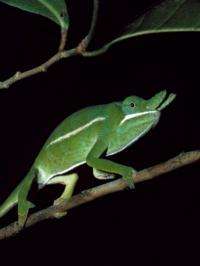
Madagascar is an island nation in the Indian Ocean that has been completely isolated from other land masses for the last 80 million years. Isolation has led to a high number of unique species like chameleons (Furcifer petteri), lemurs (Lemur catta), and day geckos (Phelsuma madagascariensis) which, in turn, has led Madagascar to be labeled a biodiversity "hotspot" by conservation groups. The Malagasy government pledged to set aside 10 percent of the land for conservation purposes as part of the 2003 World Parks Congress in Durban. Previous research papers have attempted to use species location records to determine which areas of the island would conserve the largest number of species.
The current research project used over 1,700 museum records that describe the distribution of 73 species of lemurs, geckos, and chameleons. The distributions of species were plotted and used to distinguish the fit of two different hypotheses, one focused on watersheds and the other on climate types. The "watershed" hypothesis suggests that geographic isolation drives evolution: species move up and down the watershed—and adapt or go extinct—as climate changes. The "climate" hypothesis, on the other hand, suggests that speciation occurs when species become specialized to particular climatic environments. Species adaptation along climatic gradients does not require strict geographic isolation. The two hypotheses address a fundamental question in biology: does speciation occur allopatrically (within isolated watersheds) or parapatrically (along environmental gradients).
Each hypothesis predicted very different patterns of local endemism. But when comparing the two hypotheses, Pearson and Raxworthy found that 41 species across all taxa fit the predicted distribution of one or both hypotheses and that 32 species were not allied with either idea. This suggests that multiple biogeographic criteria should be built into conservation prioritizations. For the evolution of some species, watersheds might be very important, but climate gradients are also important—and both need to be conserved.
"In this paper, we put two hypotheses head to head and found that there is an element of truth to each one," says Pearson. "There's no silver bullet or overarching answer for conservation prioritization. The situation is a lot more complex."
Raxworthy, Associate Curator in the Department of Herpetology, agrees. "Our analysis shows that both climate change and the climatic diversity drive speciation in Madagascar. This result might help solve one of the great mysteries: why are so many unique species confined to just small regions on this island."
Source: American Museum of Natural History


