Alligators hint at what life may have been like for dinosaurs
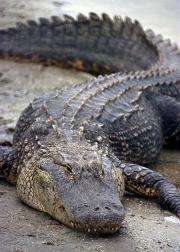
April 17, 2009 Alligator

During the last 540 million years, the earth's oxygen levels have fluctuated wildly. Knowing that the dinosaurs appeared around the time when oxygen levels were at their lowest at 12%, Tomasz Owerkowicz, Ruth Elsey and James Hicks wondered how these monsters coped at such low oxygen levels. But without a ready supply of dinosaurs to test their ideas on, Owerkowicz and Hicks turned to a modern relative: the alligator.

'We knew testing the effects of different levels would work with alligators,' Owerkowicz explains, 'because crocodilians have survived in their basic shape and form for 220 million years. They must be doing something right to have survived the oxygen fluctuations.' Choosing to start at the beginning of alligator development, the trio decided to try incubating alligator at different oxygen levels, to find out how the youngsters grew and developed and publish their results on April 17 2009 in The .

Receiving newly laid alligator eggs from Elsey at the Rockefeller Wildlife Refuge, Owerkowicz divided the eggs into groups incubated at 12% (low) oxygen, 21% (normal) oxygen and 30% (high) oxygen, and waited to see what would happen. After almost 10 weeks of waiting, the eggs began hatching and Owerkowicz could see that there were no obvious differences between the alligators that developed in normal and high oxygen atmospheres.

But he was in for a shock when the low oxygen level hatchlings began to emerge. The tiny alligators' bellies were enormously swollen. They had failed to absorb all of the egg yolk food supply, leaving them with huge yolk-distended bellies. In some cases the bellies were so big that the animals' legs could not reach the ground, and the alligators had to sit around until they had burned off the yolk and could begin moving. Owerkowicz suspects that there was not enough oxygen for the developing to consume the yolk.

The low oxygen level youngsters' organs were much smaller too, all except the heart, which was relatively large, presumably to maximise use of the youngsters' limited oxygen supplies. Owerkowicz admits that he had thought that the low oxygen newborns' lungs would also be enlarged, to compensate for the poor oxygen supply, but they were not, probably because the incubating youngsters do not use their lungs and instead obtain their oxygen through blood vessels in the egg's membrane.

Next Owerkowicz was curious to see how the alligators performed after 3 months in their respective atmospheres. Checking the reptiles' breathing and metabolic rates, it was clear that the animals in the high oxygen atmosphere were breathing much less than the normal and low oxygen animals, probably because animals in the 30% oxygen atmosphere breathe in more oxygen per lungful, translating into a significant energy saving, which the reptiles could invest in growth. And when Owerkowicz checked the size of the 3 month old low oxygen youngsters' lungs, he could see that they had caught up with his expectations and were larger than those of the normal oxygen alligators. The alligators' lungs were enlarged to compensate for the low oxygen supply, allowing the alligators to increase their metabolic rates, but not as much as the normal or high oxygen alligators.

Owerkowicz admits that although his results can't tell us what life was like for his alligators' prehistoric predecessors, it is clear that 'their growth and metabolic patterns would have been significantly different,' he says.

More information: Owerkowicz, T., Elsey, R. M. and Hicks, J. W. (2009). Atmospheric oxygen level affects growth trajectory, cardiopulmonary allometry and metabolic rate in the American alligator (Alligator mississippiensis). J. Exp. Biol. 212, 1237-1247. http://jeb.biologists.org

Source: The Company of Biologists (news : web)


print this article email this article download pdf blog this article bookmark this article     Stumble it Digg this share on Facebook retweet share on Reddit add to delicious
Rate this story - 4.1 /5 (8 votes)

Rank Filter

Move the slider to adjust rank threshold, so that you can hide some of the comments.


Display comments: newest first

  • LuckyBrandon - Apr 17, 2009
    • Rank: not rated yet
    thats freakin cool.
    if that isnt a beautiful example of adapatation in action, then nothing is.
  • jimbo92107 - Apr 17, 2009
    • Rank: not rated yet
    It would be really cool to run the low-Oxygen alligators through an entire generation, then see what happens to their hatchlings. Would the second-generation alligators emerge as swollen as the first did, or would we see an adjustment?

    Possibly the experiment could be done with a species of reptile that matures more quickly.
  • Nartoon - Apr 18, 2009
    • Rank: not rated yet
    The alligators used were from normal oxygenated parents. If the oxygen level dropped to 12% over many generations the results would be much less dramatic as they would have evolved to be successful in the lower oxygen landscape. What would happen to most other reptiles whose eggs were created at normal levels and then incubated in lower levels of oxygen, probably the same result. So all this proves is that survival adaptation requires evolution over time.

April 17, 2009 all stories

Comments: 3

4.1 /5 (8 votes)
  • Stumble this up

  • Digg this

  • share this

  • hide
  • Related Stories

  • Alabama alligators may become hunted
    created May 03, 2006 | popularity not rated yet | comments 0
  • Mammals triumphed with oxygen increase
    created Sep 28, 2005 | popularity not rated yet | comments 0
  • Cost of hatchling turtles' dash for freedom
    created Dec 12, 2008 | popularity not rated yet | comments 0
  • Study: How carp survive with little oxygen
    created Jun 01, 2006 | popularity not rated yet | comments 0
  • More gator complaints may mean rule change
    created Nov 10, 2006 | popularity not rated yet | comments 0


  • hide
  • Relevant PhysicsForums posts

  • Does this serial dilution question make sense?
    created 2 hours ago
  • Frequency and Location of Genes
    created 4 hours ago
  • Cornea and Sclera
    created 12 hours ago
  • This is a long shot...
    created Nov 11, 2009
  • How do I get an A in Bio AP if I know nothing about Biology?
    created Nov 10, 2009
  • Mutation
    created Nov 10, 2009
  • More from Physics Forums - Biology

Other News

Africa's rarest monkey had an intriguing sexual past, DNA study confirms

Africa's rarest monkey had an intriguing sexual past, DNA study confirms

Biology / Plants & Animals

created 14 hours ago | popularity 4.8 / 5 (4) | comments 0

The most extensive DNA study to-date of Africa's rarest monkey reveals that the species had an intriguing sexual past. Of the last two remaining populations of the recently discovered kipunji, one population ...


Antarctic lake

Antarctic lake home to diverse community of viruses

Biology / Cell & Microbiology

created 16 hours ago | popularity 5 / 5 (12) | comments 0

(PhysOrg.com) -- A study of the genetic structure of viruses in an Antarctic lake has revealed an astonishing genetic richness in the large number of viral families discovered.


Warm-blooded dinosaurs worked up a sweat

Warm-blooded dinosaurs worked up a sweat

Biology / Plants & Animals

created 21 hours ago | popularity 5 / 5 (4) | comments 1

(PhysOrg.com) -- Were dinosaurs endothermic (warm-blooded) like present-day mammals and birds or ectothermic (cold-blooded) like present-day lizards? The implications of this simple-sounding question go beyond ...


Can a plant be altruistic?

Biology / Plants & Animals

created 16 hours ago | popularity 5 / 5 (1) | comments 0

The concept of altruism has long been debated in philosophical circles, and more recently, evolutionary biologists have joined the debate. From the perspective of natural selection, altruism may have evolved because any ...


Cornell releases predator beetle to battle hemlock pest

Cornell releases predator beetle to battle hemlock pest

Biology / Ecology

created 17 hours ago | popularity 5 / 5 (1) | comments 0

(PhysOrg.com) -- Cornell researchers released a well-studied beetle predator to test its ability to ward off a hemlock-killing aphid-like insect.