Forests could flip from sink to source of CO2: study
April 17, 2009 by Marlowe Hood
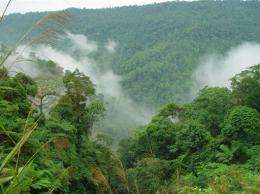
A view of a lowland rainforest on Sumatra, Indonesia. Forests that today soak up a quarter of carbon pollution spewed into the atmosphere could soon become a net source of CO2 if Earth's surface warms by another two degrees Celsius (3.6 degrees Fahrenheit), cautions a report to be presented Friday at the UN.
Forests that today soak up a quarter of carbon pollution spewed into the atmosphere could soon become a net source of CO2 if Earth's surface warms by another two degrees Celsius (3.6 degrees Fahrenheit), cautions a report to be presented Friday at the UN.
Plants both absorb and exhale carbon dioxide, but healthy forests -- especially those in the tropics -- take up far more of the greenhouse gas than they give off.
When they are damaged, get sick or die, that stored carbon is released.
"We normally think of forests as putting the brakes on global warming," said Risto Seppala, a professor at the Finnish Forest Research Institute and head of the expert panel that produced the report.
"But in fact over the next few decades, damage induced by climate change could cause forests to release huge quantities of carbon and create a situation in which they do more to accelerate warming than slow it down."
Authored by 35 of the world's top forestry scientists, the study provides the first global assessment of the ability of forests to adapt to climate change.
Manmade warming to date -- about 0.7 C since the mid-19th century -- has already slowed regeneration of tropical forests, and made them more vulnerable to fire, disease and insect infestations. Increasingly violent and frequent storms have added to the destruction.
If temperatures climb even further, the consequences could be devastating, according to the report by the Vienna-based International Union of Forest Research Organisations (IUFRO).
"The current carbon-regulating functions of forests are at risk of being lost entirely unless carbon emissions are reduced drastically," said Alexander Buck, IUFRO's deputy director and coordinator of the report.
"With a global warming of 2.5 C (4.5 F) compared to pre-industrial times, the forest ecosystems would begin to turn into a net source of carbon, adding significantly to emissions from fossil fuels and deforestation," he told AFP by phone.
The UN's Intergovernmental Panel on Climate Change (IPCC) predicted in 2007 that average global temperatures would go up before 2100 by 1.1 C to 6.4 C (2.0 F to 11.5 F), depending on efforts to curb the gases that drive global warming.
Any increase of more than 2.0 C, the panel said, would unleash a maelstrom of human misery, including drought, famine, disease and forced migration.
Since the IPCC report, however, a growing number of climate scientists have said that this threshold is likely to be crossed no matter what actions are taken.
The forest assessment did contain what appears to be some good news: cold-clime boreal forests stretching across vast expanses of Russia, northern Europe, Canada and Alaska are set to expand rapidly as climate change kicks in.
But while this may be a boon for the timber industry, it is not likely to help curb global warming, it said.
"One might assume with the increasing growth in boreal forests that more carbon would be taken up by forest ecosystems and removed from the atmosphere," said Buck.
"But these positive effects will be clearly outweighed by the negative impacts on forest ecosystems."
The report urged international negotiators trying to hammer out a new global climate change treaty before the end of the year to take into account the potential impact of warming on forests.
Up to now, discussions on forests at the UN climate talks have focused almost exclusively on the impact of deforestation.
The destruction of vegetation straddling the equator -- some 130,000 square kilometers (50,000 square miles) disappear every year -- accounts for nearly 20 percent of total carbon emissions.
"But it is also important to keep in mind that those forests that remain will be affected by climate change to a degree that might exceed their capacity to adapt," Buck cautioned.
The IUFRO report will be submitted to the UN Forum on Forests.
(c) 2009 AFP
-
Tropical forests: Earth's air conditioner
Apr 10, 2007 |
not rated yet |
0
-
First-ever 'State of the Carbon Cycle Report' finds troubling imbalance
Nov 14, 2007 |
not rated yet |
0
-
Decisive action needed as warming predictions worsen, says expert
Feb 14, 2009 |
not rated yet |
0
-
Dried mushrooms slow climate warming in Northern forests
Nov 03, 2008 |
not rated yet |
0
-
If a Tree Falls in the Forest, and No One Is Around to Hear It, Does Climate Change?
Jun 12, 2008 |
not rated yet |
0
-
Engineers build first sub-10-nm carbon nanotube transistor
Feb 01, 2012 |
4.9 / 5 (33) |
30
-
Something old, something new: Evolution and the structural divergence of duplicate genes
Jan 31, 2012 |
4.6 / 5 (7) |
1
-
The hidden nanoworld of ice crystals: Revealing the dynamic behavior of quasi-liquid layers
Jan 30, 2012 |
5 / 5 (4) |
1
-
Stock market network reveals investor clustering
Jan 27, 2012 |
3.9 / 5 (23) |
8
-
Of microchemistry and molecules: Electronic microfluidic device synthesizes biocompatible probes
Jan 26, 2012 |
5 / 5 (2) |
0
-
Do some geologists actually act a lot like Randy Marsh?
Feb 11, 2012
-
Discrepancy between oxygen and carbon-dioxide levels
Feb 09, 2012
-
where gems are found in the world
Feb 09, 2012
-
Wind Waves in Reservoir ~ Wind run-up and Wind set-up
Feb 08, 2012
-
Balance of oxygen in the atmosphere
Feb 01, 2012
-
The case for a methanol-based economy
Jan 30, 2012
- More from Physics Forums - Earth
More news stories
Latin America mining boom clashes with conservation
Latin America is experiencing a mining boom as prices rise fuelled by a hike in global demand, but the region is also being hit by a wave of violent protests, strikes and rallies by environmentalists.
20 hours ago |
5 / 5 (1) |
1
Salvage workers begin pumping fuel from Italian shipwreck
Salvage workers Sunday began pumping fuel from the shipwrecked Italian cruise liner Costa Concordia, a day ahead of schedule, officials said.
12 hours ago |
5 / 5 (2) |
0
Political leaders play key role in how worried Americans are by climate change: study
More than extreme weather events and the work of scientists, it is national political leaders who influence how much Americans worry about the threat of climate change, new research finds.
Feb 06, 2012 |
5 / 5 (8) |
75
NASA budget will axe Mars deal with Europe: scientists
US President Barack Obama's budget proposal to be submitted next week for 2013 will cut NASA's budget by 20 percent and eliminate a major partnership with Europe on Mars exploration, scientists said Thursday.
Space & Earth / Space Exploration
Feb 10, 2012 |
5 / 5 (4) |
58
Humans may have helped the decline of African rainforests 3000 years ago
(PhysOrg.com) -- Large areas of rainforests in Central Africa mysteriously disappeared over three thousand years ago, to be replaced by savannas. The prevailing theory has been that the cause was a change ...
Scientists discover molecular secrets of 2,000-year-old Chinese herbal remedy
For roughly two thousand years, Chinese herbalists have treated Malaria using a root extract, commonly known as Chang Shan, from a type of hydrangea that grows in Tibet and Nepal. More recent studies suggest that halofuginone, ...
New method to examine batteries -- MRI from the inside
There is an ever-increasing need for advanced batteries for portable electronics, such as phones, cameras, and music players, but also to power electric vehicles and to facilitate the distribution and storage of energy derived ...
A mitosis mystery solved: How chromosomes align perfectly in a dividing cell
Although the process of mitotic cell division has been studied intensely for more than 50 years, Whitehead Institute researchers have only now solved the mystery of how cells correctly align their chromosomes during symmetric ...
Google might launch Drive for cloud storage soon
(PhysOrg.com) -- Google's next big move, according to the Wall Street Journal, is a cloud storage service called Drive. Hardly first to the plate, Google is simply catching up to introducing its cloud reposi ...
Lab study raises questions over nano-particle impact
Tests involving chickens have raised questions about the impact on health from engineered nano-particles, the ultra-fine grains commonly used in drugs and processed foods, scientists said on Sunday.
Starve a virus, feed a cure? Findings show how some cells protect themselves against HIV
A protein that protects some of our immune cells from the most common and virulent form of HIV works by starving the virus of the molecular building blocks that it needs to replicate, according to research published online ...
Apr 17, 2009
Rank: 4.5 / 5 (8)
Apr 17, 2009
Rank: 5 / 5 (4)
Apr 17, 2009
Rank: 5 / 5 (4)
Apr 17, 2009
Rank: 5 / 5 (2)
But that's just the biologist in me talking. :)
Apr 18, 2009
Rank: 5 / 5 (3)
Either way we're going to learn something interesting about ourselves.
Apr 19, 2009
Rank: 5 / 5 (1)
Oh! The horror! Plants use O2 at night and add CO2 into the atmosphere!?! Yep... Under most circumstances they use up what they produce in optimum conditions for photosynthesis.
Apr 19, 2009
Rank: 5 / 5 (1)
If temps rise in their native area by a few degrees, that means local, adjacent areas that were formerly uninhabitable, will become more habitable.
Apr 19, 2009
Rank: 5 / 5 (1)
Apr 20, 2009
Rank: not rated yet
You forgot that they also add hydrocarbons to the air at the same time. That is why the LA basin had smog before there was any significant population.
Apr 20, 2009
Rank: not rated yet
I haven't heard of this before, can you post a link.
Apr 24, 2009
Rank: not rated yet
That's right! I did forget. The two most notable hydrocarbons emitted by various plants are terpenes and isoprenes. These react with NO2 from both natural and artificial sources to produce ozone at the ground level.
Apr 24, 2009
Rank: not rated yet