Surveillance vehicles take flight using alternative energy (w/Video)
April 17, 2009 Surveillance vehicles take flight using alternative energy

Enlarge

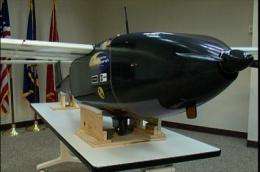
The Office of Naval Research's "Ion Tiger" UAV will test a hydrogen-powered fuel cell design, which can travel farther and carry heavier payloads than earlier battery-powered designs. Credit: The Office of Naval Research

Nearly undetectable from the ground, unmanned aerial vehicles (UAVs) are widely used by the military to scan terrain for possible threats and intelligence. Now, fuel cell powered UAVs are taking flight as an Office of Naval Research (ONR)-sponsored program to help tactical decision-makers gather critical information more efficiently... and more quietly.

Piloted remotely or autonomously, UAVs have long provided extra "eyes in the sky" especially for missions that are too dangerous for manned aircraft. This latest technology is showcased by Ion Tiger, a UAV research program at the Naval Research Laboratory (NRL) that merges two separate efforts — UAV technology and systems.

In particular, the Ion Tiger UAV tests a hydrogen-powered fuel cell design, which can travel farther and carry heavier payloads than earlier battery-powered designs. Ion Tiger employs stealthy characteristics due to its small size, reduced noise, low heat signature and zero emission

FLV player

Pursuing energy efficiency and energy independence are core to ONR's Power and Energy Focus Area. ONR's investments in alternative energy sources, like fuel cell research, have application to the Navy and Marine Corps mission in future UAVs and vehicles. These investments also contribute directly to solving some of the same technology challenges faced at the national level. Video: The Office of Naval Research

"Pursuing efficiency and energy independence are core to ONR's Power and Energy Focus Area," said Rear Admiral Nevin Carr, Chief of Naval Research. "ONR's investments in , like fuel cell research, have application to the Navy and Marine Corps mission in future UAVs and vehicles. These investments also contribute directly to solving some of the same technology challenges faced at the national level."

Fuel cells create an electrical current when they convert hydrogen and oxygen into water and are pollution-free. A fuel cell can also deliver potentially twice the efficiency of an — while running more quietly and with greater endurance.

"In this size range, we are hopefully able to conduct very productive surveillance missions at low cost with a relatively small vehicle, and a high-quality electric payload," says NRL Principal Investigator Dr. Karen Swider-Lyons.

This spring, Ion Tiger's flight trial is expected to exceed the duration of previous flights seven-fold.

"This will really be a 'first of its kind' demonstration for a fuel cell system in a UAV application for a 24-hour endurance flight, with a 5 pound payload," says ONR Program Manager Dr. Michele Anderson. "That's something nobody can do right now."

In 2005, NRL backed initial research in fuel cell technologies for UAVs. Today, says Swider-Lyons, it's paying off with a few lessons learned from the automotive industry.

"With UAVs, we are dealing with relatively small fuel cells of 500 watts," she explains. "It is hard to get custom, high-quality fuel cell membranes built just for this program. So we are riding along with this push for technology from the automotive industry."

"What's different with fuel cell cars is that developers are focused on volume…so they want everything very compact," adds Swider-Lyons. "Our first issue is weight, our second issue is weight and our third issue is weight!"

Besides delivering energy savings and increased power potential, fuel cell technology spans the operational spectrum from ground vehicles to UAVs, to man-portable power generation for Marine expeditionary missions to meeting power needs afloat. In fact, it's technology that Marines at Camp Pendleton are using today to power their General Motors fuel cell vehicles.

Across the board, the Navy and Marine Corps are seeking more efficient sources of energy. ONR has been researching and testing power and energy technology for decades. Often the improvements to power generation and fuel efficiency for ships, aircraft, vehicles and installations yield a direct benefit to the public.

"ONR has been a visionary in terms of providing support for this program," says Swider-Lyons.

Other Ion Tiger partners include Protonex Technology Corporation and the University of Hawaii. NRL's work on UAVs also leverages funding from the Office of the Secretary of Defense.

Source: Office of Naval Research


print this article email this article download pdf blog this article bookmark this article     Stumble it Digg this share on Facebook retweet share on Reddit add to delicious
Rate this story - 4.5 /5 (2 votes)

Rank Filter

Move the slider to adjust rank threshold, so that you can hide some of the comments.


Display comments: newest first

  • ProCon - May 15, 2009
    • Rank: not rated yet
    Fossil fuels are a finite resource and will eventually run out.

    Fueling the next generation of crafts with alternative energy will be necessary.

    To find out more about how well alternative and renewable energies will be able to replace fossil fuels you might like to take a look at the following website: http://alternativ...con.org/

    The site has pro and con responses on over 30 questions about alternatives to fossil fuels.

April 17, 2009 all stories

Comments: 1

4.5 /5 (2 votes)
  • Stumble this up

  • Digg this

  • share this

  • hide
  • Related Stories

  • Surveillance vehicles take flight using alternative energy
    created Mar 30, 2009 | popularity not rated yet | comments 0
  • ONR and GM partner to test advanced fuel cell vehicles of the future (w/Video)
    created Mar 18, 2009 | popularity not rated yet | comments 0
  • NRL demonstrates fuel cell-powered unmanned aerial system
    created Nov 22, 2005 | popularity not rated yet | comments 0
  • Flying on hydrogen
    created Aug 28, 2006 | popularity not rated yet | comments 0
  • Proton-Exchange-Membrane Fuel Cell Tested at Glenn
    created Oct 04, 2005 | popularity not rated yet | comments 0


  • hide
  • Relevant PhysicsForums posts

  • Relative pressure & specific volume
    created 2 hours ago
  • Making 4'x8' sign inkjet printer - need nozzles - help?
    created Nov 06, 2009
  • Calculating Velocity
    created Nov 06, 2009
  • shear stress distribution in triangular steel profile
    created Nov 06, 2009
  • Polygonal mirror reflection beam Problem
    created Nov 05, 2009
  • Help with a Basic design
    created Nov 05, 2009
  • More from Physics Forums - General Engineering

Other News

Microsoft websites were the most visited in September

Microsoft websites top spots in September: comScore

Technology / Internet

created 11 hours ago | popularity 3 / 5 (2) | comments 0

Industry tracker comScore on Friday released a study showing that Internet users in September spent more time at Microsoft websites that at any other online properties.


Brazil blackouts result of cyber hacking: report

Technology / Internet

created 11 hours ago | popularity 2.5 / 5 (2) | comments 0

Massive power outages in Brazil in 2005 and 2007 that impacted millions were caused by cyber hackers attacking control systems, the US television network CBS said Sunday.


The Beatles perform in 1964 at the Olympia in Paris

Bluebeat to battle EMI over Beatles songs

Technology / Internet

created 10 hours ago | popularity not rated yet | comments 0

US online music service Bluebeat said it plans to fight British recording label EMI over rights to stream and sell versions of Beatles songs.


airpod

Car That Runs on Compressed Air Questioned by Critics (w/ Video)

Technology / Energy

created Nov 03, 2009 | popularity 3.8 / 5 (17) | comments 26

(PhysOrg.com) -- As electric cars begin breaking into the short-distance vehicle market, one French company thinks that it has an alternative to the electric vehicle: a car that runs on compressed air. Motor ...


Sahara

Will Europe Be Powered by the Sahara

Technology / Energy

created Nov 04, 2009 | popularity 4 / 5 (18) | comments 23

(PhysOrg.com) -- Europe has long been interested in developing alternative energy sources. And, one of the more interesting places that some Europeans are looking for solar power is the Sahara. With the vast ...