Male impotence drugs may deserve a second look in women
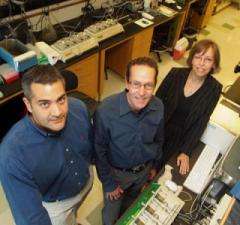
New studies indicate the three drugs used to treat male impotence also appear to work in females, albeit a little differently, and should give the scientific community pause to take a second look at their potential in the 40 percent of women who report sexual dysfunction, researchers say.
In one of the first studies of the effect of phosphodiesterase Type 5 inhibitors - Viagra, Levitra and Cialis - on the pudendal arteries that supply the penis, vagina and clitoris the blood needed to produce a satisfying sexual experience, Medical College of Georgia researchers showed the drugs relax the artery in male and female rats.
"It shows the drugs need to be investigated more for women and small alterations could make these compounds more effective for women living with these disorders," says Dr. Kyan J. Allahdadi, postdoctoral fellow in physiology at MCG. He's presenting the findings during the 122nd Annual Meeting of the American Physiological Society held in New Orleans April 18-22 as part of the Experimental Biology 2009 scientific conference.
Although there was talk years ago of a pink pill for women to parallel the blue Viagra for men, early clinical trials found essentially no response in women.
MCG researchers decided to look again, first giving a drug to constrict the internal pudendal arteries in male and female rats - as they would be in a non-erect state - then giving doses of each impotency drug to see the impact. The arteries from male rats displayed a relatively standard concentration-dependent relaxation - the more drug they got, the more they relaxed - while in females arteries, there was an initial relaxation then an odd oscillation between relaxation and contraction with subsequent dosing.
While they don't fully understand the swing, the unique female response likely provides more evidence that sexual function is more complex in females, says Dr. R. Clinton Webb, chair of the MCG Department of Physiology and a study author. Scientists define female sexual dysfunction as a multifaceted disorder that includes anatomical, psychological, physiological and social-interpersonal aspects.
MCG researchers have shown part of that complexity may be the smooth muscle cells in the internal pudendal arteries of females communicate, agreeing to contract and relax, while male smooth muscle cells make independent decisions to just relax.
They found one other distinction: females were more sensitive to Viagra®, or sildenafil, while males were most sensitive to Levitra®, or vardenafil.
Previous studies on the effectiveness of these drugs focused on the cavernosal tissue, or penis. The internal pudendal artery actually feeds the penile artery which is buried deep in the penis where numerous caverns enable it to be flaccid when not engorged with blood. Physical stimulation of the area causes the tissue, endothelial cells and nerves to release nitric oxide, a powerful dilator of blood vessels. The system works pretty much the same way in the vagina and clitoris.
"If you have too much constriction or not enough relaxation to allow blood to go through the internal pudendal artery, you are not going to get the net effect of an erection," Dr. Allahdadi says. "That is why we wanted to begin to characterize what was going on in this blood vessel."
Perhaps as importantly, the MCG scientists and others are beginning to believe sexual dysfunction provides an early, or at least visible, clue of vascular disease. Vascular problems, that can result from diabetes, hypertension, high cholesterol and the like, are a major cause of sexual dysfunction in men and women. "You don't feel atherosclerosis but you know darn well if you are not getting an erection," Dr. Webb says. In fact, the MCG scientists are beginning to look at animal models of disease states, such as diabetes, to see what it does to these internal pudendal arteries.
"What we have seen preliminarily is there is big difference in responsiveness in these arteries. The diabetic pudendal arteries are much more sensitive to contraction," Dr. Allahdadi says. They will look at how drugs like Viagra impact that contraction in the days ahead.
In fact MCG scientists suspect one reason that many of the women participants in previous studies of Viagra did not seem to respond is because they did not have vascular problems that could have been circumvented by a drug that relaxes arteries so blood can enter. In men with a healthy vasculature, the drugs likely would still produce a longer erection.
Dr. Rita C. Tostes, associate professor in the MCG Department of Physiology, is a co-author who contributed to the design and analysis of the study.
Source: Medical College of Georgia


