Pioneering medical nanotechnology offers new cancer breakthrough hope
April 17, 2009 Pioneering medical nanotechnology offers new cancer breakthrough hope

Enlarge

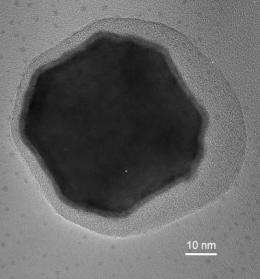
This is a transmission electron micrograph of the magnetic nanoparticles that will be used in this study. Credit: Credit: Professor Chris Binns, Department of Physics and Astronomy, University of Leicester

A multi-disciplinary team of scientists from the University of Leicester could be potentially paving the way for the development of a powerful new strategy for both the early diagnosis and treatment of prostate cancer.

The research is to use cutting edge nanotechnology to identify a pioneering treatment which could also be applied to other aggressive cancers.

The University of Leicester researchers say that microscopic (5-100 nm) magnetic nanoparticles could be applied in the sensitive diagnosis and effective treatment of . This follows breakthrough nanotechnology research at the University.

Dr Wu Su, of the Department of Chemistry, has been awarded a grant worth £321 K. This is one of only ten Postdoctoral Research Fellowships in the Life Sciences Interface area given this year by the Engineering and Physical Sciences Research Council (EPSRC). This is the first EPSRC postdoctoral research fellowship awarded to the University of Leicester.

The highly prestigious award will allow a multi-disciplinary research team to design high-performance magnetic nanoparticles. The team consists of researchers from the University of Leicester departments of Chemistry, Physics, Cancer Studies and Molecular Medicine and Cardiovascular Sciences.

High-performance magnetic nanoparticles act as probes that show up (using ) and kill (by hyperthermia) tumour cells at a much earlier stage than conventional methods.

The pioneering technology, developed at the University of Leicester, is focused on the development of a new type of magnetic nanoparticle in which the magnetic performance is increase by a factor of ten. Targeting these magnetic nanoparticles to unique cell surface receptors present on the prostate tumour cell surface will enable efficient and specific delivery to . The approach is general and it is envisaged that these systems could be applied to other types of aggressive cancers [liver, breast, colon] in which early diagnosis and treatment is essential for recovery.

Dr Su said this technology requires a multidisciplinary approach: "Prostate cancer cure rates are predicated on early diagnosis and treatment. The technology that we are developing offers the potential of both the identification and of prostate cancer in a highly selective manner."

Successful implementation of this technology would provide significant welfare benefits for patients [reducing the need for surgical removal of the prostate] and significant cost benefits for the UK health-care system.

Source: University of Leicester (news : web)


print this article email this article download pdf blog this article bookmark this article     Stumble it Digg this share on Facebook retweet share on Reddit add to delicious
Rate this story - 5 /5 (5 votes)

Rank Filter

Move the slider to adjust rank threshold, so that you can hide some of the comments.


Display comments: newest first

  • E_L_Earnhardt - Apr 17, 2009
    • Rank: not rated yet
    Please, please! HypOthermia! Not HypeRthermia! Heat will INCREASE mitosis in target and neighboring cells! COOLING will DECREASE the rate!
    Cyroablation has PROVEN the point!

April 17, 2009 all stories

Comments: 1

5 /5 (5 votes)
  • Stumble this up

  • Digg this

  • share this

  • hide
  • Related Stories

  • New treatment hope for prostate cancer
    created Feb 06, 2009 | popularity not rated yet | comments 0
  • MRI findings help forecast prostate cancer prognosis
    created Mar 25, 2008 | popularity not rated yet | comments 0
  • Proepithelin encourages cell growth and migration in prostate cancer
    created Feb 26, 2009 | popularity not rated yet | comments 0
  • Using magnetic nanoparticles to combat cancer
    created Jul 16, 2008 | popularity not rated yet | comments 0
  • Low-income men more likely to be diagnosed with advanced prostate cancer
    created Dec 16, 2008 | popularity not rated yet | comments 0


  • hide
  • Relevant PhysicsForums posts

Other News

Engineers image nanostructure of a solid acid catalyst and boost its catalytic activity

Nanotechnology / Nanomaterials

created 5 hours ago | popularity 5 / 5 (1) | comments 2

The catalytic processes that facilitate the production of many chemicals and fuels could become much more environmentally friendly thanks to a breakthrough achieved by researchers from Lehigh and Rice Universities.


New transparent insulating film could enable energy-efficient displays

New transparent insulating film could enable energy-efficient displays

Nanotechnology / Nanomaterials

created 9 hours ago | popularity 4.9 / 5 (7) | comments 0

Johns Hopkins materials scientists have found a new use for a chemical compound that has traditionally been viewed as an electrical conductor, a substance that allows electricity to flow through it. By orienting ...


Ideal nanoparticle cancer therapies surf the bloodstream

Nanotechnology / Bio & Medicine

created 9 hours ago | popularity 5 / 5 (1) | comments 0

Eric Shaqfeh studies blood at Stanford University, using computer models that simulate how the fluid and the cells it contains move around. On November 11 at a meeting of the scientific society AVS, he will present his latest ...


New Digital 'Electronics' Concept May Continue Moore's Law

New Digital 'Electronics' Concept May Continue Moore's Law

Nanotechnology / Nanophysics

created Nov 05, 2009 | popularity 4.6 / 5 (57) | comments 9

(PhysOrg.com) -- Computers of the future could be operating not on electrons, but on tiny waves traveling through an electron "fluid," if a new proposal is successful. The new circuit design, recently introduced ...


Nanoparticles for gene therapy improve

Nanoparticles for gene therapy improve

Nanotechnology / Bio & Medicine

created Nov 06, 2009 | popularity 5 / 5 (5) | comments 3

(PhysOrg.com) -- About five years ago, Professor Janet Sawicki at the Lankenau Institute in Pennsylvania read an article about nanoparticles developed by MIT's Robert Langer for gene therapy, the insertion ...