Increasing carbon dioxide and decreasing oxygen make it harder for deep-sea animals to 'breathe'
April 17, 2009 Increasing carbon dioxide and decreasing oxygen make it harder for deep-sea animals to 'breathe'

Enlarge

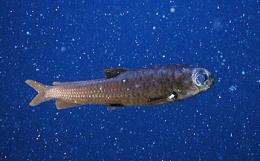
A new study by marine chemists at MBARI suggests that deep-ocean animals such as this owlfish (Bathylagus milleri) may suffer as carbon dioxide increases and oxygen concentrations decline in the deep sea. Image: © 2001 MBARI

(PhysOrg.com) -- New calculations made by marine chemists from the Monterey Bay Aquarium Research Institute (MBARI) suggest that low-oxygen "dead zones" in the ocean could expand significantly over the next century. These predictions are based on the fact that, as more and more carbon dioxide dissolves from the atmosphere into the ocean, marine animals will need more oxygen to survive.

Concentrations of are increasing rapidly in the Earth's atmosphere, primarily because of human activities. About one third of the carbon dioxide that humans produce by burning is being absorbed by the world's oceans, gradually causing seawater to become more acidic.

However, such "ocean acidification" is not the only way that carbon dioxide can harm . In a "Perspective" published today in the journal Science, Peter Brewer and Edward Peltzer combine published data on rising levels of carbon dioxide and declining levels of oxygen in the ocean in a set of new and thermodynamically rigorous calculations. They show that increases in carbon dioxide can make marine animals more susceptible to low concentrations of oxygen, and thus exacerbate the effects of low-oxygen "" in the ocean.

Brewer and Peltzer's calculations also show that the partial pressure of dissolved carbon dioxide gas (pCO2) in low-oxygen zones will rise much higher than previously thought. This could have significant consequences for marine life in these zones.

For over a decade, Brewer and Peltzer have been working with marine biologists to study the effects of carbon dioxide on marine organisms. High concentrations of carbon dioxide make it harder for marine animals to respire (to extract oxygen from seawater). This, in turn, makes it harder for these animals to find food, avoid predators, and reproduce. Low concentrations of oxygen can have similar effects.

Currently, deep-sea life is threatened by a combination of increasing carbon dioxide and decreasing oxygen concentrations. The amount of dissolved carbon dioxide is increasing because the oceans are taking up more and more carbon dioxide from the atmosphere. At the same time, ocean surface waters are warming and becoming more stable, which allows less oxygen to be carried from the surface down into the depths.

In trying to quantify the impacts of this "double whammy" on marine organisms, Brewer and Peltzer came up with the concept of a "respiration index." This index is based on the ratio of oxygen and carbon dioxide gas in a given sample of seawater. The lower the respiration index, the harder it is for marine animals to respire.

Brewer provides the following analogy, "Animals facing declining oxygen levels and rising CO2 levels will suffer in much the same way that humans in a damaged submarine would suffer, once the concentrations of these gasses reach critical levels. Our work helps define those critical levels for marine animals, and will enable the emerging risk to be quantified and mapped."

In the past, marine biologists have defined "dead zones" based solely on low concentrations of dissolved oxygen. Brewer and Peltzer hope that their respiration index will provide a more precise and quantitative way for oceanographers to identify such areas. Tracking changes in the respiration index could also help marine biologists understand and predict which ocean waters are at risk of becoming dead zones in the future.

To estimate such effects in the open ocean, the MBARI researchers calculated the respiration index at various ocean depths, for several different forecasted concentrations of atmospheric carbon dioxide. They found that the most severe effects would take place in what are known as "oxygen minimum zones." These are depths, typically 300 to 1,000 meters below the surface, where oxygen concentrations are already quite low in many parts of the world's oceans.

Previously, marine biologists have assumed that the effects of increasing carbon dioxide in the oceans would be greatest at the sea surface, where most of the gas enters the ocean. Such studies have predicted a doubling of pCO2 (from about 280 to 560 micro-atmospheres) at the sea surface over the next 100 years. Brewer and Peltzer's calculations suggest that the partial pressure of carbon dioxide will increase even faster in the deep oxygen minimum zones, with pCO2 increasing by 2.5 times, from 1,000 to about 2,500 micro-atmospheres.

Previous studies have indicated that such oxygen minimum zones may expand over the next century. Brewer and Peltzer's research suggests that the effects of this expansion will be even more severe than previously forecast.

According to coauthor Peltzer, "The bottom line is that we think it's important to look at both and carbon dioxide in the oceans, rather than just one or the other." The impact of these chemical changes may be minimal in well-oxygenated areas, but as the authors point out in their paper, "We may anticipate a very large expansion of the oceanic dead zones."

More information: P. G. Brewer, E. T. Peltzer. Limits to marine life. Science. 2009. Vol 324, Issue 5925. April 16, 2009

Source: Monterey Bay Aquarium Research Institute (news : web)


print this article email this article download pdf blog this article bookmark this article     Stumble it Digg this share on Facebook retweet share on Reddit add to delicious
Rate this story - 4.8 /5 (78 votes)

Rank Filter

Move the slider to adjust rank threshold, so that you can hide some of the comments.


Display comments: newest first

  • GrayMouser - Apr 17, 2009
    • Rank: 3.7 / 5 (6)
    Yeah, CO2 has increased from nano-scopic to microscopic (and much slower than the IPCC has predicted) so the question is, what proof for their "respiration index" or the "double whammy" exist to support their prophecy?
  • mikiwud - Apr 17, 2009
    • Rank: 2.8 / 5 (4)
    At the same time, ocean surface waters are warming and becoming more stable, which allows less oxygen to be carried from the surface down into the depths.

    I thought the oceans had cooled recently.
  • pres68y - Apr 17, 2009
    • Rank: 3 / 5 (2)
    What we are putting into the atmosphere is not as important as what we are taking out.
    Namely, oxygen.
    We use up oxygen for a vast number of things and do very little to replace it.

    Interesting, when one is sick they frequently give an oxygen bottle to help make them better.
    Yet, for some reason there is little concern about long term effects of reduced oxygen -primarily in our cities.

    Join your local O24US club! :)

    Pres
  • PPihkala - Apr 18, 2009
    • Rank: 5 / 5 (2)
    The amount of oxygen in air (>20%) is so much that any change in it by humans is less relevant than is the change in amount of CO2 (that is somewhere like 300 ppm = 0.03%). So the amount of O2 needed to rise CO2 from 300 to 1000 ppm would be 0.07%. Assuming 21% of O2 to start with, that would then reduce to 20.93%. So no issue there. But if CO2 will reach 1000 ppm, then world would be a much harder place to live, also for the fish, it seems.
  • PPihkala - Apr 18, 2009
    • Rank: 2.3 / 5 (3)
    I thought the oceans had cooled recently.

    Yeah, where is the proof? Just look at arctic having less and less ice each year and then come and tell me oceans have cooled recently. Same applies to diminishing Antarctic ice. Surely there are some variation cycles, but the overall trend is towards warmer.
  • mikiwud - Apr 18, 2009
    • Rank: 3.7 / 5 (3)
    I thought the oceans had cooled recently.

    Sorry my bad. I should have said:-
    The oceans HAVE cooled recently.
    I was being sarcastic in first post.
    As for diminishing Antarctic ice see www.whattsupwiththat.com

    From the Nat Geo story:

    %u201C[It's] an event we don%u2019t get to see very often,%u201D Ted Scambos, lead scientist at the U.S. National Snow and Ice Data Center in Boulder, Colorado, said in a press statement.

    Now, how is it that an ice shelf breaks up in the spring of 2008 and again in the spring of 2009 and it%u2019s %u201Cnot very often%u201D? Hmmm.


    It seems NSIDC%u2019s Ted Scambos gets around. Doing a Google search for

    Wilkins ice shelf %u201CTed Scambos%u201D

    yields about 4,930 results. Yep, he sure gets the word out every year.

    Ted Scambos said something similar in 1999:

    %u201COn the southwest side of the peninsula, the Wilkins ice shelf retreated nearly 1,100 square kilometers in early March of last year [1998], said Scambos. %u2026 Within a few years, much of the Wilkins ice shelf will likely be gone%u201D

    But, as can be seen from the following January 1996 and March 2008 images, there has been hardly any change in a decade. Look at the photos below from the appinsys web site:

    This is the scaremongering the gullible accept as gospel.


  • dachpyarvile - Apr 18, 2009
    • Rank: 4.3 / 5 (4)
    The editor should have added the words "in a lab" to this story's headline. A laboratory is not the ocean. Samples need to be taken directly from these O2-minimum regions the old-fashioned way and not simulated in an aquarium lab or on computers.

April 17, 2009 all stories

Comments: 7

4.8 /5 (78 votes)
  • Stumble this up

  • Digg this

  • share this

  • hide
  • Related Stories

  • Food source threatened by carbon dioxide
    created Dec 10, 2007 | popularity not rated yet | comments 0
  • Nitrous oxide from ocean microbes
    created Dec 10, 2007 | popularity not rated yet | comments 0
  • Dramatic expansion of dead zones in the oceans
    created Jan 25, 2009 | popularity not rated yet | comments 0
  • Ocean acidification from CO2 emissions will cause physiological impairment to jumbo squid
    created Dec 15, 2008 | popularity not rated yet | comments 0
  • Regardless of global warming, rising CO2 levels threaten marine life
    created Mar 08, 2007 | popularity not rated yet | comments 0


  • hide
  • Relevant PhysicsForums posts

  • cycles
    created Nov 08, 2009
  • The Origin of the term 'fossil' fuels
    created Nov 05, 2009
  • co2
    created Nov 03, 2009
  • Early Earths Sulfidic Ocean Conditions
    created Oct 30, 2009
  • vegetation
    created Oct 29, 2009
  • climate change
    created Oct 29, 2009
  • More from Physics Forums - Earth

Other News

Making Climate Forecasts More Useful to Farmers

Making Climate Forecasts More Useful to Farmers

Space & Earth / Environment

created 1hour ago | popularity not rated yet | comments 0

(PhysOrg.com) -- Climate forecasts are becoming more useful to farmers and ranchers, thanks to research by Agricultural Research Service (ARS) scientists and their cooperators.


L-R: Chiwetel Ejiofor, Amanda Peet and John Cusack at the premiere of "2012"

NASA on crusade to debunk 2012 apocalypse myths

Space & Earth / Space Exploration

created 3 hours ago | popularity not rated yet | comments 0

The world is not coming to an end on December 21, 2012, the US space agency insisted Monday in a rare campaign to dispel widespread rumors fueled by the Internet and a new Hollywood movie.


NASA satellites make a movie and get rainfall, wind info on Ida

NASA satellites make a movie and get rainfall, wind info on Ida (w/ Video)

Space & Earth / Earth Sciences

created 3 hours ago | popularity not rated yet | comments 0

NASA satellites are amazing examples of technology. The TRMM satellite peers into tropical cyclones and can tell how much rain is falling per hour and where. QuikScat uses microwave technology to measure Ida's ...


Antarctica glacier retreat creates new carbon dioxide store

Antarctica glacier retreat creates new carbon dioxide store

Space & Earth / Earth Sciences

created 8 hours ago | popularity 4.3 / 5 (3) | comments 0

Large blooms of tiny marine plants called phytoplankton are flourishing in areas of open water left exposed by the recent and rapid melting of ice shelves and glaciers around the Antarctic Peninsula. This ...


NASA's TRMM Satellite sees most of Ida's heaviest rain stayed off coasts

NASA's TRMM Satellite sees most of Ida's heaviest rain stayed off coasts

Space & Earth / Earth Sciences

created 4 hours ago | popularity not rated yet | comments 0

NASA and the Japanese Space Agency's Tropical Rainfall Measuring Mission (TRMM) satellite flew over Ida and captured her rainfall when she passed by Nicaragua, Honduras and Belize this weekend. TRMM data revealed ...