Diagnosing skin cancer without a biopsy
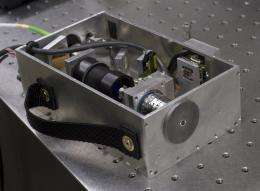
(PhysOrg.com) -- A recent Montana State University master's graduate is working with doctors at Vanderbilt Medical Center in Tennessee to build a handheld laser microscope that could someday reduce the number of biopsies needed to diagnose skin cancer.
Suspicious spots on the skin often prompt dermatologists to remove skin samples for analysis. These procedures are currently the best way to diagnose skin cancers, said Chris Arrasmith, who recently earned his master's degree and now works as a researcher in MSU's electrical engineering department.
But biopsies are invasive procedures that are often painful. Millions are conducted each year in the United States, and according to the American Cancer Society, most of those biopsies -- as many as 80 percent for some types of cancers -- come back negative.
The handheld microscope could help doctors get a better idea when biopsies are absolutely necessary. That would cut down on the number of biopsies that have to be performed and streamline the process of diagnosing cancers, Arrasmith said.
"Any combination of tools we can provide to enable early detection of any kind of disease is a good thing," said Arrasmith, 25.
Like most microscopes, the MSU-Vanderbilt device uses lenses to look at a patient's skin, but instead of illuminating the skin with normal white light, the device uses laser light.
The laser light is used to form an image of the skin's cellular structure, and it monitors the way a patient's cells change the reflected laser light, Arrasmith said. Those changes to the light can tell scientists the chemical composition of the skin cells -- a process called spectroscopy.
"Within the microscope's image, we can select an area of interest, and from that we can take a spectrum and get chemical data," Arrasmith said.
Doctors would then compare that chemical signature to a database containing the chemical signatures of known cancers to see whether the patient's cells are cancerous.
The project, which Arrasmith began working on when he was an undergraduate at MSU, is funded by a five-year grant from the National Institute of Biomedical Imaging and Bioengineering, part of the National Institutes of Health. The NIBIB focuses on researching new biomedical imaging devices and techniques to improve the detection, treatment and prevention of disease.
The $1.79 million grant is administered by Vanderbilt. MSU will receive $500,000 from the grant over all five years. That money covered, among other things, the cost of the microscope itself and Arrasmith's graduate tuition.
David Dickensheets, an associate professor of electrical and computer engineering at MSU and adviser to Arrasmith's work, said other labs have built microscopes that work on the same principles, but they have been desktop instruments that still required skin samples to be taken from patients.
Shrinking the microscope takes advantage of MSU's expertise in a field called micro-electrical-mechanical systems, or MEMS.
The handheld microscope contains a tiny mirror made of silicon that scans the laser beam across the skin, Dickensheets said. This allows the microscope to form an image and lets it look at cells beneath the patient's outer skin layer.
Merging MSU's expertise in microscopy and MEMS with Vanderbilt's spectroscopy research will produce a device that could one day find its way into dermatology clinics around the world, Dickensheets said.
"We think that microscopic imaging of cell structure combined with the chemical specificity provided by spectroscopy is the real key to making it a useful tool," Dickensheets said.
For Arrasmith, who has worked on the microscope since 2006, the approaching end of his time at MSU is both satisfying and bittersweet.
It's satisfying, he said, because he's been able to build a prototype microscope that's now being tested at Vanderbilt's medical clinics. It's bittersweet, he said, because he knows he won't be around to see the finished second-generation model, which he hopes will be about the size of a chalkboard eraser.
"As a person who likes to see things from start to completion, it's difficult to leave in the middle of a long project like this," he said.
But he said the experience he's gained from having a hand in every aspect of the project -- from theory and design to machining parts -- will give him a leg up in searching for an engineering job after he leaves MSU.
"This project has really allowed me to see how things come together from multiple facets of design," he said. "What I'm taking away from MSU is a general knowledge base that I can apply to any other situation."
Provided by Montana State University


