Desert clash in West over solar potential, water
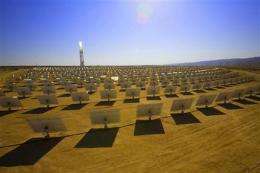
(AP) -- A westward dash to power electricity-hungry cities by cashing in on the desert's most abundant resource - sunshine - is clashing with efforts to protect the tiny pupfish and desert tortoise and stinginess over the region's rarest resource: water.
Water is the cooling agent for what traditionally has been the most cost-efficient type of large-scale solar plants. To some solar companies answering Washington's push for renewable energy on vast government lands, it's also an environmental thorn. The unusual collision pits natural resources protections against President Barack Obama's plans to produce more environmentally friendly energy.
The solar hopefuls are encountering overtaxed aquifers and a legendary legacy of Western water wars and legal and regulatory scuffles. Some are moving to more costly air-cooled technology - which uses 90 percent less water - for solar plants that will employ miles of sun-reflecting mirrors across the Western deserts. Others see market advantages in solar dish or photovoltaic technologies that don't require steam engines and cooling water and that are becoming more economically competitive.
The National Park Service is worried about environmental consequences of solar proposals on government lands that are administered by the Bureau of Land Management. It says it supports the solar push but is warning against water drawdowns, especially in southern Nevada. In the Amargosa Valley, the endangered, electric-blue pupfish lives in a hot water, aquifer-fed limestone cavern called Devil's Hole.
"It is not in the public interest for BLM to approve plans of development for water-cooled solar energy projects in the arid basins of southern Nevada, some of which are already over-appropriated," Jon Jarvis, director of the Park Service's Pacific West Region, wrote to the BLM director in Nevada.
Jarvis' e-mail from February, obtained by The Associated Press, noted that the rare pupfish's dwindling numbers prompted Nevada to ban new groundwater allocations within 25 miles of the pool.
Jarvis urged the BLM to promote technologies that use less water and hold off on permits until it finishes its assessment of the solar program next year. The BLM tried suspending new applications last year but relented under pressure from industry and advocates of renewable energy.
"Water is a big concern and the desert tortoise is a major concern, and the amount of site preparation is a concern," said Linda Resseguie, a BLM project manager. The government in reviewing each project wants to make careful decisions over what it considers "a potentially irreversible commitment of lands," she said.
Water is among the complications in deserts where more than 150 solar applications have been submitted for hot spots in Nevada, California, and Arizona, plus a few in New Mexico.
Companies are wrestling with routes for long-distance transmission lines and habitat for the threatened desert tortoise. They also are worried about a proposal being developed by Sen. Dianne Feinstein, D-Calif., for a Mojave national monument, which could put up to 600,000 acres off-limits alongside already protected park and military lands. It could affect at least 14 solar and five wind energy proposals.
The Spanish-owned energy company, Iberdrola, has submitted 12 applications in four states. Its solar managing director, Kim Fiske, said her company is planning to use photovoltaic technology in Amargosa Valley but elsewhere will evaluate each site's feasibility for water. Photovoltaic systems use conducting material to convert sunlight directly to electricity and need only nominal amounts of water to wash their solar panels, compared with the traditional steam-turbine solar that uses much larger volumes of water for cooling towers.
"Water usage is becoming the larger issue. Some companies still want wet cooling and say it's less efficient to do dry cooling, and they need 10 percent more land to get the same output," said Peter Weiner, an attorney representing solar companies. Some are exploring hybrid systems that use water during the hottest part of the day.
The government won't say how much water would be needed by applicants because those proposals are still in flux. But National Park Service hydrologists last fall tallied more than 50,000 acre feet per year - nearly 16.3 billion gallons - proposed by applications in Amargosa Valley alone, or enough to supply more than 50,000 typical American homes. Nevada previously said the basin could support only half that. Since then, some companies have dropped out or switched to photovoltaics, making that estimate of 16.3 billion gallons outdated.
Nevada's policy and legal mandates restrict water in the driest areas. California regulators warn that wet-cooled projects face an uphill climb. The two under review there so far on government land use minimal water. First up is Oakland, Calif.-based BrightSource Energy's five-square mile, air-cooled, mirror complex near the Mojave National Preserve.
In Arizona, most solar proposals are away from populous areas with the most water restrictions.
Water is "a hot button for everybody," said Fiske. "Everyone is concerned about water. It's probably one of the biggest issues."
---
On the Net:
National Park Service: http://www.nps.gov/
Bureau of Land Management: http://www.blm.gov
Iberdrola: http://www.iberdrolausa.com
BrightSource Energy: http://www.brightsourceenergy.com/
©2009 The Associated Press. All rights reserved. This material may not be published, broadcast, rewritten or redistributed.


