Yellow submarine to try again for Atlantic glide
April 19, 2009 By RANDOLPH E. SCHMID , AP Science Writer Yellow submarine to try again for Atlantic glide (AP)

Enlarge

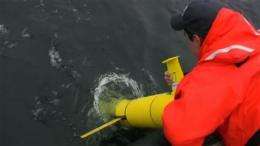
This undated handout photo provided by Coastal Ocean Observation Lab, Rutgers University shows the launch and an unmanned, with with no motor, glider that can rise and dive, seeking out currents that will carry it along without worrying about refueling. Whenever it comes to the surface it radios its findings back to the scientists. A second try at sending a little yellow submarine gliding across the Atlantic Ocean to collect scientific data from beneath the waves is about to get underway. (AP Photo/Coastal Ocean Observation Lab, Rutgers University)

(AP) -- A second try is about to get under way at sending a little yellow submarine gliding across the Atlantic Ocean to collect scientific data from beneath the waves.

"The launching is tremendously exciting because there is just so much that we don't really know about what happens in the oceans," said Jane Lubchenco, head of the .

"The capacity to fly through the ocean, across the Atlantic, taking data about temperature, salinity and other properties of the water gives us keen insight into what's happening down there," she said in a telephone interview.

The first glider was lost last year before it completed its trip. The second, improved version has been put together by the same team at Rutgers University in New Brunswick, N.J. If conditions cooperate, the launch is set for Wednesday - Earth Day.

Rutgers professor Scott Glenn, who is leading the glider project, points out that Earth is the ocean planet.

Unmanned and without a motor, the glider can rise and dive, seeking out currents that will carry it along without worrying about refueling. Whenever it comes to the surface, it radios its findings back to the scientists.

"The ocean plays such a critical role in the dynamics of the climate system, having a better understanding of what's happening in real time is invaluable information," said Lubchenco (LUB-chen-co).

"We're beginning to be able to infer much about the kinds of plants and animals and microbes that may be present from some of the kinds of data that the glider will be taking," she added.

Glenn said the device will be able to take a daily profile of water conditions and maneuver, directed by radio messages from student researchers. "If we can do it with one, we can do it with 10," he said, and then with more, and that will make an impact on forecasting .

"That's important because the ocean is very important for and it is undersampled," said Glenn, co-director of the Mid-Atlantic Regional Coastal Ocean Observing System.

And the robots can be sent into hurricanes and into Arctic and Antarctic conditions.

"If you lose them it's sad, but its just wires, you can build another one. These are the things that we can take risks with," he said. "We're doing some risk taking here that will benefit the entire scientific community."

The glider has been improved with new software, a new surface that scientists hope will discourage marine organisms from attaching to, and the ability to dive as much as 660 feet down, farther than the first version. The glider has been reinforced to resist bites from creatures such as sharks.

The first glider was lost after it developed a leak, possibly from a bite.

Like its predecessor, the new glider (yellow, as before) has been named Scarlet Knight after the Rutgers school mascot.

The glider is part of the Integrated Ocean Observing System, a project to collect and use ocean information continuously covering oceans, coastal waters and Great Lakes.

"Oceans are vital to all of life on earth. A billion people a day depend on seafood for their primary or sole source of protein, oceans drive the climate system, oceans provide most of the oxygen that we breathe," Lubchenco said.

"They provide wonderful places for recreation, they are an important source of jobs, livelihoods. Just within the U.S., half of Americans live in coastal areas and 60 percent of gross domestic product comes from coastal areas, so clearly they are an integral part of our very fabric. Yet we know precious little about them," she said.

"We're constructing a vast, three dimensional jigsaw puzzle," Lubchenco said. "We have bits and pieces of the puzzle and we're building out from that. So every track that this glider makes, every new sensor that we have in the oceans" provides data to construct a more meaningful and dynamic picture of the world, she said.

"We have only just begun to tap the potential that is here on planet ocean."

---

On the Net:

NOAA: http://www.noaa.gov

Integrated Ocean Observing System: http://ioos.noaa.gov

Mid-Atlantic Regional Coastal Observing System: http://marine.rutgers.edu/marcoos/

©2009 The Associated Press. All rights reserved. This material may not be published, broadcast, rewritten or redistributed.


print this article email this article download pdf blog this article bookmark this article     Stumble it Digg this share on Facebook retweet share on Reddit add to delicious
Rate this story - 4.9 /5 (8 votes)

Rank Filter

Move the slider to adjust rank threshold, so that you can hide some of the comments.


Display comments: newest first

  • Fazer - Apr 19, 2009
    • Rank: 4.5 / 5 (2)
    This is pretty darn cool. I certainly prefer to curtail government spending, but this seems like great use of technology on all fronts.

    Of course, one day the ocean will be littered with these things. Do Lithium batteries seep out clouds of toxic waste, or do they explode as soon as the water reaches the Lithium?
  • david_42 - Apr 19, 2009
    • Rank: 5 / 5 (1)
    Odd you ask about lithium batteries, as nothing in the article mentions them. It's more likely that they use alkaline batteries, the 40% increase in energy per liter over lithiums would be critical for a mission of this length. Energy per kg is about the same, but the article makes it clear the glider is volume limited.
  • Fazer - Apr 19, 2009
    • Rank: not rated yet
    Good point.
  • amos - Apr 19, 2009
    • Rank: not rated yet
    We have collected huge amounts of ocean surface data from Niiler's "Drifter" buoys over the years, and partly as a result of that data we have some insight into the "Niiler striations" of currents at different levels. It will be extremely interesting to see how the data collected by these semi-robotic submarines relates to that model. I hope they do a could job of data collection.
  • Crossrip - Apr 20, 2009
    • Rank: not rated yet
    http://www.benthos.com/ Old technology. Benthos and Woodshole have been doing this for years.

April 19, 2009 all stories

Comments: 5

4.9 /5 (8 votes)
  • Stumble this up

  • Digg this

  • share this

  • hide
  • Related Stories

  • Flying Underwater, Staying Dry
    created Oct 20, 2008 | popularity not rated yet | comments 0
  • 'Ocean glider' home after two-month voyage
    created Apr 16, 2009 | popularity not rated yet | comments 0
  • Researchers give new hybrid vehicle its first test drive in the ocean
    created Feb 07, 2008 | popularity not rated yet | comments 0
  • Census of Marine Life and ocean in Google Earth bring ocean information to life
    created Feb 02, 2009 | popularity not rated yet | comments 0
  • New head of NOAA says science will guide policy
    created Mar 19, 2009 | popularity not rated yet | comments 0


  • hide
  • Relevant PhysicsForums posts

  • The IPCC and the term "most"
    created Nov 23, 2009
  • Is global warming a fact?
    created Nov 23, 2009
  • Random variability of wind patterns
    created Nov 23, 2009
  • Record precipitation in the UK
    created Nov 22, 2009
  • How to move cloud from one time to another..
    created Nov 22, 2009
  • Which countries around the world cause the most destruction to the rain forest
    created Nov 21, 2009
  • More from Physics Forums - Earth

Other News

Cutting greenhouse pollutants could directly save millions of lives worldwide

Space & Earth / Environment

created 1hour ago | popularity 1 / 5 (1) | comments 0

Tackling climate change by reducing carbon dioxide and other greenhouse emissions will have major direct health benefits in addition to reducing the risk of climate change, especially in low-income countries, according to ...


Small faults in Southeast Spain reduce earthquake risk of larger ones

Small faults in Southeast Spain reduce earthquake risk of larger ones

Space & Earth / Earth Sciences

created 1hour ago | popularity not rated yet | comments 0

A team of Spanish scientists, studying recent, active deformations in the Baetic mountain range, have shown that the activity of smaller tectonic structures close to larger faults in the south east of the ...


It's not just dirt!

Space & Earth / Environment

created 1hour ago | popularity not rated yet | comments 0

Soil is the linchpin of the environment, where atmosphere, biosphere, and hydrosphere meet. Despite that, many students see soil as "just dirt" - a place to grow plants, but nothing more. Soil science educators are challenged ...


Mars Reconnaissance Orbite

Mars Reconnaissance Orbite Team Plans Uplink of Protective Files

Space & Earth / Space Exploration

created 4 hours ago | popularity 5 / 5 (1) | comments 0

(PhysOrg.com) -- The team operating NASA's Mars Reconnaissance Orbiter plans to uplink protective files to the spacecraft next week as one step toward resuming the orbiter's research and relay activities.


First black holes may have incubated in giant, starlike cocoons, says CU-Boulder study

First black holes may have incubated in giant, starlike cocoons

Space & Earth / Astronomy

created 22 hours ago | popularity 4.5 / 5 (11) | comments 15

(PhysOrg.com) -- The first large black holes in the universe likely formed and grew deep inside gigantic, starlike cocoons that smothered their powerful x-ray radiation and prevented surrounding gases from ...