Agreement reached on common 'plug' for electric cars: firm
April 19, 2009
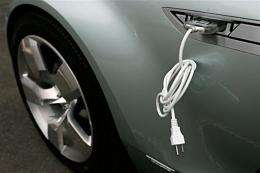
An electric cable is attached to the side of a car. Leading automotive and energy companies have reached agreement on a common "plug" to recharge electric cars, a spokeswoman for German energy company RWE said Sunday.
Leading automotive and energy companies have reached agreement on a common "plug" to recharge electric cars, a spokeswoman for German energy company RWE said Sunday.
The three-point, 400-volt plug, which will allow electric cars to be recharged anywhere in a matter of minutes, is set to be unveiled Monday at the world's biggest industrial technology fair in Hanover, northern Germany.
"A car must be able to be recharged in Italy in exactly the same way as in Denmark, Germany or France," an RWE spokeswoman, Caroline Reichert, was quoted as saying in an edition of Die Welt to appear Monday.
She gave no timeframe for the introduction of the plug, saying that talks between the companies were ongoing.
The agreement on a common standard for the plug comprises several major automakers, including Volkswagen, BMW, Ford, General Motors, Fiat, Toyota and Mitsubishi.
Energy firms signed up to the accord include Eon, Vattenfall, EDF, Npower, Endesa and Enel.
Berlin hopes that one million electric cars will be on the road by 2020. RWE and Daimler launched a pilot project in Berlin in September.
The development of a common plug is a major step towards the mass production of electric cars, Reichert told Die Welt.
(c) 2009 AFP


NoFixNoPay.info installs those plugs for anyone who buys Euro appliances. Similar European equip. voltages run at US trade shows & homes all the time, with inexpensive buck-boost transformers.
North America's "National Electrical Code" requires specific wiring methods with boost xfmrs, and local codes may require safety inspection & approved plans to prevent fire hazards.
The Equip. Mfg. certifies frequency for both 50/60Hz markets. Any Electric Car Mfg making 60Hz recharging incompatible would be unheard of.
The biggest hassle is avoiding criminal contractors that intimidate small property owners into avoiding local inspections, by overstating the cost of a $150 permit.
Not until they make electrical "filling stations" and charge people $0.30/kWh on electricity they paid $0.10/kWh for.
http://en.wikiped...ic_power
(There's little practical difference between 50hz and 60hz in this application as long as the designers are aware of the situation. I'm surprised they didn't pick 276hz or something equally goofy.)
But seriously, this is good news, in that many people have had the foresight to get together on something this important. "The devil is in the details".
And by the way, there are things called "step-up" transformers for those with no access to 400V.
The biggest issue will be having the connect have a soft start circuit and a cutout circuit. You don't want a 400 V energized cable when it's not plugged into a car.
Four-wire electricity? (to get to 220 you just double the number of input wires, right?)
I love an optimist as much as anyone, but... try "70 cents less than 4 years after it's implemented".
@Ant, I'm sorry to hear you're to cheap in the UK to put a few extra vires in the ground when your at it, that's even more stupid than not using the metric system, I'm stunned of how clever people can be. Copper's not that expensive. I'm happy, since the 400V is the highest untransformed voltage I can get at home, I'm happy if I can use it.
[ACTUALLY the MEALER does run on hot air]
Why.. WHY would I give you the details of the design for the MEALER's engine and power train system? Once we are in actual manufacturing I will be MORE THAN HAPPY to take you on a tour of a plant.
My patented engine and power system will supply
3 phase power in itself to whatever medium I choose for delivering power.. Let's see if you can handle this DGBEACH, The MEALER uses a form of 'man made' highly charged Solvolytic Plasma in a closed system to drive the secret parts of the 'engine'...The final power transfer is hydrastatic drive.. Does that make you feel better?
Send me an email at yahoo.. with my name and I will explain more.
4 wire electricity is normally used for what they call "3 phase power" It's normally reserved for very high powered applications. I've personally seen 3 phased power in 120, 220 and 600V systems. There are 3 hots that are 120 degrees out of phase (instead of 2 at 180 degrees) and a ground return line.
Don't try to hook it up yourself... You need an electrician. It IS available from your electric company, but it's expensive. Most large industries have them.
That won't work. If it needs 400 then 220 won't cut it. I'll bet they want a 350V DC battery. 220 won't trigger the diodes in the bridge rectifier. You'll need to step it up. That's easy to do with a cheap transformer.
I agree with you on the metric system, but one drop of 220 is more than enough for most households in the UK. You don't *REALLY* don't need a center tap like we have in North America. 220 as base power is easier and leaves for smaller wire diameters, but larger transformers for electronics.
Copper is VERY expensive, and it's price is skyrocketting. Go to your hardware store and compare copper tube to steel aluminum PVC or ABS. I remember when copper was so cheap we made fences from it, but those days are long gone.
You can get far more than 400VAC 3 phase to a residence, you just have to prove to the electric company why you need it. A buddy of mine has 80 acres just north of here with an airstrip. He has his own 25 KV drop which he breaks down into 600 VAC and 220 with a center tap. He's got all the power he'll ever desire.
Use 3-phase. It's likely your stove and your washing machine's already got it; why would it be such a horrible inconvenience to install for your car?
Spot price is $2/pound.
It's plummeting like a rock. Just a year ago during the commodity bubble it was double!
Uh... not many residences in North America have 3 phase power. They all have two phase power. I've never seen a stove or washing machine outside of laudromats or restaurants that use 3 phase power.
Can't they drive their cars on to a recharging mat like we have started using for mobile phones and netbooks? Could recharging mats be laid into parking spaces so that electric car drivers get something in return for paid parking?
If they get stuck in traffic, had they better turn off the radio ... or could the car manufacturers include power generation by the driver 'cycling' on the pedals of the stationary car (in 'neutral')?
In-car workout routines displayed on the GPS screen?
Generate electricity, improve health, reduce stress and wonder why people held on to their four polution-generating explosion chambers for so long ...
"Come on Barney, Yabba-Dabba-Doo!"
I would guess they used 3-phase 400V power because it makes refilling times much shorter than 1 phase 230.
Apparently only jstack6 knows what he is talking about. In the US the J-1772 plug using either 120 or 240vac, a ground and sensing wire.
Myself I use just a 120vac plug and completely recharge in 2-4 hrs. With a 50 amp dryer plug I could do it in 15 minutes. But I have a very eff EV as EV's should be, lightweight and aerodynamic which needs a far smaller battery pack and EV drive, cutting costs way down.
My 2 EV's get 250 and 600mpg equivalent.