Atmospheric lead causes clouds to form more easily, could change pattern of rain and snow
April 19, 2009
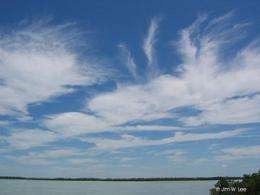
Cirrus clouds (also known as ice clouds) form high in the atmosphere. Their formation may be affected by lead generated from human activities. Courtesy of the National Weather Service
(PhysOrg.com) -- By sampling clouds -- and making their own -- researchers have shown for the first time a direct relation between lead in the sky and the formation of ice crystals that foster clouds. The results suggest that lead generated by human activities causes clouds to form at warmer temperatures and with less water. This could alter the pattern of both rain and snow in a warmer world.
The lead-laden clouds come with a silver lining, however. Under some conditions, these clouds let more of the earth's heat waft back into space, cooling the world slightly. Atmospheric lead primarily comes from human sources such as coal.
The international team of researchers reported their results in the May issue of Nature Geoscience. The collaboration included researchers from institutions in the United States, Switzerland and Germany.
"We know that the vast majority of lead in the atmosphere comes from man-made sources," said atmospheric chemist Dan Cziczo of the Department of Energy's Pacific Northwest National Laboratory and study author. "And now we show that the lead is changing the properties of clouds and therefore the balance of the sun's energy that affects our atmosphere."
Globe Trotting for Lead
Scientists first attempted to goad rain from the sky with silver and lead iodide in the 1940s. Since then, researchers have known that lead can pump up the ice crystals in clouds. But daily human activities also add lead to the atmosphere. The top sources include coal burning, small airplanes flying at the altitude where clouds form, and construction or wind freeing lead from the ground. Cziczo and colleagues wanted to know how lead from these sources affects clouds.
To find out, the researchers collected air from high atop a mountain peak on the Colorado-Wyoming border. In their high altitude lab, they created artificial clouds from the air in a cloud chamber about the size of a small refrigerator. Half of the ice crystals they plucked from the synthetic clouds, they found, contained lead.
The team then collected a dollop of real cloud atop a mountain in Switzerland. About half of those ice crystals also contained lead. But finding lead in an incriminating position doesn't mean it causes ice crystals.
To determine whether lead causes ice crystals and clouds to form, the team turned to a lab in Germany that houses a cloud chamber three stories tall, as well as a smaller chamber in Switzerland. They created dust particles that were either lead-free or contained one percent lead by weight, which is about what scientists find in the atmosphere. They put these dust particles into the chambers and measured the temperature and humidity at which point ice nucleated around the dust.
They found that lead changed the conditions under which clouds appeared. The air didn't have to be as cold or as heavy with water vapor if lead was present.
"Most of what nucleates clouds are dust particles," said Cziczo. "Half of the ones we looked at had lead supercharging them."
Leaden Clouds, Cooler Climes
To investigate what this might mean for the earth's climate, the researchers simulated the global climate with either lead-free dust particles floating around, or with either 10 percent or all of them containing lead.
The computer simulation showed that the clouds they looked at -- typically high, thin clouds -- formed at lower altitudes and different locations in the northern hemisphere when lead was present in dust particles. This will probably affect precipitation, said Cziczo.
"In our atmosphere, lead affects the distribution and density of the kinds of clouds we looked at," said Cziczo, "which might then affect where and when rain and snow fall."
Clouds at lower altitudes let more of the earth's heat, or so-called longwave radiation, escape out to space. So lead-triggered clouds could partly offset global warming due to greenhouse gases.
But that doesn't mean lead in the atmosphere will simply cool the planet, said Cziczo, since they looked at only one type of cloud. Cloudy skies are far more complicated than their wispy image lets on.
"This work highlights how complex these interactions between lead and water vapor and temperature are," said Cziczo. "They're not as simple as greenhouse gases."
Future work will look at the type of lead and how much is needed to affect clouds and precipitation, as well as the atmospheric distribution of the metal dust.
More information: D. J. Cziczo, O. Stetzer, A. Worringen, M. Ebert, S. Weinbruch, M. Kamphus, S. J. Gallavardin, J. Curtius, S. Borrmann, K. D. Froyd, S. Mertes, O. Möhler and U. Lohmann, Inadvertent Climate Modification Due to Anthropogenic Lead, Nature Geoscience, May 2009, DOI 10.1038/NGEO499 (http://www.nature.com/ngeo/index.html).
-
Scientists Want to Solve Puzzle of Excess Water Vapor Near Cirrus Clouds
Nov 30, 2006 |
not rated yet |
0
-
Ice clouds put Mars in the shade
Jan 16, 2008 |
not rated yet |
0
-
Cloud formation affected by human activity, study says
Sep 12, 2006 |
not rated yet |
0
-
Study may produce better weather forecasts
Aug 11, 2005 |
not rated yet |
0
-
AIM to Clear Up Mystery of Elusive Clouds at Edge Of Space
Apr 11, 2007 |
not rated yet |
0
-
Engineers build first sub-10-nm carbon nanotube transistor
Feb 01, 2012 |
4.9 / 5 (30) |
30
-
Something old, something new: Evolution and the structural divergence of duplicate genes
Jan 31, 2012 |
4.6 / 5 (7) |
1
-
The hidden nanoworld of ice crystals: Revealing the dynamic behavior of quasi-liquid layers
Jan 30, 2012 |
5 / 5 (3) |
1
-
Stock market network reveals investor clustering
Jan 27, 2012 |
3.9 / 5 (23) |
8
-
Of microchemistry and molecules: Electronic microfluidic device synthesizes biocompatible probes
Jan 26, 2012 |
5 / 5 (1) |
0
-
Discrepancy between oxygen and carbon-dioxide levels
6 hours ago
-
where gems are found in the world
10 hours ago
-
Wind Waves in Reservoir ~ Wind run-up and Wind set-up
Feb 08, 2012
-
Balance of oxygen in the atmosphere
Feb 01, 2012
-
The case for a methanol-based economy
Jan 30, 2012
-
Weather in a rotating cylinder
Jan 25, 2012
- More from Physics Forums - Earth
More news stories
New views show old NASA Mars landers
(PhysOrg.com) -- The High Resolution Imaging Science Experiment (HiRISE) camera on NASA's Mars Reconnaissance Orbiter recorded a scene on Jan. 29, 2012, that includes the first color image from orbit showing ...
Space & Earth / Space Exploration
21 hours ago |
4.9 / 5 (7) |
9
|
Black holes and star formation
(PhysOrg.com) -- It has long been recognized that galaxy mergers or even close interactions can play a vital role in shaping the morphology of galaxies. One way they can do so, it is thought, is by triggering ...
20 hours ago |
4.1 / 5 (7) |
5
|
Deconstructing a mystery: What caused Snowmaggedon?
In the quiet after the storms, streets and cars had all but disappeared under piles of snow. The U.S. Postal Service suspended service for the first time in 30 years. Snow plows struggled to push the evidence ...
Space & Earth / Earth Sciences
13 hours ago |
4.7 / 5 (3) |
1
|
Ocean microbe communities changing, but long-term environmental impact is unclear
As oceans warm due to climate change, water layers will mix less and affect the microbes and plankton that pump carbon out of the atmosphere but researchers say it's still unclear whether these processes ...
Space & Earth / Earth Sciences
15 hours ago |
5 / 5 (2) |
2
|
Researchers create 3-D laser maps that show how earthquake changes landscape
Geologists have a new tool to study how earthquakes change the landscape down to a few inches, and it's giving them insight into how earthquake faults behave. In the Feb. 10 issue of the journal Science, a team ...
Space & Earth / Earth Sciences
15 hours ago |
5 / 5 (4) |
0
|
Fighting crimes against biodiversity: How to catch a killer weed
Invasive species which have the potential to destroy biodiversity and influence global change could be tracked and controlled in the same way as wanted criminals, according to new research from Queen Mary, University of London.
A novel method for simultaneously measuring blood pressure and arterial stiffness
Arterial stiffness due to is a major contributor to cardiovascular disease but is very difficult to measure. It also can influence blood pressure readings since these rely on the time taken for arteries to return to normal ...
Study finds that red blood cell transfusion decreases fatigue in women with acute postpartum anemia
In a study to be presented today at the Society for Maternal-Fetal Medicine's annual meeting, The Pregnancy Meeting , in Dallas, Texas, researchers will report findings that show that in women with acute postpartum ...
Study weighs risks and benefits of birthing facilities
In a study to be presented today at the Society for Maternal-Fetal Medicine's annual meeting, The Pregnancy Meeting , in Dallas, Texas, researchers will report findings that indicate that the risk of obstetric intervention ...
FDA-approved drug rapidly clears amyloid from the brain, reverses Alzheimer's symptoms in mice
Neuroscientists at Case Western Reserve University School of Medicine have made a dramatic breakthrough in their efforts to find a cure for Alzheimer's disease. The researchers' findings, published in the journal Science, show t ...
'Dark plasmons' transmit energy
Microscopic channels of gold nanoparticles have the ability to transmit electromagnetic energy that starts as light and propagates via "dark plasmons," according to researchers at Rice University.
Apr 19, 2009
Rank: 4 / 5 (4)
Apr 19, 2009
Rank: 3.4 / 5 (5)
Does this seem to go along with the earth dramatically warming(if you believe the GCW theorists) at almost exactly the same time as we eliminated leaded gasoline from our fuel tanks and therefore lead from the atmosphere?
Apr 19, 2009
Rank: 4.5 / 5 (4)
Try reading the article, instead of just making policataly motived comments about science, it helps understanding the issues.
The lead is not from leaded gasoline but from burning coal. Leaded gasoline greatly increases lead content of air in cities and near roads in rural areas at ground level. Whereas coal burning power plants produce more lead, but because of high smoke stacks this is not so much of an immediate health problem, it does how ever put large amounts of lead in to the atmosphere.
Apr 19, 2009
Rank: 2.3 / 5 (3)
Apr 19, 2009
Rank: 5 / 5 (3)
For example, what if massive coal burning in the 19th and 20th centuries artificially cooled off the Earth, masking a natural warming trend toward the interglacial peak? If not for that coal burning, it would now be much warmer, perhaps as warm as was mentioned in that recent article about higher sea levels during the last interglacial.
Apr 19, 2009
Rank: 5 / 5 (1)
Apr 19, 2009
Rank: 5 / 5 (1)
http://www.physor...684.html
Apr 20, 2009
Rank: 3.7 / 5 (3)
No you thicky. Someone is suggesting that we ARE dumping about as much lead into the atmosphere as always(it's called coal power) and it has this effect.
Apr 20, 2009
Rank: 5 / 5 (1)
Maybe you missed these lines....
**Scientists first attempted to goad rain from the sky with silver and lead iodide in the 1940s.**
&
**Future work will look at the type of lead and how much is needed to affect clouds and precipitation, as well as the atmospheric distribution of the metal dust.**
mmhmm.
Apr 20, 2009
Rank: 1 / 5 (1)
Apr 21, 2009
Rank: not rated yet
I posted the wrong link earlier, this is the sea level story I was refering to:
http://www.physor...292.html
I've been checking things out, and it is hard to find charts of atmospheric lead levels. What little I have come across suggests that levels were high in the 70's and started dropping in the 80's due to the switch to unleaded gasoline.
I also found a mention of high lead levels during the Younger Dryas, the Little Ice Age.
This is not my forte. Any of you detail oriented people on here interested in this? Or do you think I'm just full of it?
And no, I certainly am not suggesting spraying lead in the air to cool things off, I just see an interesting correlation, and I don't know how to do the research to find out more.
Apr 22, 2009
Rank: 2.3 / 5 (3)
Because a 50 foot difference is huge in the scope of a 10 to 16km thick troposphere.
Apr 22, 2009
Rank: 5 / 5 (3)
Apr 22, 2009
Rank: 3 / 5 (2)
Apr 26, 2009
Rank: 5 / 5 (1)
There is something wrong when scientists, or any group, pile on and endorse government actions before all of the facts are in and understood.