Bridging the gap in nanoantennas
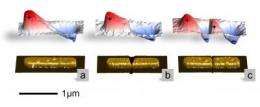
In a recent publication in Nature Photonics, a joint team of researchers at CIC nanoGUNE, Donostia International Physics Center DIPC, Centro de Física de Materiales of CSIC/UPV-EHU in San Sebastian (Spain), Harvard University (USA) and the Max Planck Institute of Biochemistry in Munich (Germany) reports an innovative method for controlling light on the nanoscale by adopting tuning concepts from radio-frequency technology.
The method opens the door for targeted design of antenna-based applications including highly sensitive biosensors and extremely fast photodetectors, which could play an important role in future biomedical diagnostics and information processing.
An antenna is a device designed to transmit or receive electromagnetic waves. Radio frequency antennas find wide use in systems such as radio and television broadcasting, point-to-point radio communication, wireless LAN, radar, and space exploration. In turn, an optical antenna is a device which acts as an effective receiver and transmitter of visible or infrared light. It has the ability to concentrate (focus) light to tiny spots of nanometer-scale dimensions, which is several orders of magnitude smaller than what conventional lenses can achieve. Tiny objects such as molecules or semiconductors that are placed into these so-called "hot spots" of the antenna can efficiently interact with light. Therefore optical antennas boost single molecule spectroscopy or signal-to-noise in detector applications.
In their experiments the researchers studied a special type of infrared antennas, featuring a very narrow gap at the center. These so called gap-antennas generate a very intense "hot spot" inside the gap, allowing for highly efficient nano-focusing of light. To study how the presence of matter inside the gap (the "load") affects the antenna behavior, the researchers fabricated small metal bridges inside the gap (Figure b). They mapped the near-field oscillations of the different antennas with a modified version of the scattering-type near-field microscope that the Max Planck and nanoGUNE researchers had pioneered over the last decade. For this work, they chose dielectric tips and operated in transmission mode, allowing for imaging local antenna fields in details as small as 50 nm without disturbing the antenna. "By monitoring the near-field oscillations of the different antennas with our novel near-field microscope, we were able to directly visualize how matter inside the gap affects the antenna response. The effect could find interesting applications for tuning of optical antennas" says Rainer Hillenbrand leader of the Nanooptics group at the newly established research institute CIC nanoGUNE Consolider.
The nanooptics group from DIPC and CSIC-UPV/EHU led by Javier Aizpurua in San Sebastián fully confirmed and helped to understand the experimental results by means of full electrodynamic calculations. The calculated maps of the antenna fields are in good agreement with the experimentally observed images. The simulations add deep insights into the dependence of the antenna modes on the bridging, thus confirming the validity and robustness of the "loading" concept to manipulate and control nanoscale local fields in optics.
Furthermore, the researchers applied the well developed radio-frequency antenna design concepts to visible and infrared frequencies, and explained the behavior of the loaded antennas within the framework of optical circuit theory. A simple circuit model showed remarkable agreement with the results of the numerical calculations of the optical resonances. "By extending circuit theory to visible and infrared frequencies, the design of novel photonic devices and detectors will become more efficient. This bridges the gap between these two disciplines" says Javier Aizpurua.
With this work, the researches provide first experimental evidence that the local antenna fields can be controlled by gap-loading. This opens the door for designing near-field patterns in the nanoscale by load manipulation, without the need to change antenna length, which could be highly valuable for the development of compact and integrated nanophotonic devices.
Source: Elhuyar Fundazioa


