First broad spectrum anti-microbial paint to kill 'superbugs'
April 20, 2009 First broad spectrum anti-microbial paint to kill 'superbugs'

Enlarge

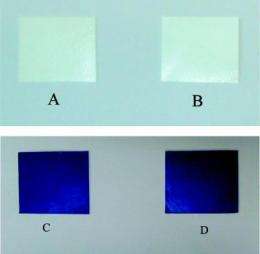
A new antimicrobial paint could disinfect and decorate as it can kill harmful bacteria, fungi, mold and viruses. Credit: The American Chemical Society

Scientists in South Dakota are reporting development of the first broad-spectrum antimicrobial paint, a material that can simultaneously kill not just disease-causing bacteria but mold, fungi, and viruses.

Designed to both decorate and disinfect homes, businesses, and health-care settings, the paint is the most powerful to date, according to their new study. It appears in the current issue of the monthly ACS' Applied Materials & Interfaces. The paint shows special promise for fighting so-called "superbugs," antibiotic-resistant microbes that infect hospital surfaces and cause an estimated 88,000 deaths annually in the United States, the researchers say.

In the study, Yuyu Sun and Zhengbing Cao note in the antimicrobial paints already on are store shelves. These paints, however, are only effective against a narrow range of disease-causing microorganisms, limiting their usefulness.

The scientists already were aware of research on the germ-killing effects of that N-halamines, bleach-like substances already in wide use. They developed a new antimicrobial polymer that includes a type of N-halamine. It has no undesirable effects on the quality of latex paints. Laboratory tests showed that the new polymer kills a wide range of disease-causing microbes including those resistant to multiple antibiotics. The retains an anti-microbial punch for extended periods, and it can be easily "recharged" with a simple chlorination process, the researchers note.

Source: American Chemical Society (news : web)


print this article email this article download pdf blog this article bookmark this article     Stumble it Digg this share on Facebook retweet share on Reddit add to delicious
Rate this story - 3.5 /5 (2 votes)


April 20, 2009 all stories

Comments: 0

3.5 /5 (2 votes)
  • Stumble this up

  • Digg this

  • share this

  • hide
  • Related Stories

  • Nanotech clay armour creates fire resistant hard wearing latex emulsion paints
    created Jul 26, 2007 | popularity not rated yet | comments 0
  • Marijuana ingredients show promise in battling superbugs
    created Sep 08, 2008 | popularity not rated yet | comments 0
  • Toward improved antibiotics using proteins from marine diatoms
    created Sep 08, 2008 | popularity not rated yet | comments 0
  • Anti-microbial 'paint' kills flu, bacteria
    created Dec 01, 2006 | popularity not rated yet | comments 0
  • Toward a Rosetta Stone for Microbes' Secret Language
    created Dec 10, 2007 | popularity not rated yet | comments 0


  • hide
  • Relevant PhysicsForums posts

  • help me please !!!!
    created 5 hours ago
  • Zinc Oxide reduction
    created 17 hours ago
  • depolymerization of HDPE
    created Nov 08, 2009
  • Question, whats the best chemistry software for a college student?
    created Nov 08, 2009
  • More from Physics Forums - Chemistry

Other News

H1N1 Virus Can Be Killed by Acidic Ozone Water

H1N1 Virus Can Be Killed by Acidic Ozone Water

Chemistry / Biochemistry

created 2 hours ago | popularity 5 / 5 (6) | comments 4

(PhysOrg.com) -- Scientists have found that acidic ozone water can deactivate H1N1 viruses very effectively, offering a promising disinfectant for the millions of people trying to avoid the disease. Acidic ...


Wet ethanol production process yields more ethanol and more co-products

Chemistry / Biochemistry

created 1hour ago | popularity not rated yet | comments 0

Using a wet ethanol production method that begins by soaking corn kernels rather than grinding them, results in more gallons of ethanol and more usable co-products, giving ethanol producers a bigger bang for their buck - ...


Look ma, no mercury in fillings!

Chemistry / Materials Science

created 1hour ago | popularity not rated yet | comments 0

Tooth enamel is hardest material in the human body because it's made almost entirely of minerals. As tough as it may be, however, enamel can be broken down by bacteria, forming cavities and eventually destroying the tooth. ...


Toward home-brewed electricity with 'personalized solar energy'

Toward home-brewed electricity with 'personalized solar energy'

Chemistry / Materials Science

created Nov 04, 2009 | popularity 3.4 / 5 (9) | comments 4

New scientific discoveries are moving society toward the era of "personalized solar energy," in which the focus of electricity production shifts from huge central generating stations to individuals in their ...


Scientists Reproduce a Building Block of Life in Laboratory

Scientists Reproduce a Building Block of Life in Laboratory

Chemistry / Biochemistry

created Nov 06, 2009 | popularity 4.8 / 5 (23) | comments 0

(PhysOrg.com) -- NASA scientists studying the origin of life have reproduced uracil, a key component of our hereditary material, in the laboratory.