India's 'holy powder' finally reveals its centuries-old secret
April 20, 2009
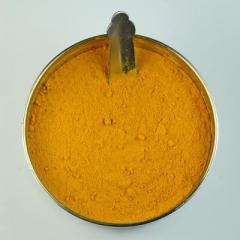
Scientists have unlocked the secrets of the "holy powder" turmeric. Image: Wikimedia Commons
Scientists in Michigan are reporting discovery of the secret behind the fabled healing power of the main ingredient in turmeric — a spice revered in India as "holy powder." Their study on the ingredient, curcumin, appears in the Journal of the American Chemical Society.
In the study, Ayyalusamy Ramamoorthy and colleagues point out that turmeric has been used for centuries in folk medicine to treat wounds, infections, and other health problems. Although modern scientific research on the spice has burgeoned in recent years, scientists until now did not know exactly how curcumin works inside the body.
Using a high-tech instrument termed solid-state NMR spectroscopy, the scientists discovered that molecules of curcumin act like a biochemical disciplinarian. They insert themselves into cell membranes and make the membranes more stable and orderly in a way that increases cells' resistance to infection by disease-causing microbes.
More information: "Determining the Effects of Lipophillic Drugs on Membrane Structure by Solid-State NMR Spectroscopy -- the Case of the Antioxidant Curcumin," Journal of the American Chemical Society.
-
'Holy powder' ingredient makes membranes behave for better health
Mar 06, 2009 |
not rated yet |
0
-
Popular alternative therapy for psoriasis performs no better than placebo
Feb 29, 2008 |
not rated yet |
0
-
Common cooking spice shows promise in combating diabetes and obesity
Jun 21, 2008 |
not rated yet |
0
-
Synthetic Molecules Could Add Spice To Fight Against Cancer
Aug 18, 2008 |
not rated yet |
0
-
Curry spice found to fight cancer
Jul 12, 2005 |
not rated yet |
0
-
Engineers build first sub-10-nm carbon nanotube transistor
Feb 01, 2012 |
4.9 / 5 (30) |
30
-
Something old, something new: Evolution and the structural divergence of duplicate genes
Jan 31, 2012 |
4.6 / 5 (7) |
1
-
The hidden nanoworld of ice crystals: Revealing the dynamic behavior of quasi-liquid layers
Jan 30, 2012 |
5 / 5 (3) |
1
-
Stock market network reveals investor clustering
Jan 27, 2012 |
3.9 / 5 (23) |
8
-
Of microchemistry and molecules: Electronic microfluidic device synthesizes biocompatible probes
Jan 26, 2012 |
5 / 5 (1) |
0
-
Stoichiometry
4 hours ago
-
Boiling and melting point of impure substances
5 hours ago
-
Safe nitrogen compound to decompose a 500 deg C in a furnace?
12 hours ago
-
[ask]electron inside drinking water
Feb 08, 2012
-
How to avoid formation of Lithium Chromate ???
Feb 08, 2012
-
how to choose a reduced or oxidated form in a redox
Feb 08, 2012
- More from Physics Forums - Chemistry
More news stories
Hydrogen from acidic water: Researchers develop potential low cost alternative to platinum for splitting water
A technique for creating a new molecule that structurally and chemically replicates the active part of the widely used industrial catalyst molybdenite has been developed by researchers with the Lawrence Berkeley ...
15 hours ago |
5 / 5 (10) |
11
|
Engineers find inspiration for new materials in Piranha-proof armor
(PhysOrg.com) -- Its a matchup worthy of a late-night cable movie: put a school of starving piranha and a 300-pound fish together, and who comes out the winner?
22 hours ago |
4.5 / 5 (4) |
2
|
Flexible paper robots
(PhysOrg.com) -- These inexpensive robots can stretch, bend and twist under control, and lift objects up to 120 times their own weight. Being soft, they can apply gentle and even pressure, and adapt to varied ...
13 hours ago |
5 / 5 (5) |
2
|
New method makes culture of complex tissue possible in any lab
Scientists at the University of California, San Diego have developed a new method for making scaffolds for culturing tissue in three-dimensional arrangements that mimic those in the body. This advance, published online in ...
12 hours ago |
5 / 5 (4) |
0
|
Chemists harvest light to create 'green' tool for pharmaceuticals
(PhysOrg.com) -- A team of University of Arkansas researchers, including an Honors College undergraduate student, has created a new, "green" method for developing medicines. The researchers used energy from ...
21 hours ago |
5 / 5 (3) |
0
|
Humans may have helped the decline of African rainforests 3000 years ago
(PhysOrg.com) -- Large areas of rainforests in Central Africa mysteriously disappeared over three thousand years ago, to be replaced by savannas. The prevailing theory has been that the cause was a change ...
Japan scientist makes 'Avatar' robot
A Japanese-developed robot that mimics the movements of its human controller is bringing the Hollywood blockbuster "Avatar" one step closer to reality.
Sleep breathing machine shows clear benefits in children with sleep apnea
Children and adolescents with obstructive sleep apnea had substantial improvements in attention, anxiety and quality of life after treatment with positive airway pressure (PAP)a nighttime therapy in which a machine ...
Neurologic improvement detected in rats receiving stem cell transplant
In a study to be presented today at the Society for Maternal-Fetal Medicine's annual meeting, The Pregnancy Meeting, in Dallas, Texas, researchers will report that early transplantation of human placenta-derived mesenchymal ...
Miami battling invasion of giant African snails
No one knows how they got there. But an invasion of African giant snails has southern Florida in a panic over potential crop damage, disease and general yuckiness surrounding the slimy gastropods.
NASA budget will axe Mars deal with Europe: scientists
US President Barack Obama's budget proposal to be submitted next week for 2013 will cut NASA's budget by 20 percent and eliminate a major partnership with Europe on Mars exploration, scientists said Thursday.
Apr 20, 2009
Rank: 5 / 5 (1)
Apr 20, 2009
Rank: not rated yet
Apr 20, 2009
Rank: 5 / 5 (1)