Live-in domestics: Mites as maids in tropical rainforest sweat bee nests
April 20, 2009 Live-in domestics: Mites as maids in tropical rainforest sweat bee nests

Enlarge

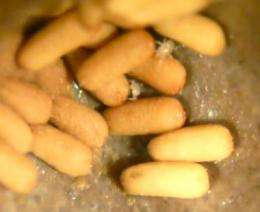
Mites eat fungi associated with higher larval mortality in tropical sweat bee nests. Credit: Natalia Biani

Mites not only inhabit the dust bunnies under the bed, they also occupy the nests of tropical sweat bees where they keep fungi in check. Bees and their young are healthier when mites live-in, report researchers from the Smithsonian Tropical Research Institute in Panama and the University of Texas at Austin. Mutually beneficial cleaning relationships have been documented for shrimps and fish that eat parasites on larger fish, but this is the first confirmation of a cleaning relationship between two different species on land.

Tropical sweat bees in the genus Megalopta tunnel into rotten wood, excavating cells for their young that they feed with nectar and pollen. Researchers working at field sites throughout Panama noticed that sweat-bee sometimes housed mites and that more young died in nests that did not contain mites than in nests that did.

"The mutualistic nature of bee-mite symbioses was hypothesized repeatedly but had never been demonstrated empirically," said Natalia Biani, short-term fellow in Staff Scientist William Wcislo's lab at STRI and graduate student in professor Ulrich Mueller's lab at the University of Texas, Austin.

Biani placed the contents of the brood cells in water and plated the liquid on Petri dishes in order to count the number of fungal colonies from nests with and without mites. "When we took away the mites, the bee nests got dirtier. When we added mites, fungus counts went down. It is pretty clear that the mites clean up the cells where the young are growing," Biani said. In return, the mites receive a clean, dry home, fungus to eat and free bee rides to new nests.

More information: This work appears online in the journal .

Source: Smithsonian Tropical Research Institute


print this article email this article download pdf blog this article bookmark this article     Stumble it Digg this share on Facebook retweet share on Reddit add to delicious
Rate this story - not rated yet


April 20, 2009 all stories

Comments: 0

not rated yet
  • Stumble this up

  • Digg this

  • share this

  • hide
  • Related Stories

  • A bee's future as queen or worker may rest with parasitic fly
    created Jul 28, 2008 | popularity not rated yet | comments 0
  • Asian bees threaten Australia
    created Jun 15, 2007 | popularity not rated yet | comments 0
  • Fungus Foot Baths Could Save Bees
    created Jul 28, 2008 | popularity not rated yet | comments 0
  • Scientists search for cause of bee deaths
    created May 14, 2007 | popularity not rated yet | comments 0
  • Bird Moms Manipulate Birth Order to Protect Sons
    created Sep 19, 2006 | popularity not rated yet | comments 0


  • hide
  • Relevant PhysicsForums posts

Other News

Scientists visualize how bacteria talk to one another

Scientists visualize how bacteria talk to one another

Biology / Cell & Microbiology

created 17 hours ago | popularity 4.9 / 5 (9) | comments 1

Using imaging mass spectrometry, researchers at the University of California, San Diego have developed tools that will enable scientists to visualize how different cell populations of cells communicate. Their ...


Laser etching safe alternative for labeling grapefruit

Laser etching safe alternative for labeling grapefruit

Biology / Other

created Nov 03, 2009 | popularity 4.4 / 5 (14) | comments 8

Laser labeling of fruit and vegetables is a new, patented technology in which a low-energy carbon dioxide laser beam is used to label, or "etch" information on produce, thereby eliminating the need for common ...


Caught in the act: Butterfly mate preference shows how 1 species can become 2

Caught in the act: Scientists find butterflies splitting into two species

Biology / Plants & Animals

created Nov 05, 2009 | popularity 4.5 / 5 (8) | comments 4

(PhysOrg.com) -- Breaking up may actually not be hard to do, say scientists who've found a population of tropical butterflies that may be on its way to a split into two distinct species.


Wolves, moose and biodiversity: An unexpected connection

Wolves, moose and biodiversity: An unexpected connection

Biology / Ecology

created Nov 02, 2009 | popularity 4.9 / 5 (7) | comments 4

Moose eat plants; wolves kill moose. What difference does this classic predator-prey interaction make to biodiversity?


Can biodiversity persist in the face of climate change?

Can biodiversity persist in the face of climate change?

Biology / Ecology

created Nov 06, 2009 | popularity 3 / 5 (8) | comments 2

(PhysOrg.com) -- Predictions made over the last decade about the impacts of climate change on biodiversity may be exaggerated, according to a paper published in the journal Science.