When every photon counts
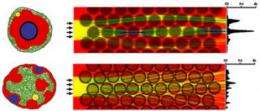
The eyes of nocturnal mammals contain particularly large numbers of the highly light-sensitive rods, the photoreceptor type used for night vision. This allows the detection of light levels millions of times lower than daylight. Researchers at the Ludwig Maximilians University Munich, the Max Planck Institute for Brain Research Frankfurt and the Cavendish Laboratory Cambridge have now shown that the nocturnal lifestyle and its visual challenges had a unique impact on rod nuclear organisation: The distributions of the densely packed inactive and the less densely packed active regions of DNA differ remarkably from those in other somatic cells of nearly all organisms from protozoans to multicellular animals, including the rods of diurnal mammals.
With this unique arrangement, the rod nuclei of nocturnal mammals act as micro-lenses that focus the incoming light. Computer simulations show that stacks of such nuclei effectively guide the light to the light-sensitive outer segments of the rods. Hence, this change in rod nuclear organisation improves vision at nocturnal low light levels. It also provides new insights into the evolution of the mammalian retina and furthers our understanding of the nuclear architecture in general.
The DNA of a mammalian cell is about two metres long if all base pairs were aligned in one string. To fit this genetic material in a nucleus of only a few microns diameter, the DNA is wrapped around millions of so-called histon proteins that are arranged like pearls on a string, leading to a 10,000-fold compaction of the DNA. This DNA-protein complex is termed chromatin. Chromatin regions with genetic information that needs to be read out and transcribed by enzymes in a given cell at a given time are less tightly packed and more easily accessible. These chromatin parts are termed euchromatin and typically located in the nuclear interior. In contrast, a major part of the ,non-active' more compacted DNA regions, termed heterochromatin, are located in the nuclear periphery. This nuclear architecture is present in nearly all higher organisms since the last 500 million years.
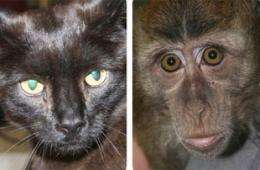
"The arrangement is so universal that one can call it the ,conventional architecture' of the cell nucleus", says Boris Joffe at the Biocenter of the Ludwig Maximilians University (LMU) Munich. "Hence we were very surprised to find marked differences in this architecture - and that they depend on an animal's lifestyle". An interdisciplinary team of researchers at the LMU, the Max Planck Institute for Brain Research in Frankfurt and the Cavendish Laboratory in Cambridge could show that in nocturnal mammals the chromatin arrangement in the rod nuclei is inverted: Here the heterochromatin is lumped in the nuclear interior whereas the less compacted euchromatin with the active DNA regions forms a peripheral shell.
This unusual nuclear architecture is explained by the requirements of vision. In humans and all other vertebrates, the light has to traverse the entire retina to reach the light-sensitive outer segments of the photoreceptors. "And here nocturnal animals face a dilemma. They need lots of rods to detect the little available light - but that makes their retinas thicker, so that more light is lost by scatter and diffusion before it reaches the photoreceptor outer segments", explains Leo Peichl at the Max Planck Institute for Brain Research.
Evolution solved the problem by using a physical property of heterochromatin: Because of its denser packing it has a higher optical refraction index than euchromatin. This has no effect when the heterochromatin lies in the periphery of the nucleus. However when it is lumped in the nuclear core, the heterochromatin acts as a minute collecting lens. As the rod nuclei are arranged in columns, several of these 'micro-lenses' are stacked on top of each other. Computer simulations at the Cavendish Laboratory show that in this way the faint light is bundled and guided through the retinal thickness with only minimal loss. "It reaches the light-sensitive photoreceptor outer segments in a more focused fashion", says co-author Jochen Guck.
Furthermore, the unusual architecture of the rod nuclei provides new insights into the early evolution of mammals. This special arrangement of genetic material must have originated more than a hundred million years ago when the ancestors of today's mammals adopted a nocturnal lifestyle to avoid the dominant carnivorous reptiles of the time. Their nocturnal descendants have preserved the inverted rod nuclear architecture to this day, but those descendants that have later become diurnal - including us humans - have reverted to the conventional rod nuclear organisation. "This confirms the superiority of the conventional architecture", says Joffe. "Obviously, the inverted nuclear organisation also has - as yet unknown - disadvantages".
A possible advantage of the conventional architecture is that the central positioning of the active eurochromatin allows more interactions between neighbouring gene loci and with the transcription apparatus in three dimensions; euchromatin in a peripheral shell factually has only two dimensions for contacts. However, in nocturnal mammals the advantages of improved night vision seem to have prevailed.
More information: Irina Solovei, Moritz Kreysing, Christian Lanctot, Süleyman Kösem, Leo Peichl, Thomas Cremer, Jochen Guck, Boris Joffe, Nuclear architecture of rod photoreceptor cells adapts to vision in mammalian evolution, Cell, 17th April 2009
Source: Max-Planck-Gesellschaft (news : web)


