'Cyberloafing' at work no bad thing, study says
April 20, 2009 'Cyberloafing' at work no bad thing, study says

Enlarge

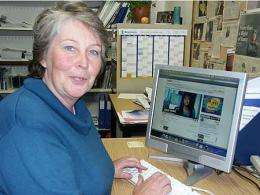
Andrea Polzer-Debruyne checks out YouTube in her own time

(PhysOrg.com) -- Employees who cyberloaf - use the Internet at work for their own interest - may be doing their bosses a favour, a Massey study suggests.

Although potentially open to abuse, the fluid border between work and personal life created by the Internet is a boon for employees and employers, says Massey University PhD student Andrea Polzer-Debruyne, who studied personal Internet use at work for her psychology thesis.

She found that people whose employers tolerated a reasonable amount of personal emailing and other Internet use at work tended to be more open to doing work from home in their own time or making themselves available on-line to deal with clients or handle after-hours matters.

She says it is one of few such studies internationally into the reasons and attitudes behind the ubiquitous practice of personal Internet use at work.

Some workers she surveyed said they felt the boundary between work and life is becoming increasingly blurred, with growing expectations of being available online for work at home. As a result, workers feel justified in shopping, banking and paying bills online at work and are therefore less resentful of being expected to carry out work duties outside office hours.

Using the Internet for personal use at work may also reduces stress for employees, giving them mini breaks that can potentially make them more productive, she suggests.

“Using the Internet for private use at work can be good for an organisation,” says one respondent in her survey. “If an employee orders a present or groceries over the net at work, it takes half the time it would if they had to leave the office and do it. In reality people can be more productive and balance their work and private lives better.”

For many workers, however, using the Internet for "cyberloafing" or "cyberslacking" is a way of alleviating boredom, regardless of how busy they are with work or how much they have to do.

“The Internet-enabled work station is, for many employees, the ideal place to regain some purpose and enthusiasm during their working day, and to balance boredom with more meaningful stimuli,” she says. “These stimuli can, for example, be provided by email contact with others, reinforcing that one has purpose as a friend, colleague or family member.”

But the push to do so is tempered in varying degrees by the individual’s moral norms about whether using the Internet at work for purely personal reasons, such as emailing friends, booking holidays or concert tickets or playing online games, is wrong.

Mrs Polzer-Debruyne, who graduates on Thursday from the Albany campus, says her interest in the topic was aroused during a stint as human resources consultant. She was struck by how extensively her office co-workers used the Internet for their own interests and began the study with the view that personal web use at work was a form of time theft and therefore wrong.

But having surveyed nearly 300 people (two thirds from New Zealand and the rest from Finland, Germany Singapore, South Africa, Sweden and the United States) she has altered her view dramatically.

She says the Internet is an endemic, pervasive tool of modern life whose multifaceted uses cannot be rigidly restricted within a work environment. If used within reason, personal can be an acceptable aspect of a “give and take” work culture based on mutual respect and trust between employee and employer.

While most New Zealand places have rules and policies restricting personal Internet, with some banning or blocking access to particular websites, she was not aware of anyone being fired solely for breeching such rules. Companies that install electronic monitoring systems to deter personal use could end up creating mistrust and resentment among staff, she says.

Provided by Massey University


print this article email this article download pdf blog this article bookmark this article     Stumble it Digg this share on Facebook retweet share on Reddit add to delicious
Rate this story - 4.2 /5 (9 votes)

Rank Filter

Move the slider to adjust rank threshold, so that you can hide some of the comments.


Display comments: newest first

  • dirk_bruere - Apr 20, 2009
    • Rank: 5 / 5 (1)
    Get back to work you slackers!
  • denijane - Apr 21, 2009
    • Rank: not rated yet
    A good research! Internet changes our society, the best thing is to find a way to integrate it better, not to try to isolate people from it. Even at work.
  • googleplex - Apr 21, 2009
    • Rank: not rated yet
    Whilst the net certainly makes the day more enjoyable productivity must suffer.
    A lot of people play games and use the ALT-TAB trick when the boss walks by.
    I don't think this is a computer problem as more a management problem. Slackers would be doing something else e.g. solitaire/minesweeper or on the phone or an extended newspaper loo break.

April 20, 2009 all stories

Comments: 3

4.2 /5 (9 votes)
  • Stumble this up

  • Digg this

  • share this

  • hide
  • Related Stories

  • Worried Workers Choosing All Work, No Play
    created Apr 24, 2007 | popularity not rated yet | comments 0
  • Get some balance - make flexible work policies work
    created Jan 21, 2009 | popularity not rated yet | comments 0
  • The Web: Working hard or hardly working?
    created Jan 25, 2006 | popularity not rated yet | comments 0
  • Work/life balance blurred for some employees
    created Dec 10, 2008 | popularity not rated yet | comments 0
  • Greener offices make happier employees
    created May 19, 2008 | popularity not rated yet | comments 0


  • hide
  • Relevant PhysicsForums posts

  • Quantum Economies: Phyisical Modeling of Economic Systems
    created Nov 16, 2009
  • The real purpose of cretenic marketing/commercial propaganda
    created Nov 15, 2009
  • Speculative Attack
    created Nov 13, 2009
  • Animals which attack their "cousins"
    created Nov 07, 2009
  • More from Physics Forums - Social Sciences

Other News

Museum: Galileo's fingers, tooth are found (AP)

Museum: Galileo's fingers, tooth are found

Other Sciences / Archaeology & Fossils

created 17 hours ago | popularity not rated yet | comments 5

(AP) -- Two fingers and a tooth removed from Galileo Galilei's corpse in a Florentine basilica in the 18th century and given up for lost have been found again and will soon be put on display, an Italian museum ...


Measure to change U. of Neb. stem-cell rule fails (AP)

Measure to change U. of Neb. stem-cell rule fails (Update 2)

Other Sciences / Other

created 17 hours ago | popularity 5 / 5 (1) | comments 0

(AP) -- The University of Nebraska's governing board on Friday voted not to place tighter restrictions on embryonic stem cell research than those outlined under federal guidelines, which were expanded after ...


Researcher: Faint writing seen on Shroud of Turin (AP)

Researcher: Faint writing seen on Shroud of Turin (Update)

Other Sciences / Archaeology & Fossils

created Nov 20, 2009 | popularity 1.9 / 5 (23) | comments 23

(AP) -- A Vatican researcher has rekindled the age-old debate over the Shroud of Turin, saying that faint writing on the linen proves it was the burial cloth of Jesus. Experts say the historian may be reading ...


Three of a kind

Three of a kind: Revealing language’s universal essence

Other Sciences / Social Sciences

created Nov 20, 2009 | popularity 3.8 / 5 (10) | comments 6

(PhysOrg.com) -- On the surface, English, Japanese, and Kinande, a member of the Bantu family of languages spoken in the Democratic Republic of Congo, have little in common. It is not just that the vocabularies ...


Maya

New insights into the life of the Maya

Other Sciences / Archaeology & Fossils

created Nov 16, 2009 | popularity 4.6 / 5 (15) | comments 7

(PhysOrg.com) -- Ancient artifacts are almost always concerned with rich and powerful religious and political leaders, but new excavations of an ancient Maya site have unearthed a pyramid decorated with murals ...