Cyclone Bijli's rainfall -- from birth to death (w/Video)
April 20, 2009
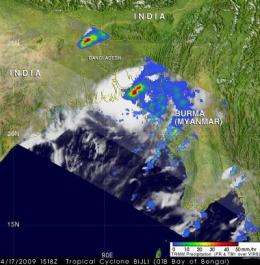
During the early morning hours of Saturday, April 18 (afternoon EDT on Apr. 17) NASA's Tropical Rainfall Measuring Mission (TRMM) satellite indicated that Tropical Cyclone Bijli was producing heavy rainfall over southeast Bangladesh as it moved ashore. These rainfall amounts of over 50 millimeters (almost 2 inches) per hour were the heaviest caused by Bijli in the countries that border the Bay of Bengal since Bijli formed. Credit: NASA/Hal Pierce
Before satellites, meteorologists had no way to estimate or measure how much rain tropical cyclones generated where there were no buoys with rain gauges. The satellite managed by NASA and the Japanese Space Agency, JAXA provides that "rain gauge" from space in the Tropical Rainfall Measuring Mission (TRMM) satellite.
NASA's TRMM mission page has unveiled an animation of the rainfall created by Cyclone Bijli from the time it was born until the time it made landfall on Apr. 17, 2009 in Bangladesh.
TRMM data, along with information from other satellites, allows researchers to see how much rain is falling over most of the world every three hours and map areas of potential flooding. Maps that show areas of potential floods use precipitation radar data and high resolution measurements of water content of clouds made by microwave radiometers.
Those rainfall maps were made into a seven-day "movie loop" that allows users to track storms as they travel over land and oceans around the globe.
This video is not supported by your browser at this time.
This animation shows Cyclone Bijli's rainfall from the time it was "born" on April 13 in the Bay of Bengal as "storm 94B," intensified into tropical depression and renamed "01B" and then grew into Tropical Storm Bijli where it made landfall in southern Bangladesh on April 17. Credit: NASA/TRMM
The rainfall animations are developed in the Laboratory for Atmospheres of the NASA Goddard Space Flight Center, Greenbelt, Md. by the TRMM precipitation research team.This animation shows Cyclone Bijli's rainfall from the time it was "born" on April 13 in the Bay of Bengal as "storm 94B," intensified into tropical depression and renamed "01B" and then grew into Tropical Storm Bijli where it made landfall in southern Bangladesh on April 17.
The TRMM Multi-Satellite Precipitation Analysis estimates that Bijli dropped as much as 129 millimeters (5.07 inches) of rainfall on Bangladesh, near 22.13 latitude and 90.63 longitude. That location is approximately 37.20km (23 miles) from coastal area of Patuakhali, a district in South-western Bangladesh.
The Hindu newspaper reported that Bijli hit the Chittagong Cox's Bazar coast hardest, bringing heavy rainfall and tropical storm-force wind gusts to 90 km/hour (55 mph) on Friday evening, April 17. The storm fizzled out the next day, but not before killing five people. Reports indicated that over 300,000 people evacuated before Bijli made landfall.
Source: NASA/Goddard Space Flight Center
-
NASA Scans Ivan Inside for 3D Image
Sep 16, 2004 |
not rated yet |
0
-
Tropical Storm Paloma Forms Quickly in the Caribbean Sea
Nov 06, 2008 |
not rated yet |
0
-
Scientists catch a hurricane transforming itself
Jan 30, 2006 |
not rated yet |
0
-
Smaller storms drop larger overall rainfall in hurricane season
Dec 10, 2007 |
not rated yet |
0
-
For Hurricanes, Storms, Raindrop Size Makes All the Difference
Jun 09, 2008 |
not rated yet |
0
-
Fast photon control brings quantum photonic technologies closer
1 hour ago |
5 / 5 (2) |
0
-
Engineers build first sub-10-nm carbon nanotube transistor
Feb 01, 2012 |
4.9 / 5 (33) |
30
-
Something old, something new: Evolution and the structural divergence of duplicate genes
Jan 31, 2012 |
4.6 / 5 (7) |
1
-
The hidden nanoworld of ice crystals: Revealing the dynamic behavior of quasi-liquid layers
Jan 30, 2012 |
5 / 5 (5) |
1
-
Stock market network reveals investor clustering
Jan 27, 2012 |
3.9 / 5 (23) |
8
-
Do some geologists actually act a lot like Randy Marsh?
Feb 11, 2012
-
Discrepancy between oxygen and carbon-dioxide levels
Feb 09, 2012
-
where gems are found in the world
Feb 09, 2012
-
Wind Waves in Reservoir ~ Wind run-up and Wind set-up
Feb 08, 2012
-
Balance of oxygen in the atmosphere
Feb 01, 2012
-
The case for a methanol-based economy
Jan 30, 2012
- More from Physics Forums - Earth
More news stories
Slowing ocean current caused Earth to spin faster
(PhysOrg.com) -- Most people probably didn’t notice it, but back in 2009, the Earth spun around on its axis a tiny bit faster than usual, making for some slightly shorter days. It only happened for a ...
China's pollution related to E-cars may be more harmful than gasoline cars, researchers find
Electric cars have been heralded as environmentally friendly, but findings from University of Tennessee, Knoxville, researchers show that electric cars in China have an overall impact on pollution that could be more harmful ...
6 minutes ago |
not rated yet |
1
|
Gearing up for data deluge from world's biggest radio telescope
The amount of computer data generated by the entire world in a whole year will need to be stored in a single day for the world's most powerful telescope − the Square Kilometre Array (SKA) − and ...
4 minutes ago |
not rated yet |
0
Planck mission steps closer to the cosmic blueprint
(PhysOrg.com) -- ESA's Planck mission has revealed that our Galaxy contains previously undiscovered islands of cold gas and a mysterious haze of microwaves. These results give scientists new treasure to mine ...
1 hour ago |
5 / 5 (4) |
0
|
New European rocket lifts off on maiden flight
Europe on Monday successfully launched a new lightweight rocket carrying a test payload, culminating a more than 12-year quest to master the entire range of space launchers.
Space & Earth / Space Exploration
5 hours ago |
5 / 5 (5) |
2
What we mean when we ask for the milk
New research into the different ways that English and Polish people use language in everyday family situations can help members of each community to understand each other better and avoid cultural misunderstandings.
Nerve sparing helps most prostate cancer patients to have same orgasms as before surgery
The vast majority of men who have a prostate cancer operation can retain their ability to orgasm if the surgery is carried out without removing the nerves that surround the prostate gland like a hammock, according to a study ...
Larger belly linked to memory problems in people with HIV
A larger waistline may be linked to an increased risk of decreased mental functioning in people infected with the AIDS virus HIV, according to research published in the February 14, 2012, print issue of Neurology, the me ...
Big fish reveal shelter secrets on reefcam
When it comes to choosing a place to hang out, big reef fish like coral trout, snappers and sweetlips have strong architectural preferences.
Pharmaceuticals from crab shells
The pharmaceutical NANA is 50 times more expensive than gold. Now it can be produced from chitin - a very cheap natural resource. The process was made possible by genetically modifying mold fungi.
Lens produces hours of scientific work in seconds
A new form of microscope which can produce results in seconds rather than hours dramatically speeding up the process of drug development - is being developed by researchers at the University of Strathclyde ...