Repairing a 'bad' reputation?
April 20, 2009 Repairing a 'bad' reputation?

Enlarge

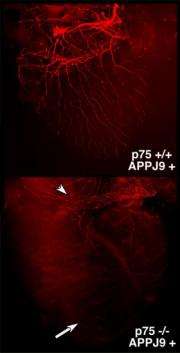
The top image shows the neuronal wiring (red) of the heart in Alzheimer's mice appears normal. The bottom image shows the sympathetic innervation in p75-deficient Alzheimer's mice is severely impaired. Credit: Credit: Lee Laboratory, Salk Institute for Biological Studies.

New research at the Salk Institute for Biological Studies casts the role of a neuronal growth factor receptor—long suspected to facilitate the toxic effects of beta amyloid in Alzheimer's disease— in a new light, suggesting the molecule actually protects the neuron in the periphery from beta amyloid-induced damage.

The receptor molecule in question, a protein better known as p75, regulates neuronal growth, survival, and degeneration, and guides in growing embryos to their final destinations. Some studies have suggested that it also exacerbates the neurotoxicity associated with beta amyloid deposits, which litter the brains of Alzheimer's patients, giving the molecule its questionable reputation.

Yet a team of scientists in the laboratory of Kuo-Fen Lee, Ph.D., a professor in the Clayton Foundation Laboratories for Peptide Biology, found that p75 instead has a neuroprotective effect on the sympathetic in mice that were genetically engineered to develop Alzheimer's disease.

Their findings, published in this week's early online edition of the , challenge the prevailing view of p75's harmful role in the condition and could lead to new insights and, ultimately, new protocols for managing the secondary deficits that accompany dementia and memory loss in Alzheimer's.

Scientific interest in the peripheral nervous system has been growing as investigators studying neurodegenerative diseases seek new insights into disease progression. "How a disease damages the could add a great deal to our understanding of its process, possibly leading to applications down the line that impact patient management and quality of life issues," says Lee, who led the study.

Proteins, like people, are often judged by the company they keep. For instance, p75 belongs to the same family as tumor necrosis factor and was widely thought to mediate cell death in some context. Various in vitro studies have examined p75 in combination with beta amyloid, seeking evidence that it helps induce nerve cell death in Alzheimer's disease.

To gather evidence about p75 and the sympathetic nervous system, Lee's team crossed a mouse model for Alzheimer's disease with a line of mice genetically modified to lack the gene for p75. Without p75, they theorized, the neurotoxic effects of beta amyloid would be reduced, and the mice would show fewer Alzheimer's symptoms.

"The role of p75 had been controversial for some time, but based on the evidence at the time, we expected to see indications that it mediates beta amyloid neurotoxicity," says co-first author Tasha Bengoechea, Ph.D., a former graduate student in Lee's lab. "We thought removing p75 while overexpressing amyloid would have a positive effect on neuron viability. The opposite was true."

Along with profound motor problems, the p75-deficient mice exhibited severe defects in the wiring of nerves to multiple organs, and the majority died within just three weeks. (Mice normally live up to two years.) When the researchers scaled down the production of toxic beta amyloid by deleting one copy of BACE1, which encodes the molecular shears that make the first cut in the production of beta amyloid fragments, the nerves in the sympathetic nervous system of p75-deficient mice were substantially restored.

"This is the first time the interplay between p75 and beta amyloid in the peripheral sympathetic system, a system that has not been paid much attention before, has been demonstrated," adds postdoctoral researcher and co-first author Zhijiang Chen, Ph.D. "Our findings will ultimately help to design novel strategies to treat the symptoms of the Alzheimer's disease and improve the quality of life for Alzheimer's disease patients."

Source: Salk Institute (news : web)


print this article email this article download pdf blog this article bookmark this article     Stumble it Digg this share on Facebook retweet share on Reddit add to delicious
Rate this story - not rated yet

Rank Filter

Move the slider to adjust rank threshold, so that you can hide some of the comments.


Display comments: newest first

  • NeilFarbstein - Apr 20, 2009
    • Rank: 1 / 5 (1)
    Ronald Reagan couldn't remember having Alzheimer's disease.
  • NOM - Apr 23, 2009
    • Rank: not rated yet
    Even compared to your normal troll behaviour Farbstain, that is tasteless.

April 20, 2009 all stories

Comments: 2

not rated yet
  • Stumble this up

  • Digg this

  • share this

  • hide
  • Related Stories

  • QBI neuroscientists make Alzheimer's disease advance
    created Jun 10, 2008 | popularity not rated yet | comments 0
  • Can tomatoes carry the cure for Alzheimer's?
    created Jul 08, 2008 | popularity not rated yet | comments 0
  • Blocking immune cell action increases Alzheimer's-associated protein deposits
    created Mar 27, 2007 | popularity not rated yet | comments 0
  • Alzheimer's gene slows brain's ability to export toxic protein
    created Nov 13, 2008 | popularity not rated yet | comments 0
  • Does growth hormone drug slow Alzheimer's disease?
    created Nov 17, 2008 | popularity not rated yet | comments 0


  • hide
  • Relevant PhysicsForums posts

  • How to prevent another stroke?
    created Nov 11, 2009
  • Swine flu vaccination
    created Nov 10, 2009
  • Improving the brain through chemistry
    created Nov 07, 2009
  • Sleep / REM Sleep and homeostasis
    created Nov 07, 2009
  • The Biceps Reflex
    created Nov 05, 2009
  • Consequenses of striking a Vein and an artery?
    created Nov 05, 2009
  • More from Physics Forums - Medical Sciences

Other News

Largest gene study of childhood IBD identifies 5 new genes

Medicine & Health / Genetics

created 6 hours ago | popularity 5 / 5 (1) | comments 0

In the largest, most comprehensive genetic analysis of childhood-onset inflammatory bowel disease (IBD), an international research team has identified five new gene regions, including one involved in a biological pathway ...


Researchers find potential treatment for Huntington's disease (w/ Video)

Medicine & Health / Research

created 6 hours ago | popularity not rated yet | comments 0

Investigators at Burnham Institute for Medical Research, the University of British Columbia's Centre for Molecular Medicine and Therapeutics and the University of California, San Diego have found that normal synaptic activity ...


Heart and bone damage from low vitamin D tied to declines in sex hormones

Medicine & Health / Research

created 6 hours ago | popularity not rated yet | comments 0

Researchers at Johns Hopkins are reporting what is believed to be the first conclusive evidence in men that the long-term ill effects of vitamin D deficiency are amplified by lower levels of the key sex hormone estrogen, ...


Young athletes need dual screening tests for heart defects, study suggests

Medicine & Health / Health

created 6 hours ago | popularity not rated yet | comments 0

To best detect early signs of life-threatening heart defects in young athletes, screening programs should include both popular diagnostic tests, not just one of them, according to new research from heart experts at Johns ...


Postmortem genetic tests after sudden death may provide less expensive way to identify risk

Medicine & Health / Research

created 6 hours ago | popularity not rated yet | comments 0

Targeted postmortem testing to identify genetic mutations associated with sudden unexplained death (SUD) is an effective and less expensive way to determine risk to relatives than comprehensive cardiac testing of first degree ...